Have you ever watched your child balance on a curb, carefully line up blocks, or become fascinated by patterns? Moments like these can seem simple while they reveal something important: children are natural mathematicians long before they ever encounter a textbook.
Dr. Maria Montessori understood that geometry is not an abstract school subject. It is part of the world children live in from the very beginning.
A glance at the typical geometry textbook used elsewhere might suggest otherwise. The way most of us learned formulas, diagrams, and definitions feels remote and lifeless, something to be memorized for a test. But look around for a moment at what it takes for your body to recalculate when you tilt your head while balancing or the new shapes that are created when blocks are pieced together. There is geometry in the angles of a mineral crystal and in the symmetry of a butterfly's wings. There is geometry in the legs of a chair and in the steel girders of a bridge. Children encounter math everywhere!
Research suggests that humans have an intuitive sense of space, pattern, and shape long before formal instruction begins. Montessori classrooms build on exactly this kind of inborn understanding.
From Sensory Experience to Big Ideas
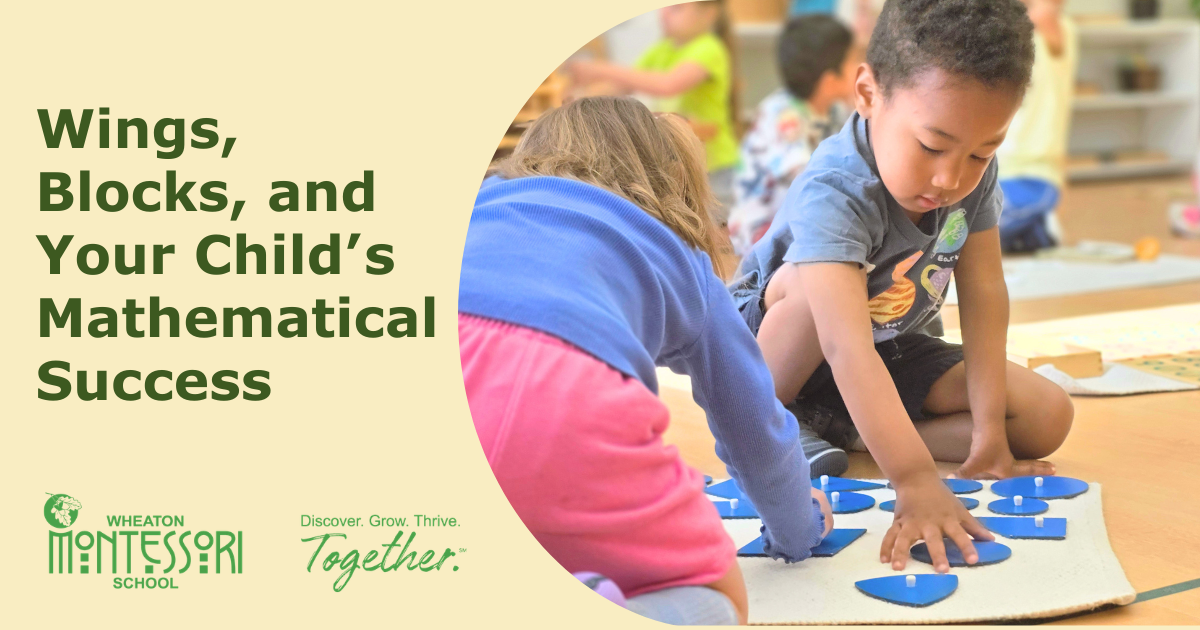
Wheaton Montessori School’s math at all levels is designed to offer hands-on experiences that form abstract understanding. Beginning in early preschool and elementary, Constructive Triangles, the Metal Insets, and the geometric cabinet give children a felt, physical understanding of shape, symmetry, and form before we introduce any formal terminology. Children gather and store these impressions. Their minds are being prepared.
Sometimes parents worry because their young child is not completing pages of math worksheets. Montessori takes a different approach. Before children memorize definitions, we help them build deep understanding through movement, exploration, and hands-on experiences. The goal is lasting and deep understanding.
As they get older, and certainly in the elementary years, children are ready to bring names and reasons to what they already sense. Elementary-aged children don't just want to know what something is called. They also want to know why, so we give more in-depth information.
One of the joys of Montessori elementary education is that subjects do not stay neatly separated. A question about a pentagon can lead to ancient Greece, language, history, and mathematics all in the same lesson.
Why is this shape called a pentagon? (Spoiler: Its name comes from the Greek word for five: pente.) Geometry becomes a doorway into the history of language, ancient Greece, and the lives of mathematicians like Thales, Pythagoras, and Euclid, who puzzled over the same ideas thousands of years ago. Spelling rules that are based on root words become fascinating.
This is the spirit of Montessori Elementary Education when we pull one thread of curiosity to find it unravels into history, language, culture, and mathematics!
Geometry, Algebra, and Arithmetic Woven Together
The Binomial Square is a great example.
(a + b)² = a² + 2ab + b²
Children build this pattern with their hands. Geometry makes the algebra visible, and the algebra makes the geometry meaningful.
Open-Ended, Creative, and Genuinely Fun
Plus, a lot of Montessori geometry work has no single correct answer.
We invite children working with the Metal Insets or Constructive Triangles to find as many equivalent figures as they can for a given shape. There may be dozens of ways to approach the same problem. This open-endedness nurtures the creative, analytical thinking that elementary children are hungry for. Plus, this quality of thinking will serve them in every area of life.
Compass-and-straightedge constructions are another example.
In a world increasingly interested in creativity, innovation, and problem-solving, it is worth remembering that these skills grow when children encounter problems with more than one possible solution.
What This Looks Like at Home
You do not need special materials or advanced math knowledge to nurture geometric thinking at home. Point out the shapes in a honeycomb. Notice the angles in a spider's web. Talk about the tiles on the floor or the panes in a window. Ask your child questions. Notice the symmetry in flowers or butterfly wings. The goal isn’t to teach a lesson at home; it’s simply to notice together.
These small moments of noticing are the same thing Dr. Montessori described when she wrote about preparing the environment to reflect the world children already live in. Geometry is everywhere. We're simply helping children observe, appreciate, name, and understand it.
Your children and adolescents are surrounded by math, learning beyond state and national standards, and doing so with passion at Wheaton Montessori School.