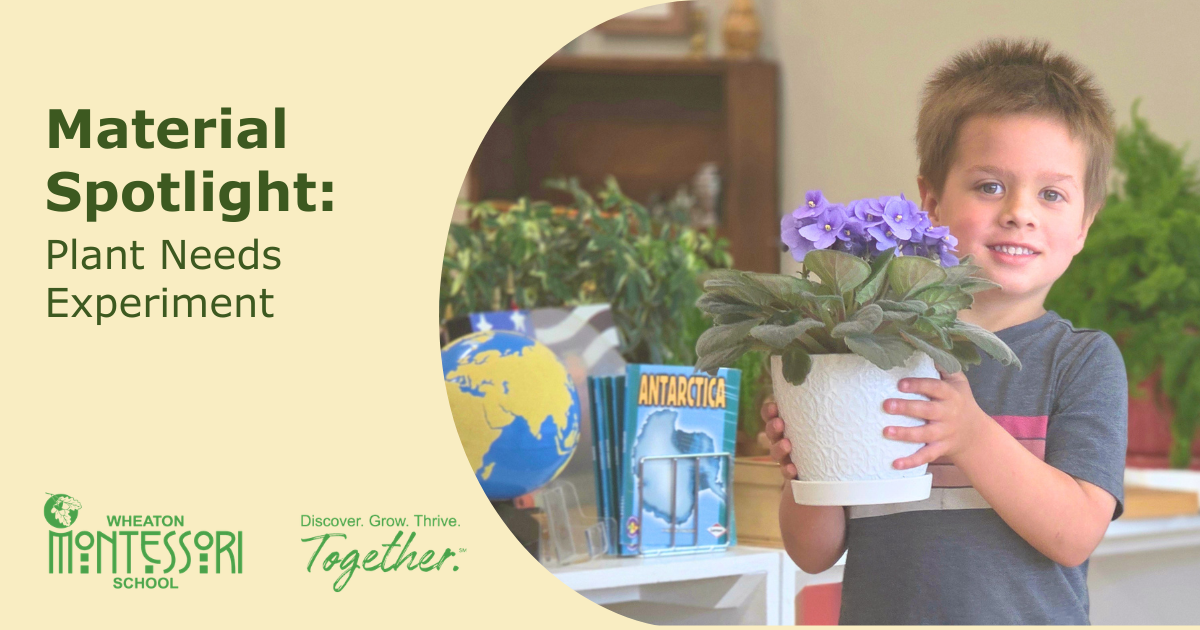
At Wheaton Montessori School, we often remind learners that scientists do not begin with answers. They begin with observation. Before a child can understand photosynthesis, ecosystems, or biology, they must first learn to notice.
This is one reason our campus places such a strong emphasis on caring for plants, observing nature, and recording what we see.
"Children come to understand life not only through lessons, but through relationships, with each other, with their work, and even with the plants they nurture each day."
Mrs. Elizabeth Berdick, Primary Teacher &
Co-Founder, Wheaton Montessori School
Research in developmental psychology suggests that careful observation strengthens attention, working memory, and critical thinking skills, the very foundations of future scientific learning.
The daily act of caring for, looking closely, and noting observations is where learning happens. Give your child(ren) a simple notebook and invite them to visit each plant every day and record their observations. What does the plant look like today? Has anything changed? What do the leaves look like? Is the stem standing upright or beginning to droop? Has the color changed?
These questions are invitations to notice. When our children visit four plants every day for a week and truly look at each one, they are developing powers of observation that will serve them in every area of science (and in many areas of life) for years to come.
This work is important for older students as well. Our adolescents share the responsibility of taking plants home for the summer break in a similar fashion to how they organized a calendar of visits to care for the chickens.
Setting Up an Experiment
With four seedings, we talk through the setup together. Begin with a conversation. What do we think plants need to live? Water almost always comes up first. Light? Warmth? Let the learner's ideas lead the way.
Invite your child to make a prediction. Scientists call this a hypothesis. What do they think will happen to each plant? Why?
As we make predictions and then compare those predictions to actual results, we are practicing one of the most important habits of scientific thinking: learning from evidence rather than assumptions.
Here, we often demonstrate and explore controlled experiments where only one variable changes at a time. This beginner plant experiment allows children to observe how water, light, and warmth affect growth by removing one condition from each plant and comparing the results.
- Plant 1: Water + Light + Heat (Control Plant)
Place in a warm, sunny location and water daily. This plant receives everything it needs to grow.
- Plant 2: Light + Heat, No Water
Place it beside the control plant in the same warm, sunny location, but do not water it.
- Plant 3: Water + Light, No Heat
Place in a cooler location with light. Water daily but keep it noticeably cooler than the control plant.
- Plant 4: Water + Heat, No Light
Place in a cupboard or covered box where it receives no light. Water daily while minimizing light exposure.
After a Week: What Did We Discover?
On our campus, we want learners to experience the joy of discovering answers rather than being given answers. The discussion afterward is often more valuable than the experiment itself.
When the week is up, gather the four plants and have a conversation. What happened? The plant that received everything (water, light, and warmth) should be thriving. The others will each show the effects of their missing need in different ways.
Let your children lead the discussion. What do they notice? What surprised them? What do they think would happen if they continued the experiment for another week? What would happen if they moved the plants back to normal conditions?
Then, together, draw the conclusion that the experiment has demonstrated: plants need water, light, and warmth to survive. And alongside those three things, introduce two more: minerals, which the plant draws from the soil through its roots, and carbon dioxide, the gas from the air that plants take in to make their food.
In the classroom, we use an impressionistic chart to show these needs: sunlight, water, carbon dioxide, minerals, and warmth. This is a way to close the experiment and give children a visual framework for what they've observed.
When children explain what they observed, they are organizing information, making connections, and strengthening their understanding in a way that simply reading a fact never could.
Why This Matters Beyond the Science
Caring for a living thing over a period of days reinforces children’s attention span, builds patience, and strengthens the habit of noticing small changes. This practice is the heart of all scientific observation.
The process also helps children develop a sense of responsibility toward the living world. Children who have watched what happens to a plant when its needs are not met understand, in a visceral and personal way, that living things depend on their environments. That understanding is the beginning of ecological awareness. We see this every year on campus. Children who care for plants begin to see themselves as caretakers of the natural world. Respect for the environment does not begin with a lecture. It begins with a relationship.
"A thirsty plant, a frozen leaf, a flower turned toward the sun, nature herself becomes the teacher, and the child becomes her attentive companion."
Mrs. Elizabeth Berdick
(And you can imagine the effects with all of the live animals in our elementary classrooms and the chickens in the adolescent program! Sorry, plants, animals often are more magnetic!)
A Note for Older Children
Elementary grades extend the experiment by exploring the nutrients plants absorb from the soil and how those nutrients support growth: nitrogen, potassium, calcium, magnesium, sulfur, and phosphorus, and the trace elements iron, zinc, and copper. This leads to early lessons in chemistry, the periodic table, and the building blocks of life.
At Wheaton Montessori School, we create opportunities for children to observe, wonder, test ideas, and draw conclusions every day. The goal is not simply to teach science. The goal is to help children think like scientists.
This simple plant experiment offers families an opportunity to continue that work at home. With four seedlings, a notebook, and a little patience, children can experience something powerful: the realization that careful observation leads to understanding.
And perhaps most importantly, they discover that learning is not something that happens only in a classroom. It happens wherever curiosity is given room to grow.