"When will my child start writing?" What often surprises families is that writing begins long before a child ever forms a letter. In Montessori classrooms, some of the most important preparation happens through activities that don't look like writing at all.
Neuroscience tells us that writing is one of the most complex tasks young children undertake. It requires coordination between visual perception, hand control, muscle development, concentration, and language. Montessori materials help develop these skills gradually and naturally, long before a child is expected to write words on a page.
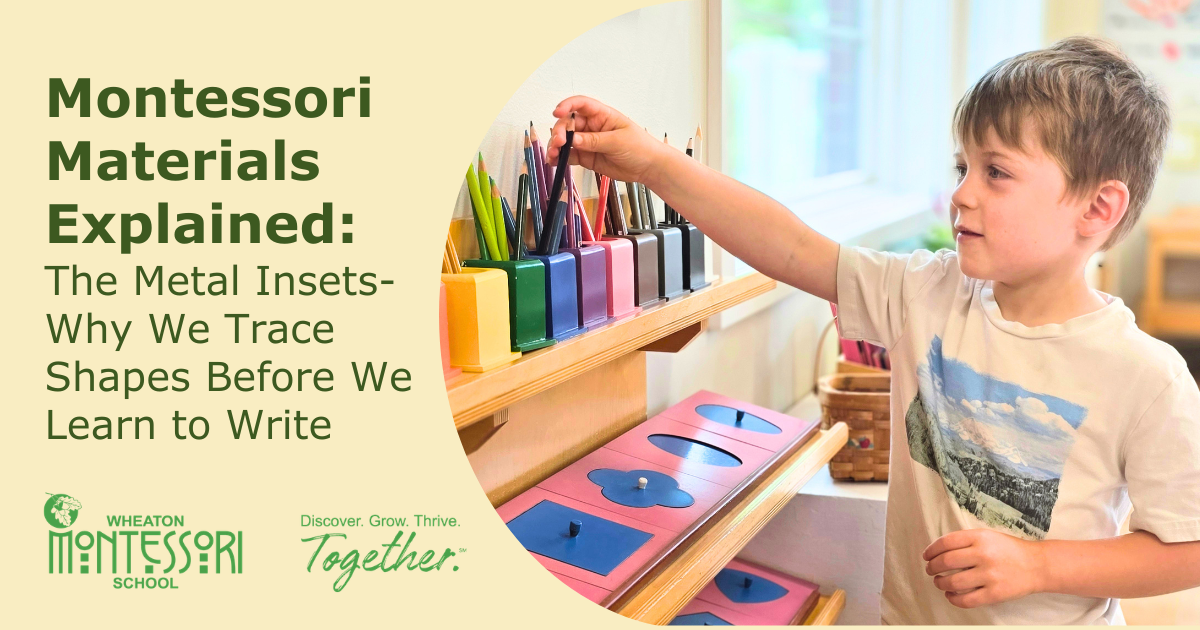
Among the many carefully designed materials in this preschool, the metal insets occupy a special place in the preparation for writing. Deceptively simple in appearance, they are in fact one of the most purposeful materials in the environment. Their purpose is to help children refine their hands for writing, and a great deal of preparation has already taken place before we invite children to use them.
What Are the Metal Insets?
The metal insets are a set of geometric shapes that children trace and fill with carefully controlled colored pencil “coloring”.
I love how many appropriate choices students have: colors, shapes, number to make, etc. The underlying limits of the activity strengthen your child’s fine motor control while keeping them excited.
Why Metal Insets Matter
While children see this work as enjoyable art, something much deeper is happening. They are strengthening the muscles needed for writing, refining pencil control, developing concentration, and building confidence through creativity.
"The Metal Insets teach more than pencil control. They teach patience, precision, and the joy of watching one's own strength emerge, one carefully traced
shape at a time."
Mrs. Elizabeth Berdick, Primary Teacher &
Co-Founder, Wheaton Montessori School
These purposes weave together in each session of work, as children trace the frame, trace the inset, and fill in the resulting shape with careful, parallel lines.
The filling-in work is particularly significant. Children draw continuous, vertical lines from one edge of the shape to the other, turning at the inner outline and continuing in the opposite direction in a serpentine pattern. As their skill develops, they try to get the lines closer and closer together, with almost no white space between them. This is slow, deliberate work, and it is precisely that quality of attention that makes it such powerful preparation for writing. The movement comes from the shoulder, not the wrist, building the muscular coordination and control that will later flow into forming letters.
Research on fine motor development shows that children build writing skills through repeated opportunities to coordinate the larger muscles of the arm before relying on the smaller muscles of the hand and fingers. Montessori anticipated this understanding decades before modern neuroscience confirmed it.
Progression of the Work
The metal insets offer a sequence of exercises that unfold over time. Children begin with a single frame and inset, using three colored pencils: one for tracing the frame, one for tracing the inset, and one for filling in. Your child’s work becomes increasingly creative and complex, allowing them to explore patterns, designs, and artistic expression while continuing to strengthen writing readiness.
One of the most beautiful exercises is graded color. Using a single inset and a single pencil, children fill the shape moving from darker to lighter (or lighter to darker) by adjusting the pencil pressure. This exercise requires an extraordinary sensitivity of touch, and when children achieve it, the result is genuinely lovely. This subtle variation in pressure strengthens exactly the kind of control your children will later need when writing comfortably and fluently
This work will be popular with your child for many years after having the first lesson. It can be relaxing and meditative, and as experienced children do it with precision, it naturally inspires younger children. In a world filled with fast-paced entertainment and constant stimulation, there is something powerful about watching your child become completely absorbed in purposeful work.
When Will My Child Have This Lesson?
When your children are talking about the geometry cabinet and the leaf shapes, the botany cabinet, and probably the movable alphabet, they will be well prepared. Teachers are trained to make assessments (i.e., tests) based on how children are working with activities that lay a foundation for the metal inset lessons. Timing matters. If we introduce the work too soon, before the hand is ready, it becomes too great a challenge rather than a satisfying one. Each teacher here is highly trained to observe carefully and to offer the presentation at the moment when it is received with both readiness and joy.
The metal insets are a landmark in the child’s journey toward written language. This layered preparation honors both the intelligence of the hand and trust in child development.
Montessori education is built on the belief that readiness matters. Rather than rushing children toward the next milestone, we carefully prepare the foundation and trust development to unfold at the right time: just enough challenge to be engaged, but not so much as to cause frustration.