When your child walks into a classroom at Wheaton Montessori School, they are not simply completing assignments. They are learning how to think.
Independence is the foundation that allows your child to concentrate deeply, practice with purpose, and build true academic mastery. Through carefully presented lessons, hands-on materials, and time to explore ideas fully, your child develops the confidence to understand challenging concepts and apply what they know.
Your child’s teachers observe, guide, and challenge them at the right moment, helping them move from curiosity to competence within a method and curriculum design that is validated by modern neuroscientific research.
Your Child Builds Understanding With Their Hands
At Wheaton Montessori School, learning begins with experiences that make ideas tangible and visible.
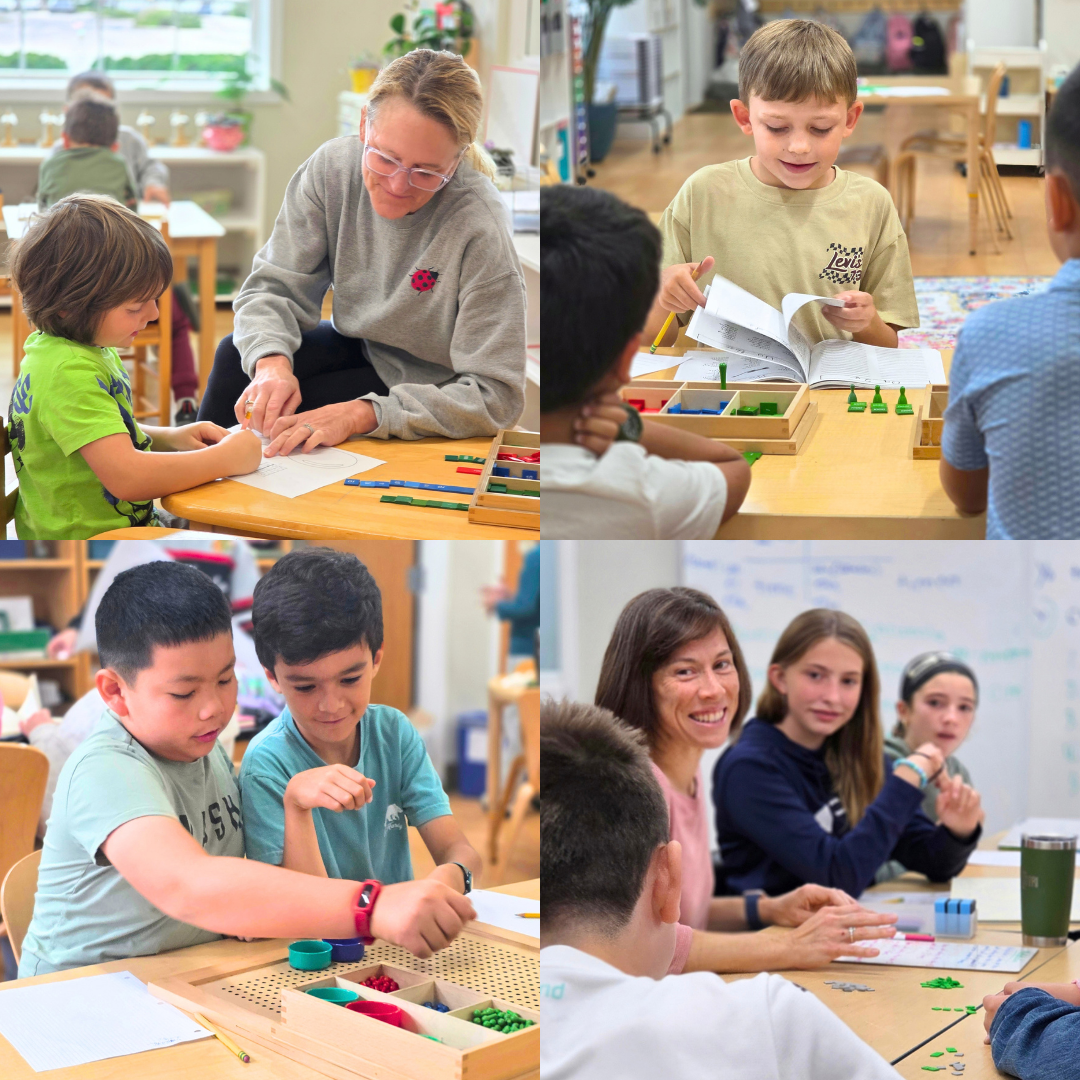
Your child first explores concepts concretely, practices the amount needed for understanding, and moves toward abstract thinking and communication. Instead of simply memorizing a formula, your child discovers why it works.
You can see this progression throughout the campus, from a Primary child playing with the difference between a rectangular prism and other solids, to an adolescent applying volume formulas for the amount of soil needed for the raised beds.
Primary: Ages 2 ½–6
For your youngest learners, mathematics begins as something they physically experience.
On visits, you’ll watch a child carry a long Number Rod across the room, counting each section, building a physical understanding of quantity. Your child may sit on a rug with a friend carefully placing Golden Beads together to understand four-digit addition, subtraction, multiplication, and division. Another child will trace Sandpaper Numerals or match quantities in the Spindle Boxes to see that zero means nothing.
You’ll see our youngest students pouring, transferring, and sequencing to build early mathematical thinking.
Your child moves from concrete materials into more complex mathematical thinking through lessons with the Stamp Game and Large Bead Frame.
You’ll see your young children work with the Geometry Cabinet and Constructive Triangles to discover relationships between shapes before memorizing formulas, before they are in our elementary classes.
Through work and play with a purpose, your child develops concentration, coordination, and confidence.
You might see a child independently returning to the same material day after day, not because they have to, but because they are driven to understand it and it’s fun.
Elementary: Ages 6–12
As your child grows, mathematics becomes a tool for reasoning, exploration, and discovery.
Trinomial Cube → expanded algebraic equations and abstract reasoning
It’s impressive to observe your child build the mental framework for algebra years before they ever encounter a high school textbook.
In Primary, children use the Trinomial Cube for spatial awareness, pattern recognition, and independent logic. This self-correcting 3D puzzle builds an understanding of how variables fit together. In Elementary, they use the same Trinomial Cube to explore algebraic formulas. They examine the place value and relationships of the prisms and cubes to understand cubing and find cube roots.
Students calculate costs, pricing, and profits for bake sales, class fundraisers, and pizza lunches. You might see students searching for circles on campus to measure the area of clocks, log ends, toy tires, etc.
Science data collection might be occurring in the wetlands. Students record observations, create charts, and analyze results of such things as water quality or density of honeysuckle.
Elementary students are ready for an incredible amount of knowledge. At Wheaton Montessori School, we keep that ceiling high, allowing your child’s curiosity and capability to continue growing.
Adolescence: Grades 7–9
7th-9th graders’ deep dives originate from the question when will I use this in life? So we keep mathematics lesson introductions connected to responsibility and meaningful applications, and then we expect the work.
Your young person applies mathematical thinking during math lessons, assignments, and math seminars. It always connects micro-economy projects, environmental studies, project research, kitchen lab, budgets, and data analysis.
At this stage, your adolescent experiences mathematics as a powerful tool for solving problems, making decisions, and contributing to the community.
Understanding Math Builds Confidence
When your child understands the reason behind a mathematical concept, they gain more than a correct answer. They gain confidence in their ability to solve problems, approach challenges, and continue learning.
At Wheaton Montessori School, your child develops the concentration, persistence, and critical thinking skills that support success throughout their education and life. Your children and adolescents are discovering the joy of learning, the confidence to solve problems, and the ability to figure things out.