At Wheaton Montessori School, literacy begins with curiosity, conversation, and hands-on discovery.
From age 2 ½, your child begins building the foundation for reading, writing, communication, and critical thinking. Through carefully presented lessons, meaningful materials, and time to practice, your child develops the confidence to express ideas, ask questions, and understand the world around them.
Your child’s teachers observe closely, understand their developmental readiness, and introduce lessons that build naturally from where they are today.
Primary: Ages 2 ½–6
Your preschooler begins developing literacy through movement linked to playful exploration and research-backed lessons.
Before reading a book independently, your child builds the skills needed for reading through sound recognition, vocabulary, fine motor development, and meaningful language experiences.
Sandpaper Letters connect touch, sight, and sound. The Movable Alphabet allows your child to build words and express ideas before handwriting skills are fully developed. Metal Insets strengthen the control and coordination needed for writing through opportunities to draw, color, and design.
Through stories, conversations, and purposeful work, your child begins to discover that written language has meaning.
Elementary: Ages 6–12
As your child grows, literacy becomes a tool for exploration, discovery, and sharing knowledge.
Your child uses reading and writing to research history, science, literature, geography, and the natural world. They use going out to the public library to extend their research beyond classroom libraries. They create bake sale flyers to communicate their fundraising goals to help after the Nepali floods. They learn how to gather information, organize ideas, communicate clearly, and develop their own conclusions.
You may see your child researching ancient civilizations, writing reports connected to the Five Great Stories, creating presentations, or documenting scientific observations on campus. Each elementary student will have their own spelling books filled with words and rules they each need to learn directly as a result of their projects. Some may have pharaohs and others will have dolphins, but they all must learn that ph will make the f sound and experience that Greek root words use this spelling. These experiences add meaning to spelling at this stage.
You may see your child researching ancient civilizations, writing reports connected to the Five Great Stories, creating presentations, or documenting scientific observations on campus. Each elementary student develops their own spelling book filled with words and spelling rules they encounter through their work. One child may be researching pharaohs while another is studying dolphins, but both will encounter words that help them discover patterns, such as how ph can make the /f/ sound and how Greek roots influence English spelling. These experiences give spelling a purpose and make the rules meaningful because they arise naturally from the child's own work.
As your child moves into Upper Elementary, literacy becomes increasingly collaborative and analytical. Sixth graders participate in book groups and literature discussions, reading together, sharing interpretations, asking questions, and considering different perspectives. They are learning not only to understand what they read, but to support their ideas, listen carefully to others, and engage thoughtfully in discussion.
Grammar and writing become more meaningful because your child is using shared conventions of language to communicate ideas clearly and effectively, not simply memorizing lists or rules. They will apply what they learn in their reports, presentations, discussions, creative writing, and research, strengthening their ability to communicate with purpose.
Adolescence: Grades 7–9
For your adolescent, literacy becomes a way to understand complex ideas and contribute to the world around them.
Students strengthen their writing, research, communication, and critical thinking skills through academic work connected to real experiences and seminars. Throughout the three-year cycle, they move through increasingly sophisticated work, beginning with building a strong foundation for independent thinking, research, and communication and progressing toward deeper analysis, synthesis, and original work.
You might see adolescents developing business plans for the campus micro-economy, harvesting and selling honey, presenting research, analyzing literature, or writing proposals connected to community projects.
At this stage, your adolescent is energized by the realization that their ideas matter and their voice has value. Literacy becomes more than a subject to study. It becomes a tool for understanding the world, expressing ideas, and contributing to their community.
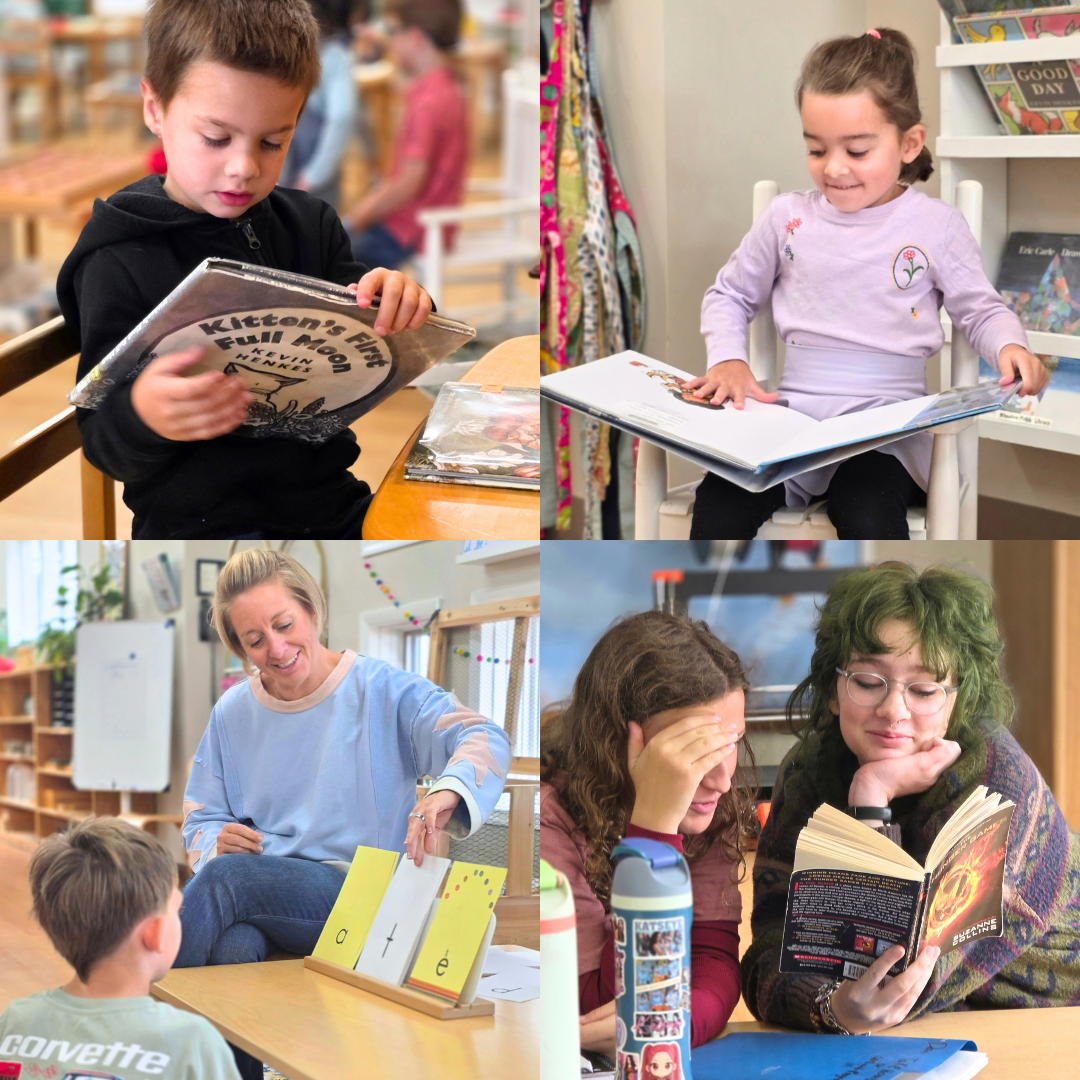
Building Confident Communicators
At Wheaton Montessori School, your child learns how to think, communicate, question, and share ideas with confidence. From the first sounds they explore at age 2 ½ with sandpaper letters to the research, public speaking, and seminar leadership in our adolescent program, your young person builds the skills to become a thoughtful communicator and independent thinker.
Prepared for School, Prepared for Life
A child who learns to read and write through authentic Montessori practice does not simply acquire a skill for the next grade level. They learn to read deeply, write clearly, think critically, and use their voice with confidence.
Read more
Primary:
- Sound Games, where children listen carefully and build phonemic awareness.
- Metal Insets, where children refine pencil control and prepare for beautiful handwriting.
- Sandpaper Letters & Movable Alphabet
- Montessori Vocabulary Lessons
Elementary:
Adolescent: