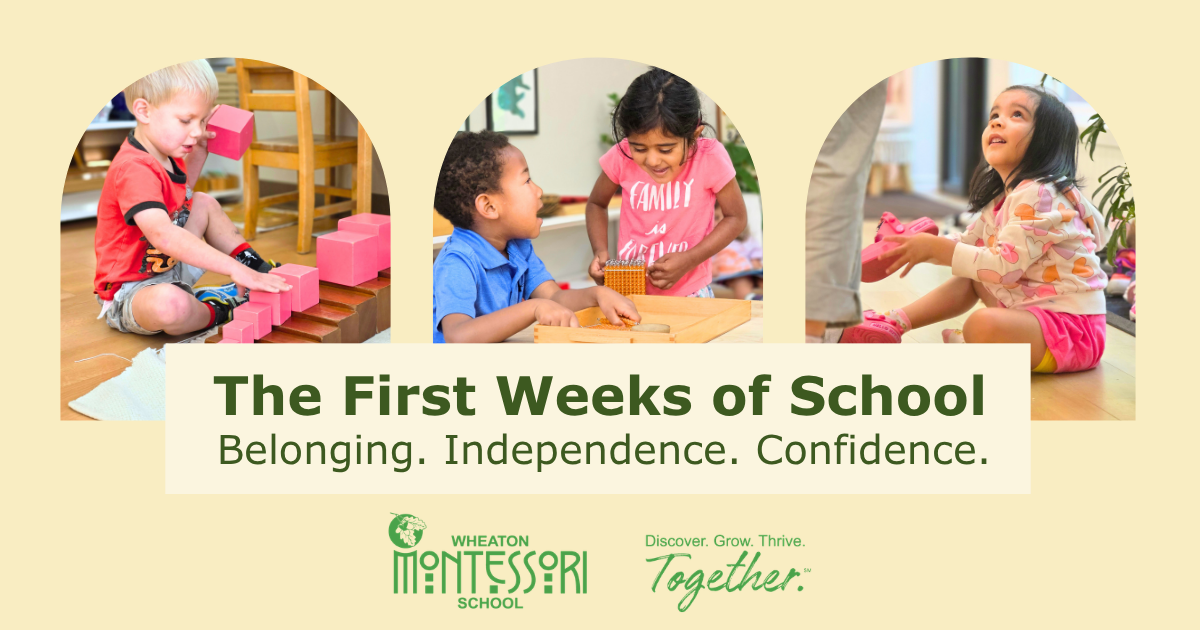
The beginning of a new school year is a season of significant change and discovery for children and families. Whether your child is joining our community for the first time, transitioning from our summer camp, or returning to a familiar classroom, the first few weeks lay the foundation for confidence, connection, and growth.
We intentionally prepare the environment, routines, and relationships to help your child feel secure, develop independence, and experience the joy of belonging.
Here is a look inside our classrooms during the first few weeks of school and how our teachers support your child’s unique transition.
1. Belonging Comes Before Independence
Before children confidently explore a classroom, they need to know they are safe, known, and valued. Our teachers focus on building relationships, learning your child's personality, comfort cues, and interests, and helping your child discover their place in the community.
Three pathways to comfort
Children often connect to their new places in different ways. Some children find comfort through a trusted teacher, some through a new friendship, and some through meaningful work.
Your child may want extra connection with a teacher, spend time with an older friend, or settle into a favorite activity involving water, scissors, painting, or another hands-on experience. These small moments of comfort help children build confidence, and often one connection naturally leads to another.
A predictable environment
Every shelf, activity, and routine in our classrooms is prepared with clear intention. Children quickly begin to understand that their classroom is a consistent and reliable place where they know what to expect and where they belong.
Supporting separation with confidence
For new children, saying goodbye can bring up big feelings. Our teachers approach morning drop-offs with compassion and reassurance, helping children transition from the security of home into their classroom community.
Children may stay close to a teacher, connect with a comforting friend, or begin with a familiar activity. Through these experiences, children discover that big feelings pass and that they are capable of moving through new experiences.
Building community in adolescence
The first weeks are also about connection for our adolescent students. Rising 7th grade students spend time participating in introductory games and team-building activities with 8th and 9th grade students.
Before taking on larger responsibilities, students first build trust and learn how to work together as a community. Their first grocery store experience is not about the pressure of shopping for a meal they will prepare. Instead, students work together on a scavenger hunt that encourages communication, teamwork, and confidence.
2. Children Learn From the Community Around Them
A powerful part of our classrooms is that children learn from one another every day. New students enter classrooms filled with experienced classmates who model routines, kindness, problem-solving, and independence.
Little teachers all around
Each classroom welcomes new students into a well-established community where expectations are modeled throughout the day.
A younger child watching an older child prepare a snack, complete a lesson, or care for the classroom is already learning. Older children gain confidence and leadership by sharing what they know.
This is the power of a multi-age classroom. Every child has opportunities to be both a learner and a contributor.
Establishing routines and expectations
To experience true freedom, children must first understand the framework of their classroom community. During the first few weeks, teachers focus on Grace and Courtesy lessons and foundational routines.
Children learn how to:
- Care for themselves and their environment.
- Change their shoes, wash their hands, select a working mat, and return materials when finished.
- Walk thoughtfully around another child’s workspace.
- Carry trays carefully with two hands.
- Push in chairs quietly.
- Listen to classmates, wait for their turn, and contribute to a peaceful community.
Elementary students learn how to collaborate on group projects, manage their time, and establish classroom expectations together.
Adolescents begin to create their own community framework. They work together to define shared values, establish expectations, solve problems, and learn how to respectfully address disagreements.
3. Small Moments Build Big Confidence
Independence does not happen all at once. It develops through hundreds of small moments when children realize, “I can do this.”
During the first weeks of school, teachers offer lessons in practical life, art, and classroom care that allow children to build concentration, confidence, and independence.
A new 2½-year-old may receive help with every part of snack preparation. An experienced student may proudly prepare an apple or carrot for a new friend. Watching others work often sparks curiosity and interest in learning how to complete the task independently.
Children begin by watching. Then they participate. Eventually, they master the skill themselves.
The same progression continues through adolescence. Ninth graders model how to prepare favorite recipes at the beginning of the year before younger adolescents begin preparing meals for the community. Students practice knife skills, fire and smoke safety, budgeting, and collaboration as they prepare for real responsibilities.
Every stage of development provides meaningful opportunities for children to grow.
4. Every Child Has Their Own Beginning
Every child transitions differently. Some children enter the classroom with immediate enthusiasm, while others prefer to observe, understand the environment, and build confidence before fully engaging.
The observer
Your child may not be shy but may simply prefer to watch first. Observation is active learning. Watching peers work and seeing how teachers interact helps children build familiarity and confidence.
The child who watches quietly is not falling behind. They are learning.
The emotional processor
It is completely normal for your child to show excitement during the first few days, followed by fatigue or reluctance in the second or third week as the reality of a new routine settles in.
New experiences require tremendous mental, emotional, and social energy.
The enthusiast
Some children immediately explore every shelf, activity, and opportunity available. Their excitement is wonderful, and they also benefit from learning routines, expectations, and the rhythm of the classroom community.
Our experienced teachers and assistants observe your child closely and adapt their support to meet your child and adolescent where they are emotionally, developmentally, and intellectually.
How Parents Can Support the Transition
The partnership between home and school is especially important during this adjustment period. Here are a few ways you can support your child:
Keep goodbyes loving and brief
A confident, loving, and brief goodbye communicates that you trust your child, their teachers, and the environment. Long goodbyes can sometimes make transitions feel more difficult.
Allow time for rest
The mental and social effort of adapting to a new environment can be exhausting for children. Your child may need extra rest, quiet time, outdoor play, or additional connections at home.
Trust the process
Transitions take time. Celebrate small moments of growth, such as putting on a coat independently, sharing a story about a new friend, or asking to prepare a family recipe.
Give your child and adolescent the grace to adapt in their own way and at their own rhythm.
We Are In This Together
We are honored to partner with your family throughout your child’s Montessori journey. Our teachers are always available to share observations, answer questions, and help you understand your child’s experience.
The partnership between home and school is an important part of your child’s growth and development. We welcome your questions, observations, and conversations along the way.
If you have questions about your child’s experience or would like to learn more about our school community, please reach out to your child’s teacher or our office team.
Read More
- Ready, Set, Grow: Recommendations for a Confident School Start
- https://www.instagram.com/p/DcCjPtPAR1u/?hl=en&img_index=1
- https://www.instagram.com/p/DcM2b2HiDII/?hl=en&img_index=1
- https://www.facebook.com/share/p/1EyRRRe9jt/
- https://www.facebook.com/share/p/1HnEnwNXqQ/