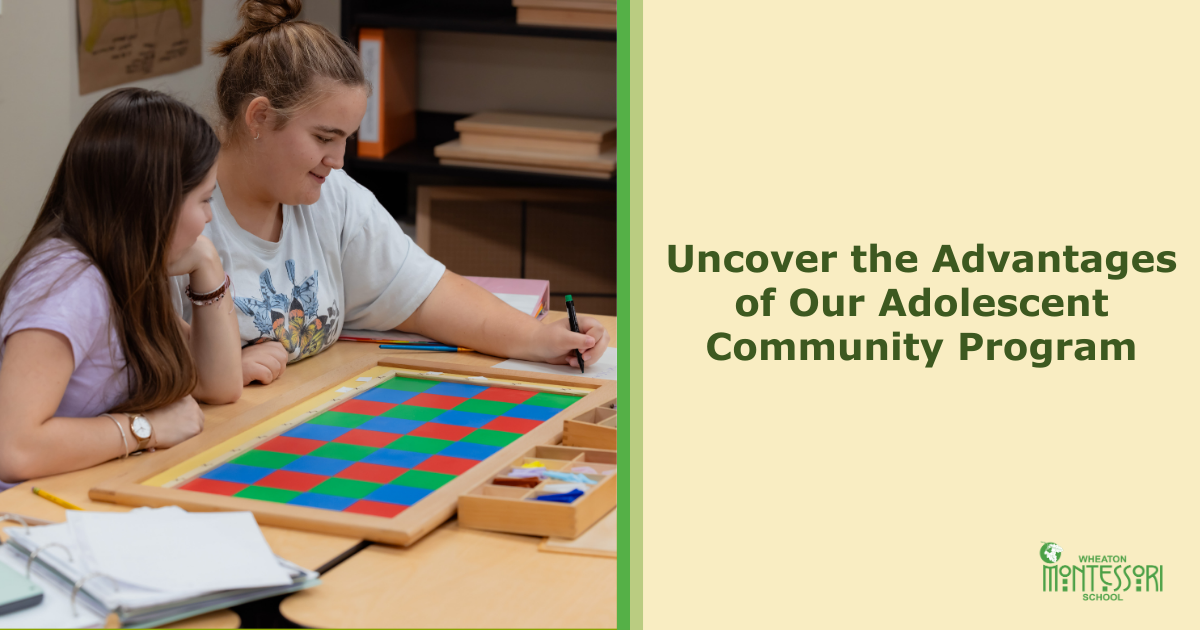
Uncover the Advantages of Our Adolescent Community Program
Rebecca Lingo • February 3, 2025

7th-9th Grade


Designed for students spanning 7th, 8th, and 9th grades, this program continues building on the foundation laid in the previous Wheaton Montessori School years and introduces new aspects to challenge young adults’ rapid intellectual, social, and emotional growth. The program is structured to ensure that students encounter all components of the curriculum and overarching themes throughout their three-year tenure. 


Experiential Learning and Student Empowerment


The Adolescent Community’s educational approach is focused on experiential learning and encourages students to take ownership of their education. By providing adolescents with the tools and guidance they need to pursue their goals, the program empowers students to be confident, capable adults who know their wants and needs and are equipped to make positive contributions to society.  


The program has an integrated project-based curriculum in which classroom subjects are approached as interrelated and taught in an interconnected manner. As students study math, economics, science, humanities, language, and writing, they are simultaneously exposed to real-world issues and challenges, refining their problem-solving skills. Group activities such as sledding, ice skating, canoeing, and hiking help develop agility and strength as well as a sense of fun and confidence in meeting physical challenges.


Evolving into Joyful, Successful, and Confident Adults through This Program


One of the key developmental experiences of adolescents is working toward economic independence. This is fostered through systems of production and exchange where students learn how to start and manage their own small business. The program teaches vital skills such as bookkeeping, budgeting, purchasing, design, advertising, conducting surveys, research, writing proposals, and interviewing experts. These lessons instill critical values such as responsibility and the significance of hard work.


Beyond intellectual development, the classroom environment of the Adolescent Program supports the well-rounded social development of all students. This includes practice in social organization and division of labor through various experiences including cooking a community lunch every day and planning camping trips. The program guides students to become active citizens and fully informed problem-solvers. Students completing 9th grade in this program emerge as confident, well-adjusted, and happy, incredible adults.


It’s truly inspiring to observe how the Wheaton Montessori School Adolescent Program provides the ideal setting for students to expand their knowledge and experience real-world responsibilities while exploring their interests and pursuing their passions in an inclusive, supportive small environment. 


We invite current families to sign up for our Parent Discovery Night in our Adolescent Community on Wednesday, February 5 at 6:00 p.m. by clicking on this link. Adolescent Community Classroom is also available for observation which you can sign up for by clicking on this link. 


Prospective families with toddlers and children under 4 are encouraged to sign up for a school tour to explore the advantages of our programs, which lay the essential foundation for our Elementary and Adolescent Community Programs. Priority enrollment will be granted to those who enroll before March 15. Our waitlist for kindergarten-9th grade for Fall 2025 is currently closed. Please check back in April to see if the waitlist is open then. Individual tours will only be offered for kindergarten through 9th grade if the waitlist is open.
How Geometry Got Its Name
By Rebecca Lingo February 2, 2026
In Wheaton Montessori School classrooms, we like to introduce big ideas with big stories. We offer children a sense of wonder first, sort of like an imaginative doorway, so that when they later study formulas, theorems, and proofs, they already feel connected to the human story behind them. One of these stories is The Story of How Geometry Got Its Name, an introduction to a subject that is far older than the textbooks and protractors we encounter today. In Montessori, Geometry is more than about shapes. It is about human beings solving real problems in the real world. A Problem as Old as Civilization To reintroduce geometry, we time-travel back around 5,000 years to the ancient civilization of Egypt. This was a land shaped by the Nile River, the longest river in the world. Each year, the Nile flooded its banks as snowmelt poured down from the mountains far to the south. The Egyptians depended on this yearly flood as it left behind rich, dark silt that nourished their crops and made life possible in an otherwise harsh desert. But the flood created a challenge, too. It washed away the boundary markers that separated one farmer’s field from another. When the waters receded, no one could quite remember where their land began and ended. Arguments ensued. “This corner is mine!” And the fields needed to be measured and marked again. The First Geometers: The Rope Stretchers To solve this annual problem, the Egyptians relied on a special group of skilled workers called the Harpedonaptai, or Rope Stretchers. These were early land surveyors who used a knotted rope tied at regular intervals and three weights to create a very particular triangle. In our elementary classrooms, we invite a few children to hold a prepared rope at its large knots, forming that same triangle. As they stretch it out and lay it on the ground, many quickly recognize what the Egyptians had unknowingly created: a scalene right-angled triangle. This shape would later become central to the geometry studied by Greek mathematicians. The Harpedonaptai used this simple tool to re-establish field boundaries, set right angles, and make sure the land was measured accurately and fairly. Geometry, in its earliest form, served a deeply practical purpose. From Rope to Pyramid The Harpedonaptai’s expertise was valued far beyond the farmlands. They also helped lay out the foundations of temples, monuments, and even the Great Pyramid of Giza. The base of the Great Pyramid is a perfect square, which is an astonishing feat of measurement and design. The Pharaoh himself oversaw these measurements, but it was the Rope Stretchers who executed them. Their work represents one of humanity’s earliest recorded sciences: the careful measuring of the earth. How Geometry Got Its Name The name geometry reflects this ancient practice. It comes from two Greek words: gê — earth metron — measure Geometry literally means earth measurement. The Egyptians did not use the language of right angles, nor did they classify triangles as we do today. Their work was grounded in practical needs. They needed to solve problems, organize land, and create structures that would endure for thousands of years. Yet their discoveries influenced later thinkers like Pythagoras, who likely traveled to Egypt and learned from their methods. Over time, the simple knotted rope inspired a whole discipline devoted to understanding lines, angles, shapes, and the relationships between them. Why We Tell This Story in Montessori When Montessori children hear this story, something important happens. Geometry becomes more than a set of rules or vocabulary words. It becomes a human endeavor born from curiosity, necessity, and ingenuity. The heart of Montessori education at Wheaton Montessori School is to help children view knowledge not as isolated subjects, but as valuable gifts passed down from earlier generations. When children pick up a ruler, explore angles with a protractor, or classify triangles in the classroom, they are continuing a legacy that began with those early Rope Stretchers, the Harpedonaptai on the banks of the Nile. Through story, students feel connected to the people who shaped our world and to the problems that inspired great ideas. Geometry becomes meaningful, purposeful, and alive, from our preschoolers working with the Geometry Cabinet , to elementary students classifying and measuring angles or using hands-on Pythagorean Theory materials, and all the way through our adolescents. At the adolescent level, geometry moves fully into the real world. Students apply measurement, angles, area, scale, and spatial reasoning through meaningful work across campus, including: Measuring and mapping land for the campus’s Wetland Conservation Area, as well as calculating classroom square footage for recognition and accreditation applications Understanding and applying area, perimeter, scale, and proportion when working with acreage, restoration plans, and campus layouts Designing and situating functional structures such as chicken coops using geometric principles Applying angle classification, measurement, and spatial reasoning through woodworking Using geometry to cut, join, and build accurately, including raised beds, greenhouses, and beehive insulation boxes
Child reaching for an object,
By Rebecca Lingo January 26, 2026
Learn how the Montessori Absorbent Mind empowers young children to effortlessly absorb language, culture, and behavior, and how parents can nurture it.