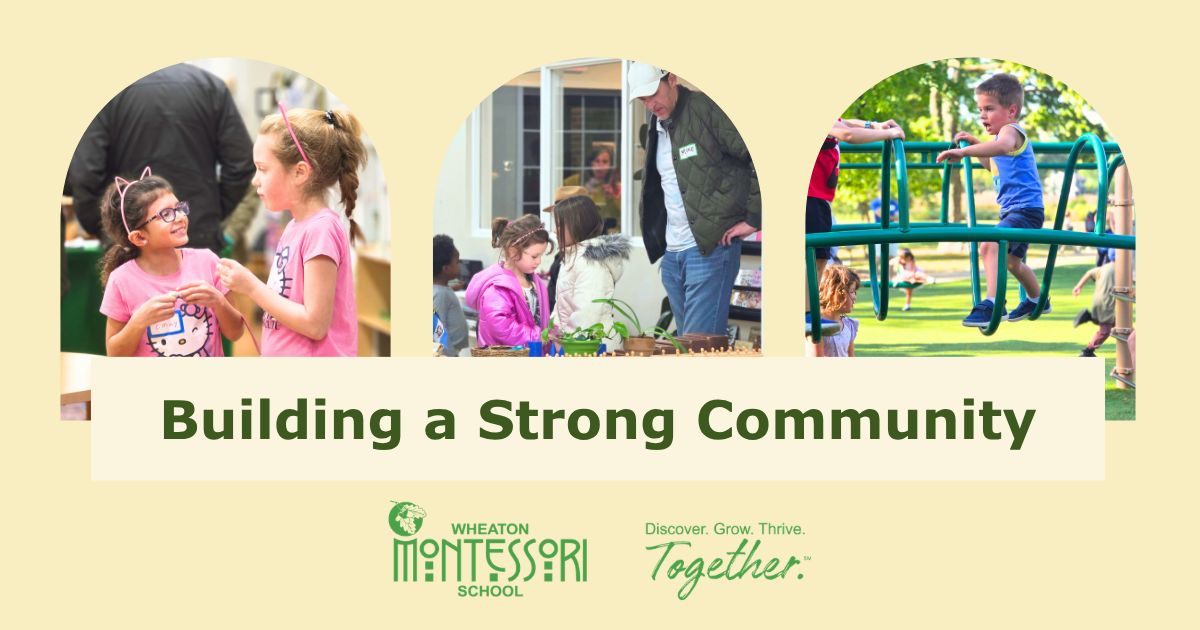
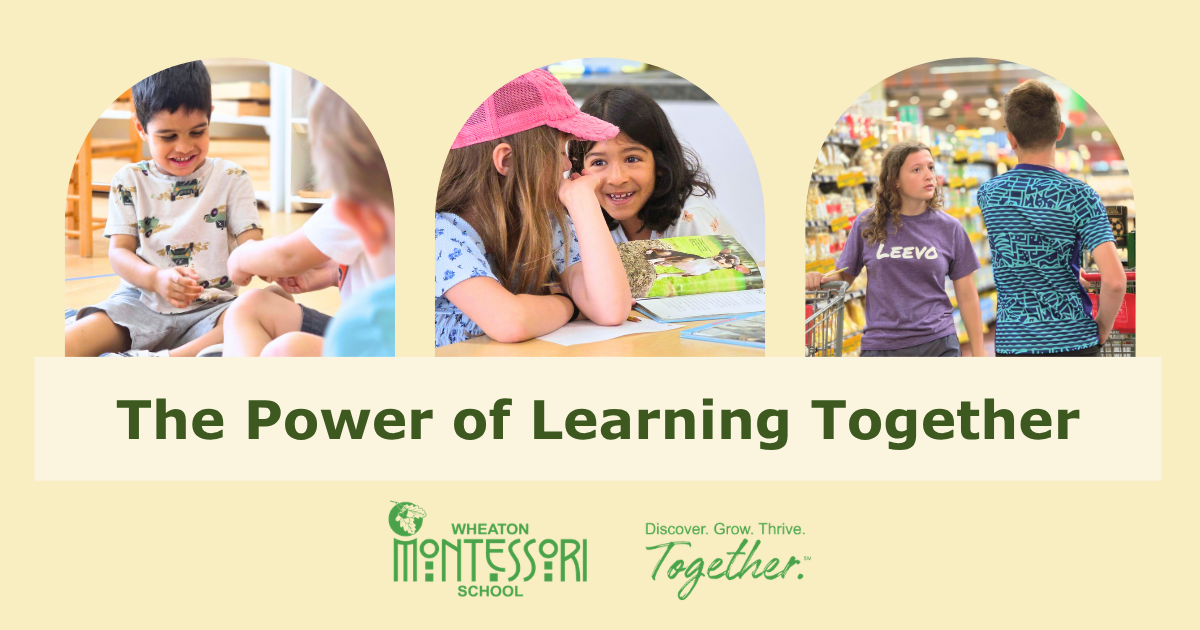
Step inside the entryway at Wheaton Montessori School, and you will immediately notice something remarkable: children of different ages learning, collaborating, and growing together in a single, peaceful community.
To a traditional mindset, grouping 2 ½ - to six-year-olds in one room, or 7th through 9th graders in another, might seem counterintuitive. However, Dr. Maria Montessori intentionally structured classrooms around developmental cycles. This mixed-age environment is one of the most powerful features of a Montessori education, cultivating academic depth, social empathy, and genuine confidence.
1. Younger Children: Learning Through Observation and Inspiration
Younger children and adolescents in a mixed-age environment have a distinct advantage: they are surrounded by older peers who model advanced academic work, graceful interactions, and social maturity. Younger students don't just "learn from older ones." They can see who they are becoming.
- They can see what comes next. A three-year-old doesn't have to imagine what reading, writing, mathematical problem-solving, or independence might look like. They see it happening around them every day. The older children provide a living picture of what is possible.
- Natural Motivation: A three-year-old in a Primary classroom watches a six-year-old read complete books or work on intricate math operations with the Golden Beads. This inspires curiosity and a natural desire to reach the next milestone.
- Peer Learning: Children often absorb concepts faster when demonstrated by a peer. Seeing a slightly older classmate navigate activities makes the work feel approachable and exciting. A preschooler doesn’t have to imagine reading; others reading surround your child.
- A Predictable Path Ahead: By observing older classmates, younger children naturally learn classroom norms, grace and courtesy lessons, and spatial awareness without needing constant adult direction.
2. Older Children: Developing Leadership, Empathy, and Mastery
As children and adolescents grow within the same community, their role naturally shifts. In their capstone years in each classroom, they experience leadership years. Your oldest children are not simply “older children.” They occupy a deliberately designed leadership position in the classroom. Kindergarteners, 6th graders, and high school freshmen are the oldest students in their respective communities and can see how far they have come while helping younger students.
- Solidifying Knowledge Through Mentorship: The best way to truly master a concept is to teach it to someone else. They reinforce their own foundational learning while building deep academic confidence.
- Cultivating Genuine Empathy: Older students naturally step up to help a younger peer tie a shoe or quadruple a recipe. These daily acts of kindness foster patience, emotional intelligence, and real leadership skills.
- Building Authentic Self-Esteem: Leadership isn't appointed; it is earned through experience and maturity. Older children take immense pride in being the capable, trusted role models within the community they know so well.
- Understanding details: When a child explains an idea, demonstrates a skill, or helps another student solve a problem, they have to organize what they know and communicate it clearly. Their own understanding becomes more precise.
- Leadership Success: the confidence that comes from being capable enough to contribute to someone else's success.
3. Continuity Across Every Level of Learning
The power of the Multi-year cycle extends across all stages of development at Wheaton Montessori School:
- Primary, Preschool & Kindergarten (Ages 2½–6) : Children progress from sensory exploration to confident reading, writing, and mathematical thinking while mastering practical life skills.
- Elementary (Grades 1–6): Students learn in Lower Elementary environments for ages 6–9 and Upper Elementary for ages 9–12. Students engage in collaborative research, peer editing, and group problem-solving.
- Adolescent Program (Grades 7–9): Young adolescents collaborate across age groups to manage micro-businesses, run committees, present research projects, plan trips, execute community initiatives, and practice real-world leadership.
Experience the Mixed-Age Community in Action
Seeing a mixed-age classroom in motion is the best way to understand its magic. Watch how our youngest students observe with wonder, how our older students lead with compassion, and how our dedicated teachers guide each child along their unique learning path.
When classroom observations open, we invite you to visit your child’s classroom and explore the next level to see where their Montessori journey is heading.
Read more: