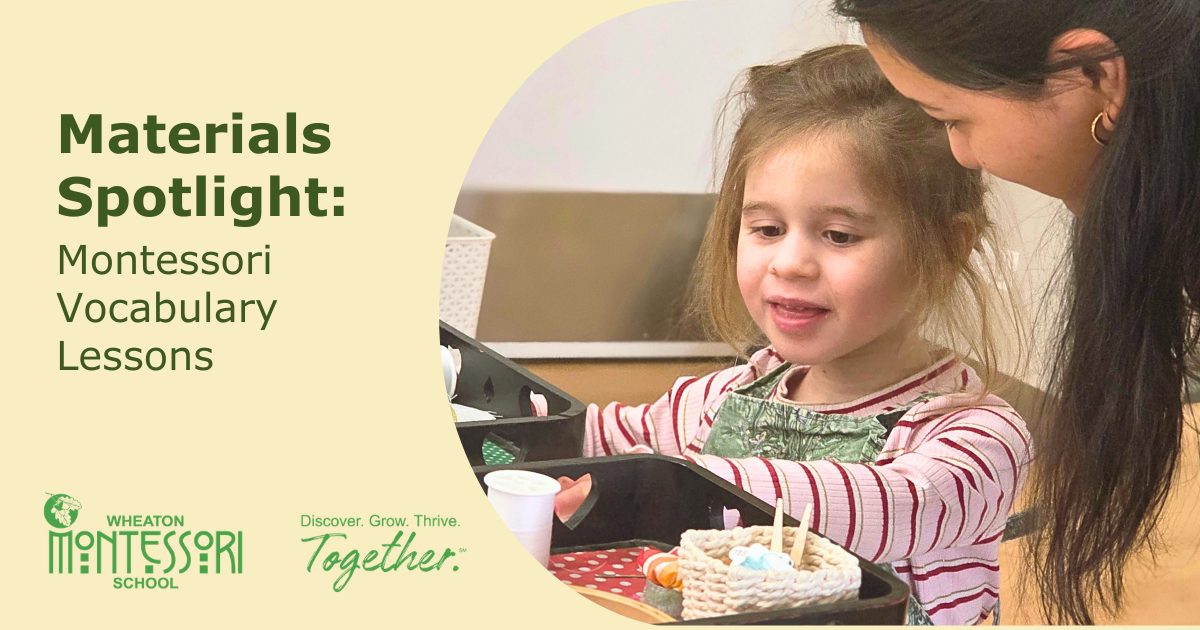
This blog shares a powerful lesson we use to teach young children new vocabulary. Let us support you while your children’s minds are especially absorbent for language. Read on for how we give three-period lessons. We use it constantly for phonetic sounds, geometric shapes, textures, quantities, biology terms, countries and continents, and so much more. Virtually every time your children learn precise new words here, we have presented the terms in our three-period lesson format.
The Simplicity of the Three-Period Lessons
Here's how our three-period lessons unfold. We’ll use a classic example of teaching the words "rough" and "smooth" with our textured touch boards.
1. ASSOCIATION — "This is..."
The teacher presents the object and names it clearly, with no extra words. Your child repeats the word while experiencing the sensation.
"This is rough."
Your child runs their fingers across the surface and repeats: "Rough."
Repeat this first stage many times with a focus on the adult stating the vocabulary word and identifying the named object.
2. RECOGNITION — "Show me..."
After repeatedly pairing the name and object, the teacher asks your child to identify the object by name.
"Which is smooth? Which is rough?"
Your child simply points or touches. Your child can remain quiet during this stage while demonstrating understanding by pointing. Repeat this stage many times until you believe they are confident. They may even volunteer the name without being asked, but they can also remain quiet during the longest of the three periods to reinforce the vocabulary word.
3. RECALL — "What is this?"
The adult points to an object, and your child says the name themselves.
"What is this?"
Your child touches the surface and answers: "Rough."
If the learner struggles or pauses, return to the second period. Often, only the first two periods are used for children learning an additional language, who are not yet verbal, or who are under three.
Teaching this at Home
Don’t purchase Montessori materials or anything new for this activity. Use items in your daily life that offer opportunities for more detailed vocabulary.
When you use the airfryer, try introducing words such as “heat setting”, “basket”, “timer”, or ”parchment liner”. It can even be fun to listen together for the “fan” or the “timer bell”?
Any time you want to help a young child connect a precise word to something they're experiencing (the names of: spice smells, facial expressions, dinner ingredients, plants, instrumental sounds, car parts, architectural features, etc.), the same three-step structure applies.
Name it clearly many times.
Ask them to show you many times.
Ask them to name and identify it as many times as is fun.
Keep it brief, keep it joyful, and if they get stuck, simply set it aside and repeat another time.
The lesson works because it is designed for how young minds learn. Children learn vocabulary in stages: first association, then recognition, and finally recall. It is particularly fun to share because it can be done anywhere, with anything, and offers something to do together.