The Gift of Unhurried Discovery
Summer opens a door that the school year can only partially prop open. Suddenly, there is time (unhurried, generous time!) to kneel beside a flower and really look at it. To follow a beetle across a garden path. To press a leaf between the pages of a book and wonder later what kind of tree it came from. To ask questions that don't have quick answers and feel good about the not-knowing.
This is exactly the spirit of Montessori biology. And summer is perhaps the most natural season to live it.
What Montessori Biology Is Really About
At Wheaton Montessori School, biology is woven into daily life through care of classroom plants, observation of animals, and walks outside, where we can pause and say: Look at this. Our goal is not to produce children who can recite facts (although there are expectations to memorize important info). We are focused on guiding children’s natural exploration through mystery, revelation, and wonder. The wonder that is caught rather than taught is as important as any information or structure we provide.
The adult's role in Montessori biology is less about knowing everything and more about modeling the joy of not knowing. When a child holds out a leaf or an insect and asks what it is, the most Montessori response in the world is: I'm not sure. Let’s find out together! A good field guide, a magnifying glass, and genuine curiosity are all the materials needed.
Hands-on Discovery
At Wheaton Montessori School summer camps, children do far more than simply fill summer hours. Every day is intentionally designed to nurture curiosity, independence, creativity, academic growth, and a deep connection to the world around them. We are focused on guiding children’s natural exploration through mystery, revelation, and wonder. The wonder that is caught rather than taught is as important as any information or structure we provide.
While our camps include exciting weekly themes and thoughtfully prepared academic experiences, what makes Wheaton Montessori School truly special is how naturally learning is woven into the rhythm of the day.
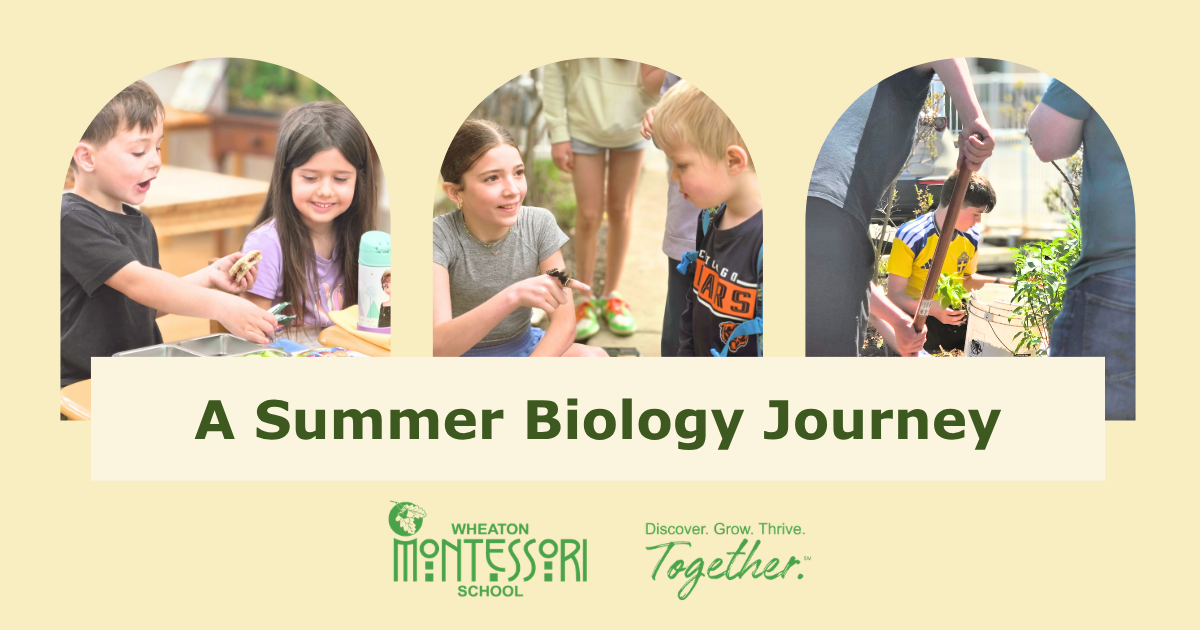
A summer morning might begin with children watering gardens, observing insects near the playground, or carefully examining leaves they collected outside. A teacher may kneel beside a child studying a flower and introduce words like petal, stem, pollen, or even corolla and stamen. Another group may use magnifying glasses to compare shells, rocks, or seeds gathered during outdoor exploration.
In our early childhood camps, children learn through hands-on discovery. They may sort living and nonliving objects, care for classroom plants, observe birds at a feeder, or explore the life cycle of butterflies. Geography materials invite children to trace continents, pour water into landform trays, and begin imagining the larger world around them.
Elementary campers build on that foundation through deeper exploration and research. In addition to the weekly theme, summer campers have opportunities to create nature journals, study ecosystems, classify animals, map habitats, research world cultures, or investigate scientific questions sparked by their own curiosity.
Learning Through Real Encounters with Nature
Throughout the summer, children may:
- Learn the real names of plants they encounter outdoors, such as black-eyed Susans, red maples, or milkweed
- Examine flowers with magnifying glasses and learn the parts of a plant, including petals, sepals, stamens, and pistils
- Collect and compare leaves while noticing veins, edges, shapes, and textures
- Sketch plants, insects, or animals in nature journals and label their observations
- Observe birds and use field guides to identify species
- Explore animal classification by discussing mammals, birds, reptiles, amphibians, fish, and insects
- Follow life cycles in real time, such as caterpillars becoming butterflies or tadpoles becoming frogs. We’ve already been listening to the spring peepers.
- Search for invertebrates beneath rocks, inside gardens, or along walking paths, and observe them respectfully before releasing them.
- Discuss how living things depend upon one another within ecosystems and habitats.
At Wheaton Montessori School, we understand that children learn best when they can move, touch, question, create, and explore in meaningful ways. Summer gives children the unhurried time to follow their interests more deeply, and our teachers know how to guide those moments into rich academic and developmental experiences.
Most importantly, our teachers model curiosity alongside the children. When a child asks, “What kind of bird is that?” or “Why do some leaves feel different?” the goal is not simply to deliver quick answers. It is to nurture the habit of wondering, observing, investigating, and thinking critically.
Alongside outdoor exploration and hands-on science, children also experience art, practical life activities, reading, storytelling, collaboration, games, and meaningful social connections woven throughout each day. The environment is calm, joyful, and intentionally prepared to support both freedom and responsibility.
At Wheaton Montessori School summer camps, your children are not stepping away from learning for the summer. They are experiencing learning as something alive, connected, and joyful.
Let’s find out together what kind of insect this is, what kind of roots this plant has, and what stage the frog is in. Summer memories in the making!
The Most Important Thing
In all of this, the spirit matters more than any specific activity. Montessori biology in the early childhood years is not about accumulating knowledge. Instead, it is about developing the habit of noticing. We want children to develop the disposition to stop, look, and ask. We also want children to understand, in the most concrete and living way possible, the interconnectedness of the world: how the flower and bee rely upon each other, how the earthworm nourishes the soil that provides nutrients for the plant. Each living thing has its place in a fascinating web of interconnections.
As adults, we don’t need to know everything. What we need to do is show our care about what is alive and growing and moving in the world around us. Children who grow up beside adults who pause to look at things become adults who pause to look at things.