The Globe That Opens the World
As Dr. Maria Montessori explains in Education for a New World, “Children are not able to follow long explanations, and need simple answers, where possible, helped by some illustrative object, such as the globe” in the child’s quest to understand geography.
One of the joys of a Wheaton Montessori School summer camp day is watching children discover just how big, connected, and fascinating the world truly is. A simple globe becomes an invitation to imagine the earth. Puzzle maps help children organize the world in their minds, while geography materials spark curiosity about places, people, animals, and cultures far beyond a child’s immediate experience.
Learning Through the Hands
Like all Montessori materials, the geography materials for children ages three to six are designed to be touched, handled, and explored. As Dr. Montessori explains, "the child's mind can acquire culture at a much earlier age than is generally supposed, but his way of taking in knowledge is by certain kinds of activity which involve movement."
At Wheaton Montessori School, we understand that your children learn best through movement, conversation, hands-on exploration, and meaningful discovery. Rather than memorizing disconnected facts, children build understanding through experiences that help them connect ideas and develop genuine curiosity about the world.
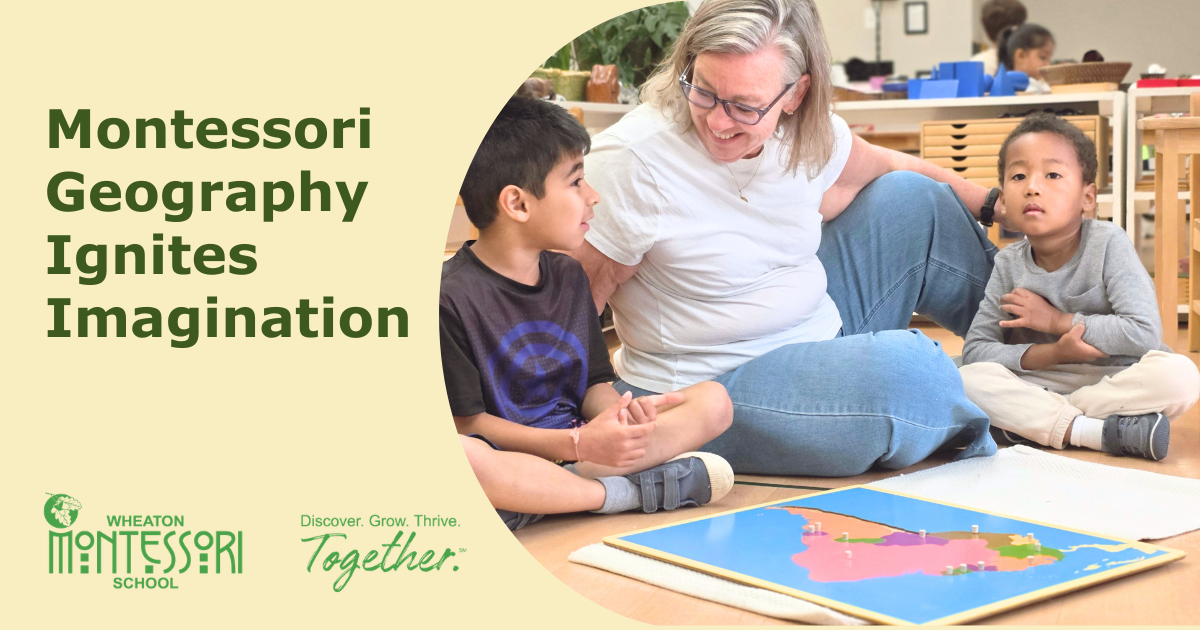
You might walk into one of our primary classrooms and see a child carefully tracing the shape of Africa with their fingertips on a puzzle map. Nearby, another child pours water into a landform tray, discovering the difference between an island and a peninsula through hands-on exploration. Across the room, a small group gathers around a globe, talking excitedly about where grandparents live, where animals come from, or where airplanes travel across the ocean.
In our elementary camps, that same curiosity expands even further. You may hear children discussing ecosystems, researching countries that interest them, creating maps, exploring world cultures, or debating how geography shapes human history and daily life. Elementary children are naturally driven to ask bigger questions, and Wheaton Montessori School gives them meaningful ways to investigate the answers.
Through all of this, children are doing what Dr. Montessori consistently described as their natural mode of learning: using their hands to access new information and then using that grounding to conceptualize aspects of the world through the power of imagination.
Real Things to Imagine
These experiences feel joyful and engaging for the children. But something much deeper is happening. Dr. Montessori believed young children possess a remarkable power of imagination. She encouraged adults to give children “real things to imagine about.” Geography offers endless opportunities for this kind of meaningful wonder, from imagining rainforests and mountain ranges to learning about cultures and communities far beyond a child’s immediate experience.
Dr. Montessori shared a charming story that captures the Montessori approach to geography. A group of six-year-olds gathered around a globe when a child not yet four years old ran up to see. Looking at the model of the earth, the little one suddenly understood something: "Is this the world? Now I understand how it is my uncle has gone around the world three times.” In that moment, the child could understand that the globe was only a model and that the real world was immense. In a single interaction with one simple material, a young child had made a conceptual leap from the concrete object in front of them to the vast reality it represented.
And because children naturally have vivid imaginations, these experiences often spark endless curiosity.
A younger child who learns where South America is may suddenly want to know what animals live there. An elementary child may begin exploring rainforests, indigenous cultures, migration patterns, or how geography influences communities around the world. One question naturally leads to another because curiosity grows when children are given real things to wonder about.
This spirit of exploration is woven throughout our summer camps.
Your children spend their days asking questions, handling beautiful materials, working alongside peers, exploring outdoors, and discovering that the world is both vast and deeply interconnected. They are not rushed through information. They are invited to explore it thoughtfully and joyfully.
Most importantly, your children are learning that their questions matter.
At Wheaton Montessori School summer camps, geography is not simply about memorizing places on a map. It is about helping your children develop curiosity, imagination, cultural awareness, critical thinking, and a genuine sense of wonder about the world around them.
And that sense of wonder becomes the foundation for a lifelong love of learning.
A Mind That Goes Beyond the Concrete
Young children are often underestimated in their capacity for abstract thought. Because they learn through their senses and their hands, we sometimes assume they can only grasp what is directly in front of them. Dr. Montessori pushed back on this firmly: "Is the child's mental horizon limited to what he sees? No. He has a type of mind that goes beyond the concrete. He has the great power of imagination."
The child who can imagine a fairy and a fairyland, as Dr. Montessori noted, has no difficulty imagining South America, or a distant mountain range, or a culture on the other side of the earth. What they need is something real and beautiful to anchor that imagination. The geography materials allow children to imagine aspects of the Earth and its features that they might not otherwise see or access. They can experience the land and water forms and learn the vocabulary of strait, isthmus, and peninsula. They can differentiate between continents and begin to explore the rich differences of human cultures.
Curiosity as a Compass
One of the more significant outcomes of Montessori geography work is how it awakens and deepens children’s curiosity. As Dr. Montessori wrote, "When a child's interest is aroused based on reality, the desire to know more about the subject is born at the same time."
The early childhood geography materials are designed to open a door so as to make the world feel knowable, fascinating, and worth exploring. The continent boxes, the cultural photographs, the land and water forms, all of it plants seeds that will bloom into the rich, research-driven, globally aware work of the Montessori elementary curriculum, where children explore the history of civilizations, the geography of ecosystems, and the deep interconnection of all life on earth.
What Families Can Do at Home
The spirit of Montessori geography extends naturally into family life. A globe at home, pulled out whenever mentioning a faraway place in conversation, does far more than a map on the wall. Photographs from different countries, looked at together with a child and accompanied by genuine curiosity and conversation, open the same doors as the continent packets in the classroom. When something happens in another part of the world, and a child is nearby, finding it on the globe together, even for a moment, plants a seed of geographical awareness.
The principle behind all of it is one Dr. Montessori returned to throughout her work: give children real things to wonder about, surround them with beauty, and give the best to the youngest. Trust their minds. Point them toward the vast, varied world. It’s worth exploring endlessly!