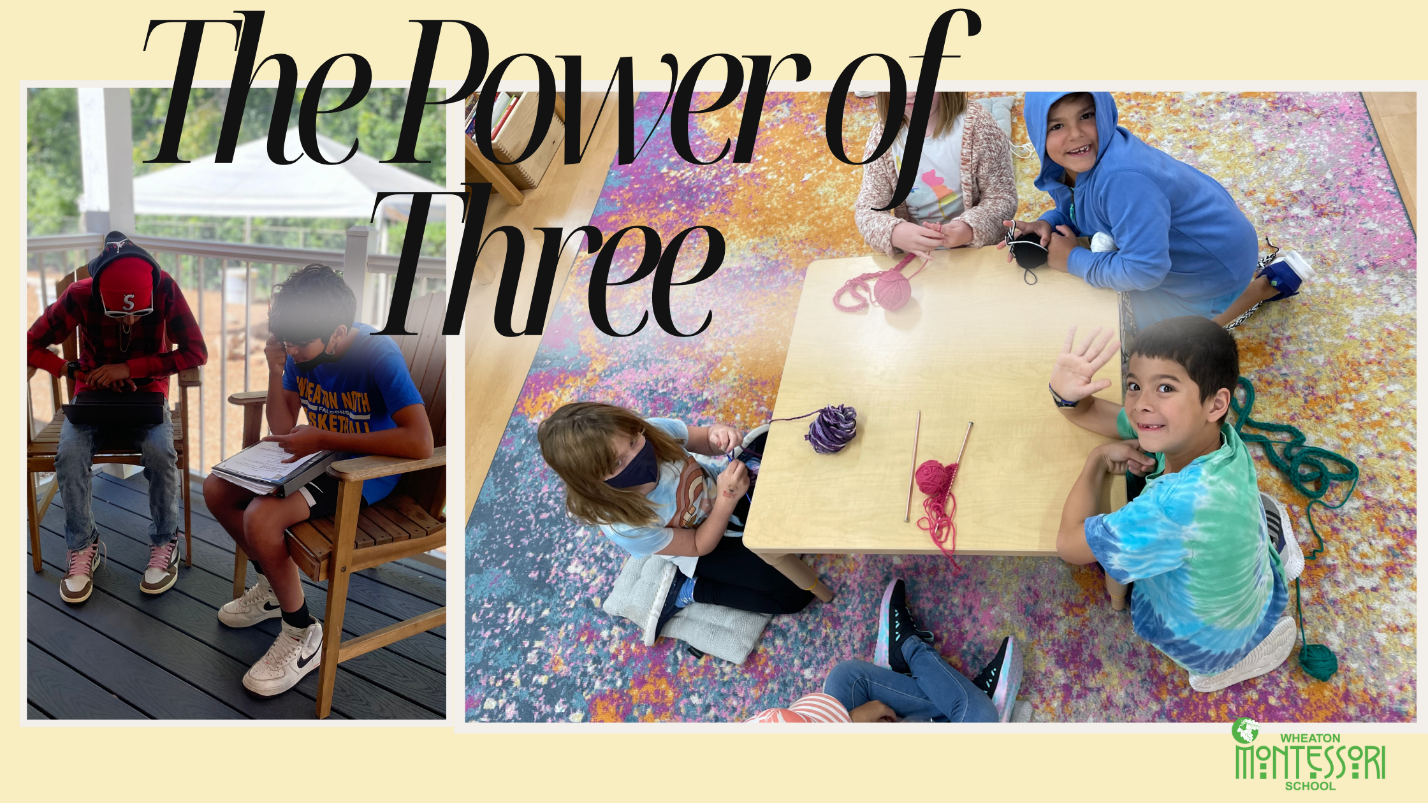
In authentic and high-fidelity Montessori school, the number three shows up a lot! We have the three-hour work cycle, three-year age spans, the three-period lesson, and the three-stage learning cycle. While there is considerable spiritual significance to the number three throughout human history, in a Montessori context, the importance of these threes is grounded in scientific observation of human development, characteristics and needs during different stages of growth, and how our brains synthesize information.
If you are curious about the three-hour work cycle and three-year age spans, check out some of our past blog posts.
This time we are going to focus on the learning process and how the three-period lesson and three-stage learning cycle meet young people’s needs for internalizing and synthesizing new information.
Three-Period Lesson
The three-period lesson model came from Édouard Séguin (1812-1880), a physician and educator known for his work with children who had disabilities. Séguin used the three-period lesson to help children make an association between an object and its corresponding term.
The three-period lesson captivates young children and rouses interest. Dr. Maria Montessori began to use three-period lessons to help young children connect language to the perception of an idea and ultimately create a permanent acquisition in their memory. There are three discrete stages to this approach.
The First Period: Naming
This first stage of the lesson is when we introduce vocabulary and help children make the connection between their experience and the language. In this first stage, we want to isolate both children’s impressions and the matching word.
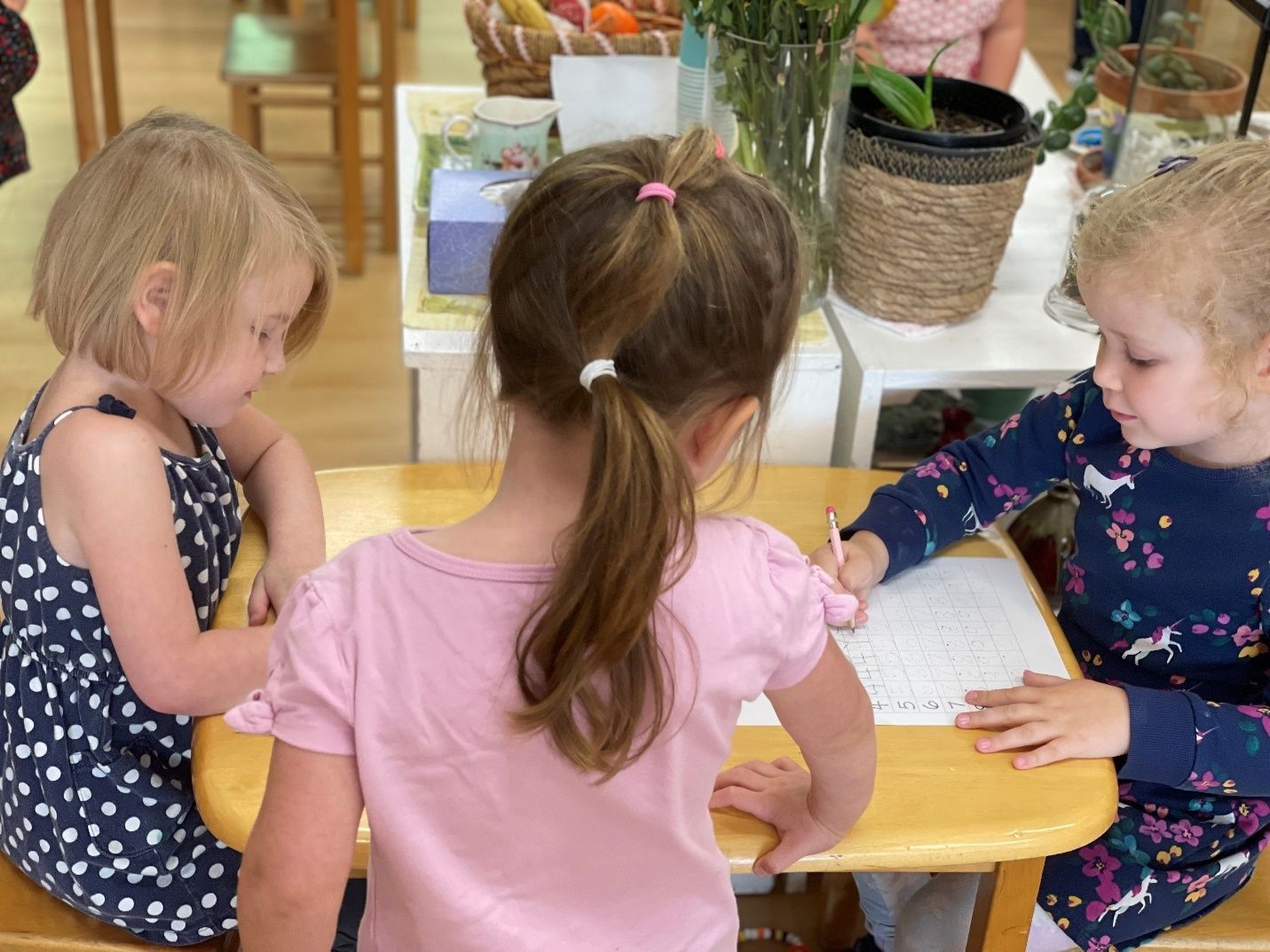
With young children, we use categorized objects, small replicas, and pictures. We pick up one object and name it. We then allow a child to have a turn feeling the object and having their own sensorial experience of the item. In the process, the child brings together the name and their sensorial experience. We continue this with each object, saying the name multiple times. For example, “This is the _____. You can feel the _____. You can place the ____ here.”
We also use a similar process for introducing vocabulary through language cards which have a picture of one isolated object on the card.
As children get a little older, we start introducing language for more abstract concepts. For example, if we are introducing tactile experiences, we offer children two different tablets that are identical except for one feature: one has rough sandpaper on it and the other has smooth paper. We feel the rough tablet and say: “It is rough.” Then the child feels the rough tablet. We repeat the same process for the smooth tablet.
The Second Period: Recognizing
This is the longest part of the lesson because we want children to have many experiences with the object or quality and its name. We rearrange the objects or cards and then ask children to place them in different locations or to point to a particular one. We might ask, “Which is rough?” Or say, “Place the _____ on my hand. Place the ______ here.”
We approach this second stage in a playful, game-like way although the goal is to cement the concept in children’s memory. If children make a mistake, we know that we have moved to quickly and reinforce the correct vocabulary: “You handed me the picture of the cheetah.”
The Third Period: Remembering or Recall
We ask children aged three and older to recall the name that corresponds to the object by isolating the object or image and asking for its name: “What is this?" If children aren’t able to remember, we just try the three-period lesson again at the same sitting and revisit it another day with reminders ahead of time.
We use this third stage with younger children when they can produce proximal sounds and are not in a defiant toddler stage. (Spoiler alert, this is an important part of everyone’s development.)
The Elementary Years
Elementary-aged children engage with new material in a similar, yet more sophisticated way. The learning process echoes the three-period lesson but isn’t exactly the same.
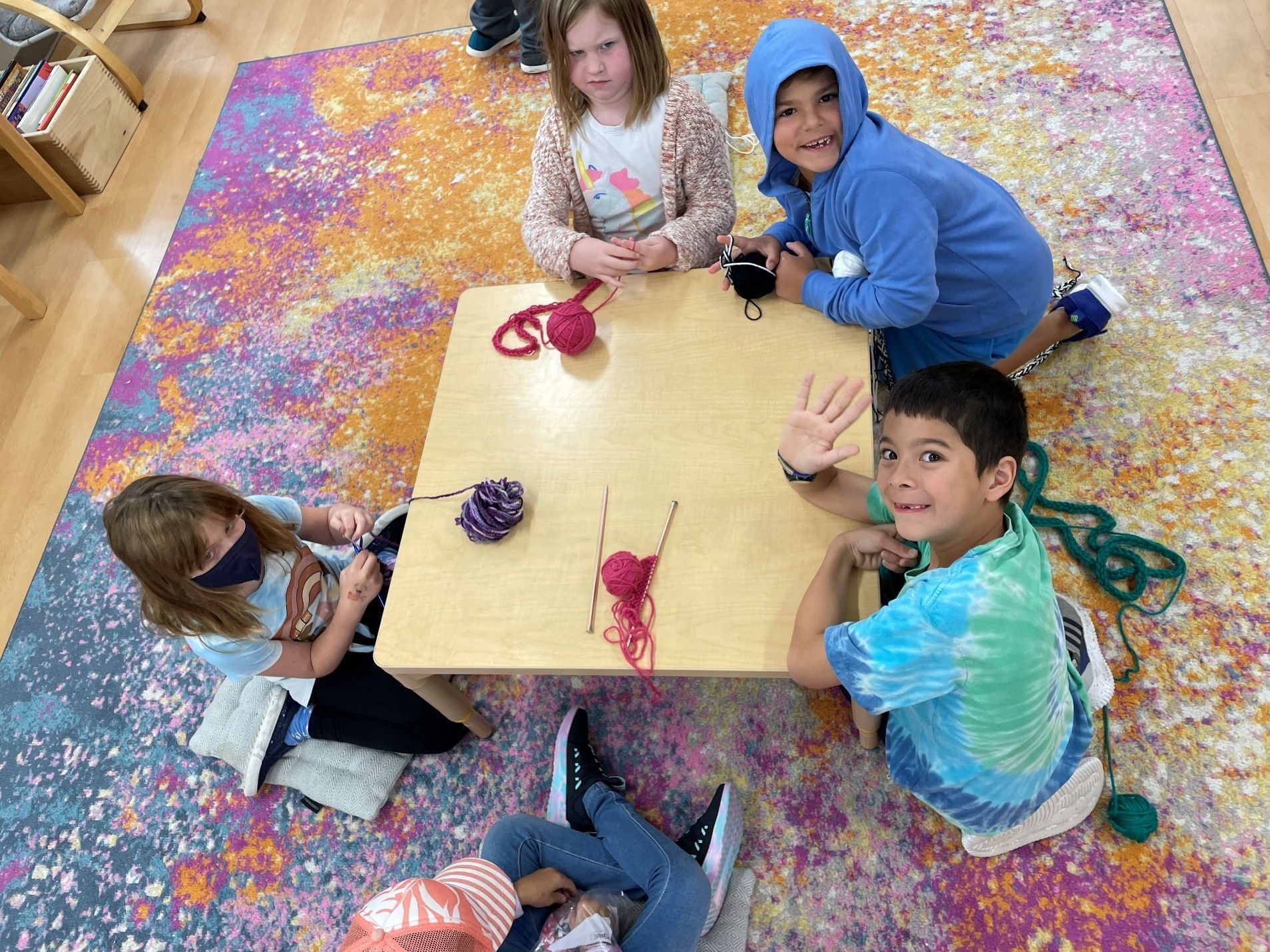
The first period involves a presentation by the adult, which can include the great stories, impressionistic charts, materials, experiments, and demonstrations. The focus is on introducing specific concepts, activating student interest, and providing a big-picture view before going into specific details. Rather than being vocabulary-based as with younger children, these lessons are intended to introduce elementary students to the wonder of the universe. In this first period, the adult gives only what is absolutely necessary for the lesson, so the students can move into their own exploration.
The second period is the longest part of the learning activity and is an exploratory phase of learning when students freely choose follow-up work. We want to see how far children can go with what they have learned, so the second period offers repetition with variation and encourages extension and elaboration of original concepts. Once they have done extensive work, students have reached the third period.
During the third period, the adults are discreetly and indirectly assessing children’s learning. Through conversation and observation, adults can see if the students can recognize the concept and perhaps apply it to a novel situation. There is an expectation for students to perform and produce evidence of the key concepts. The elementary age students’ work (game boards, posters, plays, books, timelines, dioramas, papers, etc.) can take many formats, but it is held to the expectation to meet or exceed essential benchmarks.
In Adolescence
A parallel learning cycle also exists in our adolescent community as a way to support learning, development, and valorization for 7th-9th graders.
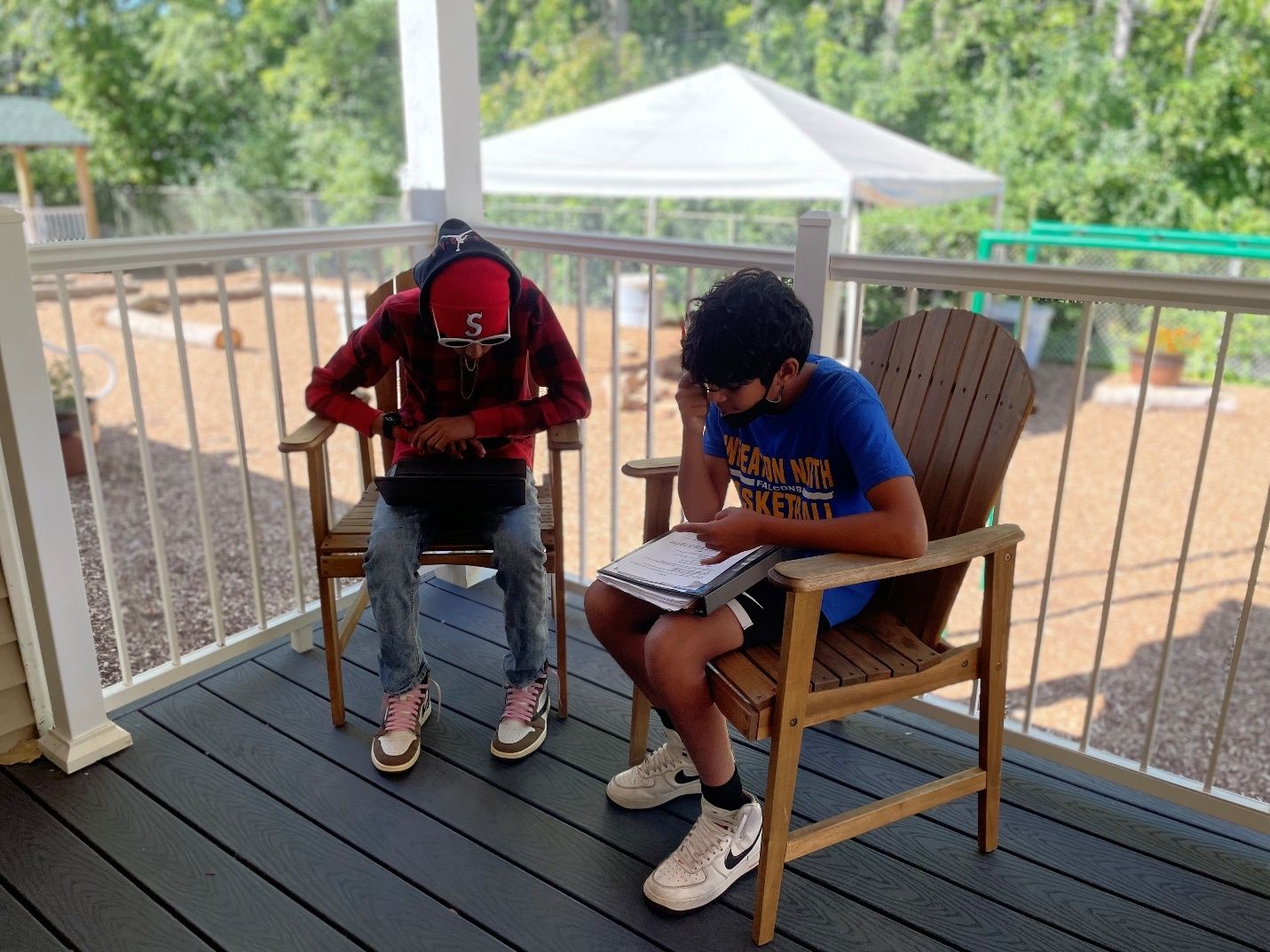
Similar to what happens in our younger, authentic Montessori classrooms, the first stage is a lesson or experience offered by Kelly or Lauren. It is an invitation to work and contribute to the community's needs by addressing a specific, concrete issue. In the first stage, the adolescent guides actively engage students by seeking their input, inviting them to engagement, and soliciting methods to connect.
During the second stage, students actively engage in work they choose, either driven by their interests or a recognition of community needs. The adults are there for guidance, scaffolding, and mentoring as adolescents work with skills and ideas and begin to consolidate them. This stage can include research, experimentation, inquiry, data collection, discussions to enhance collective understanding, physical and practical work to accomplish a task, and consultation with experts. During the second stage, the guides observe what motivates students to begin tasks, what sustains their effort, and what inspires them to actively contribute, think critically, and ask questions.
In the third stage, adolescents offer what they learned by giving back to their community. Classroom teachers expect that the adolescents produce a product at the end of their work to present. This sharing of knowledge and understanding is both a means of consolidating concepts and skills and a way to acknowledge that the work is embedded within the community's context. Products of the third stage can include a demonstration, publication, or implementation.
While these three stages take on slightly different forms from infancy through adolescence, the goal is the same: to effectively support young people as they integrate their learning. Come visit your children at Wheaton Montessori to see the power three. Observations open soon for current parents. Current parents please use these links to sign up for your classroom observation:
Adolescent Seminar Observation
Ms. Searcy’s Upper Elementary Classroom Observation
Mrs. Fortun’s Lower Elementary Classroom Observation
Mrs. Mayhugh’s Lower Elementary Classroom Observation
Mrs. Berdick’s Primary Classroom Observation
Ms. Carr’s Primary Classroom Observation
Ms. Chiste’s Primary Classroom Observation
Mrs. Rogers’ Primary Classroom Observation
Interested in enrolling? Parents of children under 4 years interested in touring Wheaton Montessori School, please use the green Schedule a Tour button located on the upper right-hand corner of our web site.