8:30 a.m.
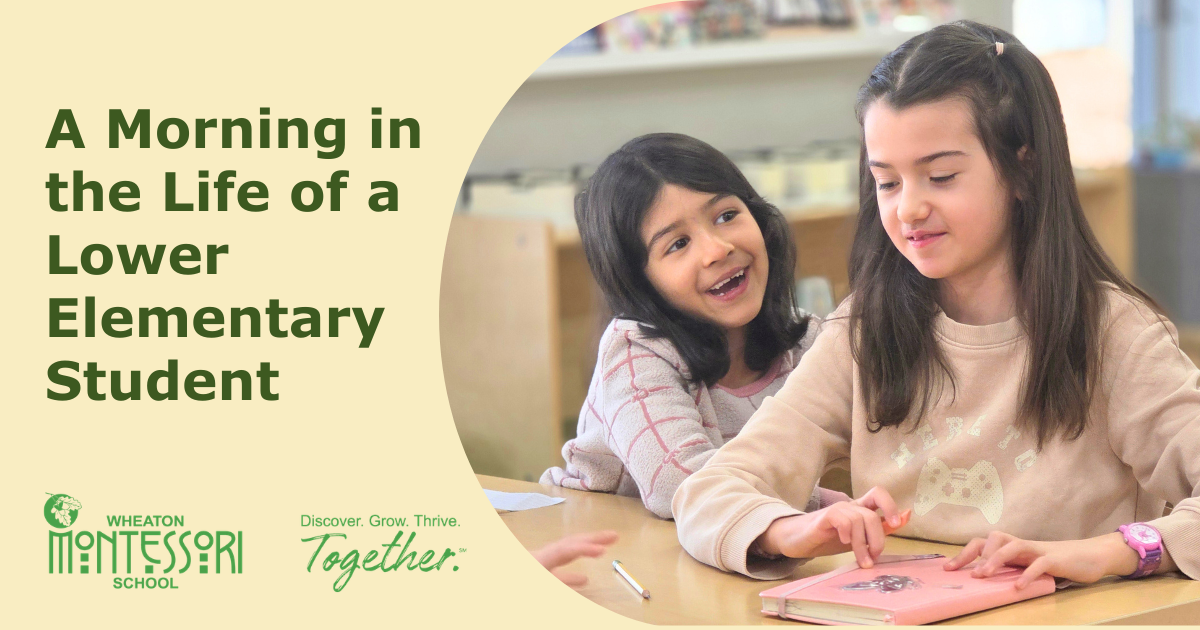
Third-grader Claire and her younger brother are dropped off at the main building’s door around 8:25 each morning. Ms. Rivera greets them at the door, and Ms. Lingo notices that Claire and her brother have gotten haircuts. She compliments them on their new styles! Claire says goodbye to her brother, who heads toward his Primary classroom. Claire joins the other Elementary students, exiting the side door to walk across the playground and through the “Nature Hallway” to her Elementary building. As she passes the Elementary gate, she says hello to Ms. Mohamed. Her younger classmate is just arriving, and Claire remembers that this friend often has a hard time leaving her mom at drop-off, so she hangs back to see if she can help. Today, when the friend sees Claire, she is excited to come in the gate and walks alongside Claire to their classroom. They chat about the new shoes the friend is wearing.
Once inside, the classmates hang up their coats and backpacks and change into their indoor shoes. After greeting a few more friends, Claire collects her work journal from her cubby and selects a freshly sharpened pencil from the supply jar. She sees some of her peers and joins them at a large group table. Their first task is to record the date at the top of a fresh page in their journals. It’s a new month, and they check in with one another to make sure they have all spelled “January” correctly. Not all of them remember how to make an uppercase “J” in cursive. Claire goes to the handwriting shelf, collects a printed chart of the uppercase letters, and brings it to the group. Everyone checks their capital “J” against the sample, and some erase their work and try again.
The teacher, Mrs. Fortun, greets each of the students at the table and welcomes them back to school after the break. She glances at their journals and notices that one of the students is still struggling with the spelling of “January”. She asks if Claire would be willing to sit with him for a few minutes and help him, before coming to a lesson on square root. Claire is excited to hear about the square root lesson, which she has been looking forward to since before winter break. She gets a small whiteboard and a dry-erase marker from the shelf, and writes “January” in her best cursive at the top. She invites the other child to practice writing it on the whiteboard in the space below hers. Claire knows how to help him because she has been in the community for nearly three years, and this is one of the ways that older students helped her when she was a first grader.
Once the other student has written “January” several times on the whiteboard, he tells Claire that he’s got it now. She gathers her own journal and pencil and moves toward the rug in the center of the room, where Mrs. Fortun and two other 3rd graders are setting up the Golden Beads. Mrs. Fortun explains that because they have been practicing finding the roots of smaller numbers, like 14, using the Square Root Board, they are now ready to find the roots of larger numbers, like 576. These students have used the Golden Beads decimal material for many activities in math, so they easily and quickly assemble five hundreds, seven tens, and six units. After Mrs. Fortun demonstrates what to do, the students work together to lay out squares with their hundreds, tens, and units. It looks something like this when they are done, and they can “read” the square root by looking at the sides of the square they have made.
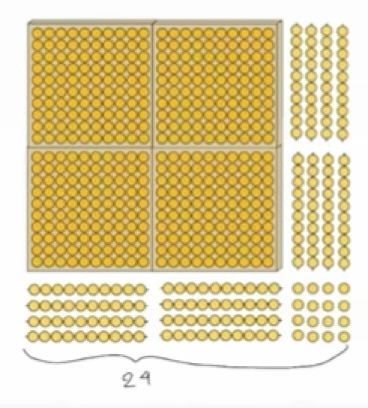
Mrs. Fortun explains that for now, they are moving the materials around to find the square root. After lots of experience with this, they will eventually use another material called the Peg Board, and will begin to learn the process of finding the square root mathematically on paper. Claire writes down the six numbers that Mrs. Fortun provides them for practice. She leans over to her friend Neel to say, “Let’s do ALL of them!”. He agrees, and they get down to work. It takes them about 40 minutes to find four of the six. Claire is starting to get a good idea of how it works, and she can start predicting the answer before the beads are all laid out.
There are two numbers left, but Claire is noticing her concentration on the activity is being interrupted by thoughts about her research project on ancient writing methods. She had hoped to fix her spelling corrections today and start working on a timeline of all the writing implements people used. She is also hoping to make her own wax tablet, like the ones used by the Greeks and Romans. She asks Neel if it would be okay to save the last two numbers for tomorrow, so she can get to work on her project. He agrees, and together they clean up the decimal material.
Claire goes to her “Work in Progress” folder and retrieves her report about the history of writing. She became interested in the topic after the Great Lesson Mrs. Fortun gave, “The Story of Communication in Signs.” She had heard this story in first grade and second grade, but upon hearing it again in third grade, some interesting facts jumped out at her that she hadn’t really noticed before. It was inspiring to her to realize that pencils, pens, and paper were relatively new inventions. She started wondering what it was like to do school work on a slate with a piece of chalk, or to carve all your messages into clay, or even into a rock! After the Great Lesson, she approached Mrs. Fortun with her idea to do a project, and together they gathered a few books from the shelf that showed pictures of different writing instruments, like the cuneiform stylus, Egyptian reed pens, and Roman carving tools. Claire’s friend Sofi browsed through the books with her, and together they came up with a plan for a project. They would each research two different ancient writing methods. Claire chose cuneiform and wax tablets; Sofi chose to focus on the making of papyrus, reed pens, and feather quills. Prior to the winter break, they sat together to gather information and write their reports over a few days. Now, each of them has received their first draft back from Mrs. Fortun with spelling, capitalization, and punctuation corrections noted lightly in pencil. This kind of correcting is best done with lots of focus, so they agree to sit quietly next to each other with their spelling books open. Claire looks for a check mark from Mrs. Fortun that indicates a word is misspelled. She finds one over the word “people” - Claire wrote “poeple”. This happens a lot. Claire double-checks the word in her spelling book to make sure, then carefully erases and switches the “e” and the “o”. The next check mark is over the word “cuneiform”. Because Mrs. Fortun knows this one is unlikely to be in Claire’s spelling book already, she has lightly written the correct spelling underneath the word. Claire flips to the “c” page in her speller and carefully writes “cuneiform” on one of the lines provided. Now she has it for next time. She fixes the spelling in that sentence, and then, as Mrs. Fortun has shown her, she scans the rest of her report for any other times she has written “cuneiform”. It is written several times, and Claire realizes that she’s made the same error each time, by flipping the “e” with the “i”.
Claire and Sofi work on their spelling side by side for about 35 minutes. Then, they get out the timeline they are making to show how the various writing systems changed over time. As they work on the timeline, they discuss what materials they will need to bring to school for their models. In addition to the timeline, they are creating, and Claire’s wax tablet, Sofi plans to create cuneiform tablets out of clay, and possibly a bulla, a kind of clay envelope that held tokens representing a trade contract between people in ancient Sumeria. They excitedly imagine the presentation they will make to the class once these items are completed. Their conversation is interrupted by the sound of the bell, which Mrs. Fortun rings to indicate that the morning work cycle has ended. Surprised, Claire looks at the clock and realizes that she was so concentrated on her project, she didn’t realize it had gotten so late!
Claire cleans up as quickly as she can because she is assigned to lunch duty this week. After she shows Mrs. Fortun her work journal, where she has recorded the activities, she chose to work on this morning, she puts her things away and goes straight to the sink area to gather the spray and cloths needed to wipe down all the tables. A partner on Lunch Duty handles getting out the plates, silverware, napkins, and placemats. Another partner collects the “clean-up” caddies with table sweepers, spray, and rags that will be used after eating. Once things are set up for lunch, Claire and her partners join the rest of the class on the rug to sing “Peace Train”. Then the students are dismissed for lunch.
After lunch and recess comes Read Aloud time. Mrs. Fortun is reading the new “Millicent Quibb” book, which Claire is very excited about. During read aloud, Claire chooses knitting as her handwork. After read aloud, Claire will help count up the pizza lunch orders, and she thinks it might be her turn to call Pizza Now and place the order! She’s excited for the afternoon ahead.