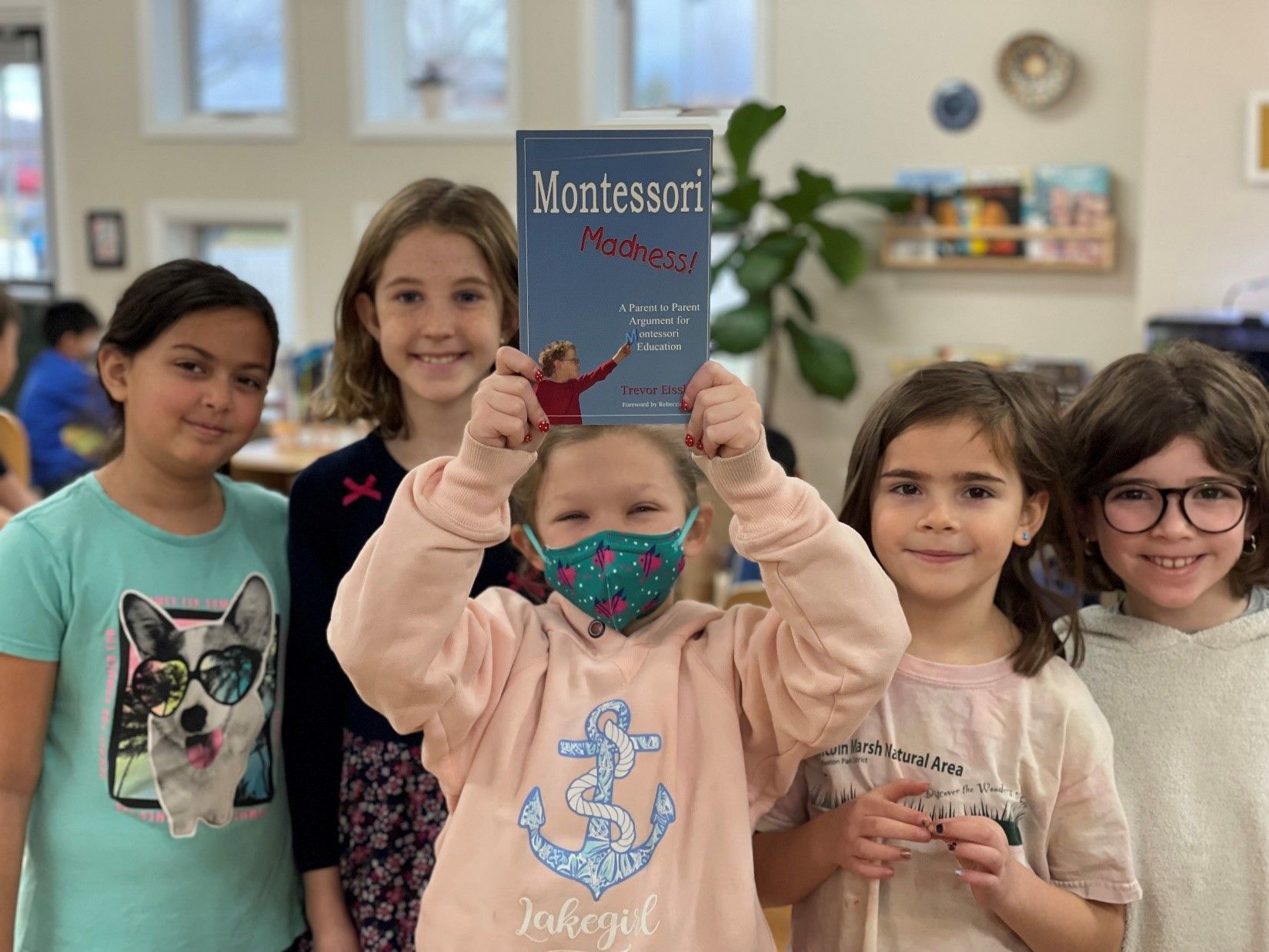
One reviewer says this book’s alternative title is “How to Change the World”. That’s a big statement, but one I know our teachers believe we are doing one child at a time, one class at a time in our little corner of DuPage County. Several WMS parents shared that reading this book helped them to understand their child’s educational experience here better. Below is Chapter Five of Montessori Madness: A Parent to Parent Argument for Montessori Education. Let us know what portions speak to you. Then share it with others and encourage more people to observe in our classrooms. Together we can change the broader educational community.
Thanks for your help,
Rebecca Lingo
A Home. A School.
I remember setting foot in that Montessori classroom. I sat down on a chair—a very, very small chair—near the door. I had just stepped into someone’s living room. Or was it a science laboratory? Or maybe an office building? I couldn’t put my finger on exactly what was different at first, but this was unlike any classroom I had ever seen. It felt different too. Peaceful. Purposeful.
What there was not struck me as much as what there was. There were no rows of desks lined up. There was no wall-to-wall chalkboard at the front of the room. There was no teacher’s desk at the front of the room. There was no teacher’s desk at all. There was no teacher!
Then I found the teacher. She was sitting on a very small chair to one side of the classroom, whispering with two students. She hadn’t interrupted her conversation with them when I walked in, so I settled into my chair the best I could and began to notice what was there. Low bookshelves wended their way around the classroom, hinting at a partial partition of several areas. The shelves were not all stacked with books. A few were, but the rest held an astonishing assortment of blocks, pitchers, beads, pencils, paper, sandpaper letters, cloth, paints, wooden numbers, maps, globes, flags, bug jars, fish tanks, plants, bells, chalk, flower arrangements, and various objects that I could not identify. It was all in perfect order! Everything was small. The chairs were child-sized. The desks were child-sized. A few low tables graced the open areas. Hand towels, light switches, window shades, door knobs—all were within reach of the youngest child, as was the highest bookshelf.
The room was square, with large picture windows along three sides, allowing in a flood of natural light. A door in the rear wall opened onto a flower garden, a vegetable garden, and a small grassy area surrounded by several trees. The side of the room without windows had a door for each of two restrooms and a third door connected to a kitchen area shared with the adjoining classroom. Three faucets with large basins and tiny footstools stood in a corner. Three faucets! (I recalled a videotaped interview from the 1980s of my late father, who at the time was the architect for the Memphis City Schools. He described a major renovation project he was attempting to spearhead throughout the city’s schools, tearing out walls and putting in a faucet and sink in each of the classrooms of these ancient, neglected buildings. His face had lit up at the prospect of inner-city kids being able to mix sand and water, splash, fill containers, pour, watercolor, and do all the “wet things” young kids need to learn how to do. This had not been possible with the existing faucets sequestered in the community bathroom down the hall, and a hall pass needed to leave the room. His jaw would have hit the floor to see three faucets.)
Thirty children were in this class, but I counted no more than ten desks. I was reminded of the outraged pleas of teachers and parents in “under-funded” schools, begging for more money because some students did not even have a desk at which to sit. Here, there weren’t enough desks by design. I looked to my left. There a child lay, stretched out on the floor, reading a book. (When I was a child, you got sent to the principal’s office for this sort of thing. Here, it was encouraged.) In front of me two children crouched on the floor arranging cut-out letters to form words on a board. Other students would remove objects from the shelves for use, or return them after use. One or two were at the sinks or in the bathrooms. I even saw one child stand up, walk to the back door, open it, and go outside into the garden! The teacher never batted an eye. In various places around the room groups of two or three children huddled, discussing this or that or working on something of interest.
I gasped. To my right a child of no more than four sat at a chair, alone, brandishing a needle! Actually, it became apparent she wasn’t brandishing it all. She was sewing. And she was entranced by her solitary work.
Across the room I spied two children with a knife! I soon realized these two little children, surely no older than three, were taking turns using a rounded butter-knife. They were slicing carrots and celery, which they would later serve to the class as a snack.
Everything here was real. The flower vases were not plastic, they were glass. Even the glasses were glass! The pitchers were ceramic, as were the plates.
The comings and goings of the children were remarkable. They seemed so assured and confident and decisive. No one was telling them where to go or what to do. It was hard to believe that I was observing a room of children ages three through six. If a child chose to do his “work” on the floor, he would first get a rolled up mat the size of a doormat from a bin of several, bring it to his chosen location on the floor, and meticulously unroll it. Then he would go get the work (or the “material” as the various pieces of work from which to choose are called) he had chosen and bring it back to the mat on the floor. Whenever he decided he was done, he’d put the work back where it came from and then re-roll the mat, placing it back in its bin. When something spilled, or it was noticed that a spot on the floor was dirty, a random child would choose to get the broom and dustpan out, or maybe hand towel, and simply clean it up without waiting to be told. I almost had to pinch myself.
The noise level was also notable. I remember two noise levels in elementary school: very loud and very quiet. When the teacher’s back was turned, or she was out of the room, pandemonium broke out. As soon as she turned around or came back in the room and shouted, “Quiet! NOW!” there was a terrified hush. The noise bounced from one to the other: loud, quiet, loud, quiet, loud, quiet—punctuated by the teacher’s occasional shout. In this class there was a hum. It was neither loud nor quiet. I think this is why “living room” and “laboratory” and “office building” initially came to mind. They are all places where there can be activity and communication without necessarily having distraction. There certainly was activity, as I’ve described. Communication was actually encouraged, not discouraged. It was expected that children work with a friend or ask for help, or give help, or talk with the teacher, or read aloud, or daydream aloud. Yet at the same time, many of the students were working quietly by themselves without seeming to be distracted by the hum of activity flowing around them. Whispered strains of classical music floated across the room from a CD player. As I sat there, I saw a child walk over to a set of bells and play a few notes before moving on to something else.
The teacher was like a chess grand master. A grand master is one of only a handful of elite chess players so accomplished they can play five, even ten chess matches simultaneously. They stroll around a room of tables, each with a chess board and a determined challenger, glance at each board in turn, make a move, and stroll to the next board. This teacher reminded me of that type of demonstration. She had keen skills of observation and quick analysis. She glided about the room giving a nod here, a whisper there, a glance, a suggestion. Then she would sit on a chair and observe the room, taking notes. In the thirty minutes I was in the room for that initial parent observation, the teacher may have actually “taught” (in the traditional sense) for ten minutes. These were seemingly spontaneous lessons, given to only a child or two at a time: help for an older child spelling a few words, demonstrating the whisk broom and dustpan to a younger child.
Five or six of the children came up to me at different times; some peered at me briefly and then went back to their work. One child asked my name. Another asked why I had come to her classroom. A boy brought something he was working on over to show me. Another girl asked me to watch while she accomplished some sort of task folding a stack of napkins in a basket. However, for the most part I was left alone, a mild curiosity. These kids were seriously intent on what they were doing.
When the thirty minutes were up, I inconspicuously rose and slipped out of the room, feeling relaxed and refreshed. I met my wife back at the school office and asked, flabbergasted, “What just happened?”

This is an excerpt from Montessori Madness!
A Parent to Parent Argument
for Montessori Education
by Trevor Eissler
www.wheatonmontessori.org