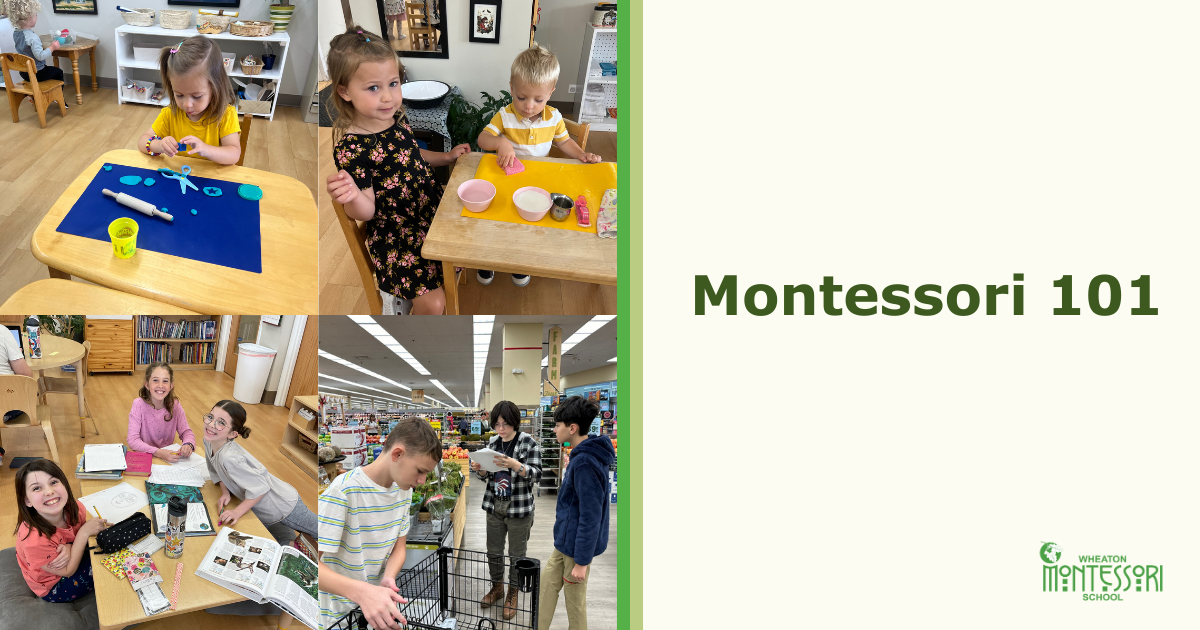
Let’s review some key elements of a Montessori education and how what we do at Wheaton Montessori School supports children’s development.
The Montessori method focuses on children’s important work of constructing themselves into the amazing humans they are becoming. Respect and a supportive environment aid in children's development of creativity, independence, self-discipline, self-confidence, and self-advocacy skills.
The Prepared Environment
Dr. Maria Montessori pioneered the understanding of the effect of the environment on human development. In Montessori prepared environments, children benefit from carefully designed spaces that meet their developmental needs at each stage of their lives. The materials in the classrooms offer young people keys to their development. In addition to the beautiful physical environments in Montessori classrooms, the prepared environment includes a community of children and professionally trained adults.
Individualized Instruction
We focus on the fact that learning starts with the child. Montessori guides observe children’s interests and abilities and use those observations to create an environment in which children flourish. This requires a comprehensive knowledge of child development, scientifically trained observation skills, and awareness of how to adjust according to where individual children are in their process of learning and growth.
The Montessori Teacher
The Montessori teacher needs comprehensive training on the focus of individualized instruction. An integral part of the Montessori approach is that the guide must respect each child’s process of self-construction and provide opportunities to help children develop their potential. An extended relationship over time in a multi-age classroom enhances the teacher’s ability to be effective in this role.
Multi-Age Classrooms
While every child works at their own level, younger children learn through the observation of older children and older children reinforce their own learning by helping younger children. Older children also have opportunities to develop leadership skills while serving as role models. Our communities emphasize and encourage cooperation and social responsibility. As children develop social and academic relationships with others of various ages, strong communities develop. The multi-age group allows for natural socialization far beyond what is found in homogenous age grouping.
The Toddler or Infant Community
Our youngest children are working toward several goals of self-sufficiency. To learn to make sense of the world, infants and toddlers need permission to explore, clear and logical limits, natural and logical consequences, positive role modeling, opportunities to make choices, and consistent procedures and ground rules. During this critical developmental time, children can extend their concentration through independent choices, purposeful activities, opportunities for repetition, and time for completion. They also benefit from exposure to grace and courtesy, group experiences, and positive attitudes toward new things. The learning materials in the Toddler Community include extensive language exposure, practical life activities, sensorial exploration, and gross and fine motor development.
The Primary Program
Designed for children two and a half to six years old, our primary program nurtures children’s individual development within the community. The classroom community provides a carefully curated array of choices for individual activities that aid children’s work of self-construction.
The Montessori teacher helps children develop their ability to choose freely, sustain focused and concentrated attention, think clearly and constructively, resolve conflicts peacefully, and express themselves through language and the arts. Through the active development of their will and the satisfaction of their authentic needs, children develop self-discipline and become connected socially.
Areas of activity at the primary level include practical life, sensorial, language, mathematics, science, cultural and social activities. The extensive sets of Montessori materials in each of these areas are designed to appeal to children's deep interest and inspire repeated activity. Because children of this age absorb so much effortlessly, they can take in vast amounts of information and grasp sophisticated relationships and principles wholly and effortlessly.
The Elementary Program
The Montessori philosophy continues in elementary and provides an unparalleled opportunity for growth in this new period of life. Children of this age have immense powers of imagination and creativity and are trying to understand themselves as social beings. The elementary environment provides an appropriate balance of freedom and responsibility and an expansive curriculum to support children’s curiosity and problem-solving to prepare them for the challenges of the future. The elementary program encourages a mature sense of justice and fairness, reinforces oral and written communication, provides cyclical experiences in all academic content and skills, and fosters the development of imagination and creativity.
The curriculum expands the sense of order that was nourished in the early childhood environment to study the order of the universe. Life is interrelated. Lessons dovetail between such subjects as geology, botany, history, language, math, and geometry. One of the goals of the program is to inspire children to explore ideas and interconnections, while also developing an understanding of their individual learning styles, needs, and goals. The Montessori interdisciplinary approach to elementary education supports children as they view the world with a continued and intense sense of wonder.
The Adolescent Program
This program provides opportunities for adolescents to gain self-knowledge, belong to an accepting community, and learn to be adaptable while empowering them with academic competence and a vision for their own future. In all academic subjects, students do personal, and group work integrated by overarching themes. The focus is on asking large questions, researching, interpreting, and connecting all the disciplines.
Adolescent students operate a real business by creating and selling self-manufactured products. They receive lessons on various aspects like science, history, economics, and organization related to their products. Tasks include bookkeeping, budgeting, design, advertising, research, and documentation.
The Adolescent Program aims to develop students as active citizens and informed problem-solvers in Chicago's western suburbs and beyond. As creative and physical expression is key during this stage of development, they learn critical thinking and public speaking skills through student-guided seminars as they grapple with real-world issues. The adolescent program is designed to grow healthy, self-confident, well-prepared young adolescents into the next phase of their development.
A Strong Foundation
Our mission is to prepare children for life. All children are naturally curious and love to learn. We support this innate drive by providing environments that meet children’s developmental needs, creating a staff of loving and well-prepared adults, and building a community of families that actively support this mission. We celebrate each child’s individuality and help them discover how they can best contribute to our world. This unique model offers children an incredible gift of independent thinking, self-assurance, inner discipline, and a love of learning.
Families who are currently enrolled are encouraged to contact the office for further details about the benefits of completing all programs at Wheaton Montessori School.
Prospective families are invited to Schedule a tour to learn more!