In our elementary classrooms, Tracy, Suzanna, and Emily offer key lessons that unlock doors to exploration and learning. One of these fundamental materials is the History Question Charts. Although they seem relatively simple, the History Question Charts inspire deep thinking about the land and culture of different people, offer children scaffolding for building their research and essay writing skills, and lead to a variety of creative explorations to challenge each student.
Designed in collaboration with Dutch historians Professor Romein-Vershoor and her husband Jan Romein (who were famous for promoting the publication of The Diary of Anne Frank), the History Question Charts serve as a compelling guide for children’s explorations and research into the past.
The History Question Charts
The color-coded charts each provide a set of questions focused on a broad topic relevant to any civilization. Under each question is space for children to collect their responses. The charts also have additional blank sections for questions children might think of on their own.
The green chart explores overarching themes of the natural world. Children use this chart to explore the terrain, flora, climate, and fauna, how and where water was found, and how, when, why, and from where humans and fauna came to the area.
The brown chart focuses on human activities and encourages children to explore how humans use the land, decorate possessions, dress, and eat. In addition, the chart includes questions about tools and techniques, construction of buildings and for what purpose, and general production.
The gold chart highlights intellectual and spiritual achievements through questions about the people’s language for speaking and writing, the number system, art and music, religious beliefs literature, and sciences. This chart also explores holidays, rituals, and ceremonies, as well as how people decorate themselves and why.
The orange chart is centered on how humans live their daily lives, asking questions about the care and education of children, form(s) of government, social structures of groups, forms of trade, cultural games, the administration of justice, roles of family members, and care of the sick and poor.
The blue chart explores relationships within the group and with other groups, including interactions such as if groups engage in wars, travel, exploration, or migration, and how trade and interactions with others happened and with what outcomes.
Research Skills
There are multiple ways our learners can use charts to engage in research and deepen their understandings. They can focus on one or two questions or use a selection of questions drawn from a combination of charts. They could complete all of the questions on one or more of the charts.
The charts are sized so that children can compile their answers to the questions and then place their written notes on the blank spaces below each question. Imagine placing index cards under a question (outline heading). To scaffold this work, we can also provide pre-made color-coded cards with key answers to questions about a particular time and place (e.g., Ancient Egypt) so children can get a sense of the type of information they can glean through researching the questions. In this format, the questions are matched to the answer cards.
As children become more adept at taking notes from their research, the charts provide a way to organize the information into paragraphs and essays. Because the charts provide a visual form of organization, they help children experience a more concrete approach to constructing their written work. Through using the History Question Charts to compile and organize their research, children discover that they are capable of composing essays younger than in traditional classrooms.
Follow-Up Explorations
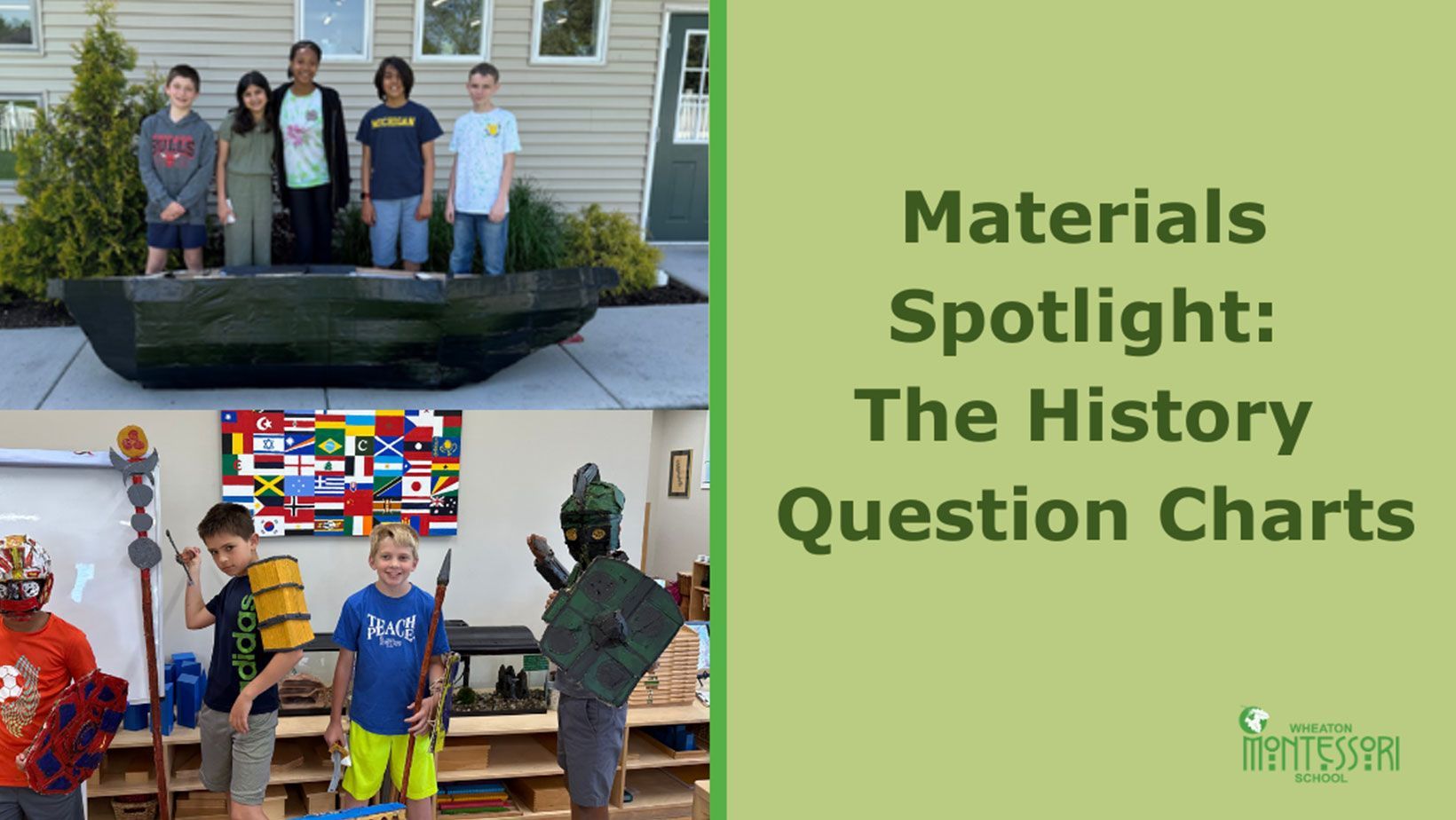
As children use the History Question Charts, their investigations inspire follow-up activities. Sometimes children extend their study of different civilizations or cultures by setting up a trip to a museum, trying out new recipes, or speaking with an expert. Children also love re-creating a culture’s art or representing aspects of what they’ve learned through displays. Sometimes children like to create a series of pictures with written captions that can be assembled into a booklet or presented in the form of a timeline. Those with a more dramatic bent may create short plays to perform for their peers.
Although the initial presentation of the History Question Charts is relatively brief, this material offers the potential for ongoing, in-depth work as children investigate different civilizations. We invite you to schedule a school tour by clicking this link to see how this material leads to a genuine appreciation of history! Current families can begin observations in October.
Go to our social media pages to see history research in action in our elementary classrooms.