“Families deserve sleep routines that work in real life, not just in perfectly controlled conditions. If you want to visit cousins, go on vacation, or have friends over, you shouldn’t feel like you have to darken every window and keep the whole house silent for two hours just to protect a bedtime routine. I’ve seen how stressful and impractical that can become. Children are capable of learning to sleep in the world as it is, with a little noise, a little light, and life happening around them. Yes, darkness supports circadian rhythms, and a calm environment helps, but it doesn’t have to mean creating a sealed, sterile space every night. When we give children some flexibility, they grow into people who can rest in different environments, whether that’s a busy home, a college dorm, or a new place altogether. Many parents, especially those who have waited a long time for a child, put so much effort into controlling every detail, hoping it will guarantee good sleep. But over the course of a childhood, there will always be nights that don’t go as planned. That doesn’t mean you’ve done anything wrong. Sometimes the most supportive approach is the most humane one: building rhythms that can travel with you, adjusting when needed, and accepting that real life is a little messy. I always think about how we do what works in the moment, whether it’s a car ride nap, a later bedtime, or a different setting, and most of the time, it turns out just fine. What matters most is that families feel free to live their lives while helping children learn to rest within it.”
Mrs. Jennifer Rogers, Primary Teacher
At Wheaton Montessori School, we focus on independence as a path toward self-sufficiency. This is a gradual, mindful process of becoming capable. For our youngest children, this journey begins with mastery of the most fundamental human needs: eating, toileting, and sleeping.
These areas matter deeply because they are ultimately under a child’s control. No one can make a child eat, use the toilet, or sleep. Our role, then, is not to force outcomes but to remove obstacles. As adults, we can provide thoughtful structure and support children as they develop the skills that build confidence and trust in their own bodies.
Language Shapes Our Intentions
At Wheaton Montessori School, our language reflects our values. For example, we don’t talk about “toilet training.” Instead, we focus on “toilet learning” because children are learning how to care for their bodies within the cultural norms. We are not training behavior. We are supporting development.
The same is true for sleep. Rather than “sleep training,” Montessori invites us to think in terms of supporting independent sleep skills. We help children learn how to settle their bodies, self-soothe, and eventually fall asleep independently, all skills they will rely on for the rest of their lives.
Why Sleep Matters So Much
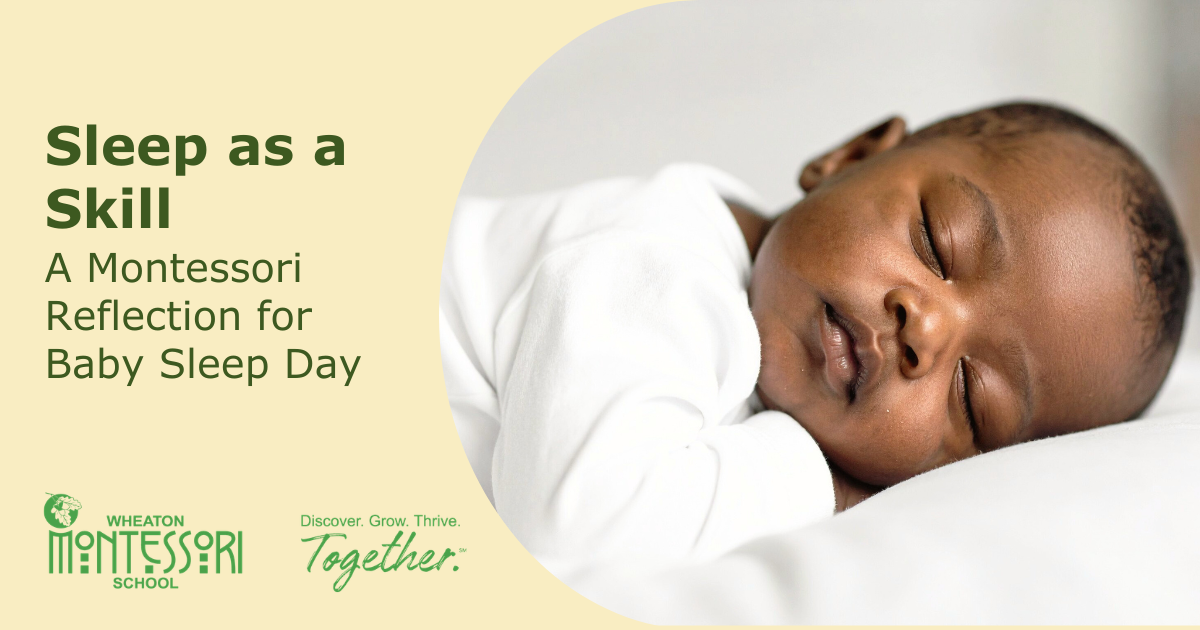
Research continues to affirm that sleep is foundational. Healthy sleep supports brain development and learning, emotional regulation, physical growth and immune function, and memory and attention.
During sleep, children’s bodies perform essential functions, including muscle growth, tissue repair, protein synthesis, and the release of growth hormones. Deep sleep stages are when the most restorative processes occur.
How Sleep Works
Two systems guide sleep: circadian rhythm and sleep pressure.
Circadian rhythm is the body’s internal 24-hour clock, regulated by light and darkness. When it’s dark, the brain releases melatonin (the sleep hormone). When it’s light, melatonin decreases, and cortisol helps us wake. This is why darkness supports sleep, blue light from screens disrupts it, and consistent bedtimes matter.
Newborns are not born with a mature circadian rhythm. It begins developing around six weeks and becomes more established around three months, which explains why early baby sleep can feel unpredictable.
The other factor is sleep pressure. The longer we’re awake, the stronger the drive to sleep. This pressure builds during the day and resets after a long stretch of rest.
When children miss their sleep window and become overtired, stress hormones (adrenaline and cortisol) kick in, creating that familiar “second wind.” Suddenly, a child who desperately needs sleep seems wired and alert. Understanding sleep pressure helps us time sleep before children tip into exhaustion.
A Montessori Framework for Healthy Sleep
To support both healthy attachment and independence, Montessori encourages clear, loving boundaries. Sleep is no different.
We can focus on four key factors: a prepared sleep environment, predictable and respectful routines, healthy sleep associations, and limits with flexibility.
A Prepared Sleep Environment
Just as we prepare our classroom communities, we want to be intentional about preparing our child’s sleep space at home. Key components include ensuring that the space is:
- Darkish
- Quieter and calmer
- Free of stimulating toys
- Slightly cool
A good question to ask ourselves is: Would I easily fall asleep here?
Predictable, Respectful Routines
Children feel secure when they know what comes next. A simple home routine might include:
- The final feeding
- Putting on pajamas
- Toileting/diapering
- Tooth brushing
- A short story or song
- A hug and kiss goodnight
Long baths or extended reading are best before the sleep window, not during it.
Healthy Sleep Associations
Children form associations with the conditions present when they fall asleep. If a child falls asleep being rocked, fed, or held, they will often need that same support during natural night wakings. Instead, we want to place a child in bed drowsy but awake, so they can practice falling asleep independently. Comfort objects, such as a small blanket or stuffed animal, can support this process.
Limits with Flexibility
Sleep needs change as children grow. Consistency matters, but we don’t want to be unnecessarily rigid. It’s important to keep in mind, though, that older children may test boundaries, delay routines, or negotiate endlessly. Calm, consistent follow-through reassures children that the structure is dependable. And just as importantly, adults need support, too! Holding limits is much harder when we are sleep-deprived, so self-care is essential.
Why Independent Sleep Is an Act of Care
Babies naturally cycle through light and deep sleep many times each night. When they wake briefly between cycles, a child who knows how to self-settle can drift back to sleep without distress. Independent sleep skills:
- Reduce frequent night wakings
- Support early morning sleep
- Improve mood and learning
- Protect parents’ well-being
Plus, poor sleep in infancy is linked to challenges later in childhood, including difficulties with emotional regulation and health concerns. Supporting sleep early is preventative care.
A Closing Thought
Supporting sleep is not about forcing independence. It’s about preparing the conditions so independence can emerge naturally, with confidence and trust.
If you’re navigating sleep challenges, please know this: you don’t have to do it alone. Sleep is learned, supported, and refined over time (just like every other human skill!).