How Your Young Children Learn and Why It Matters
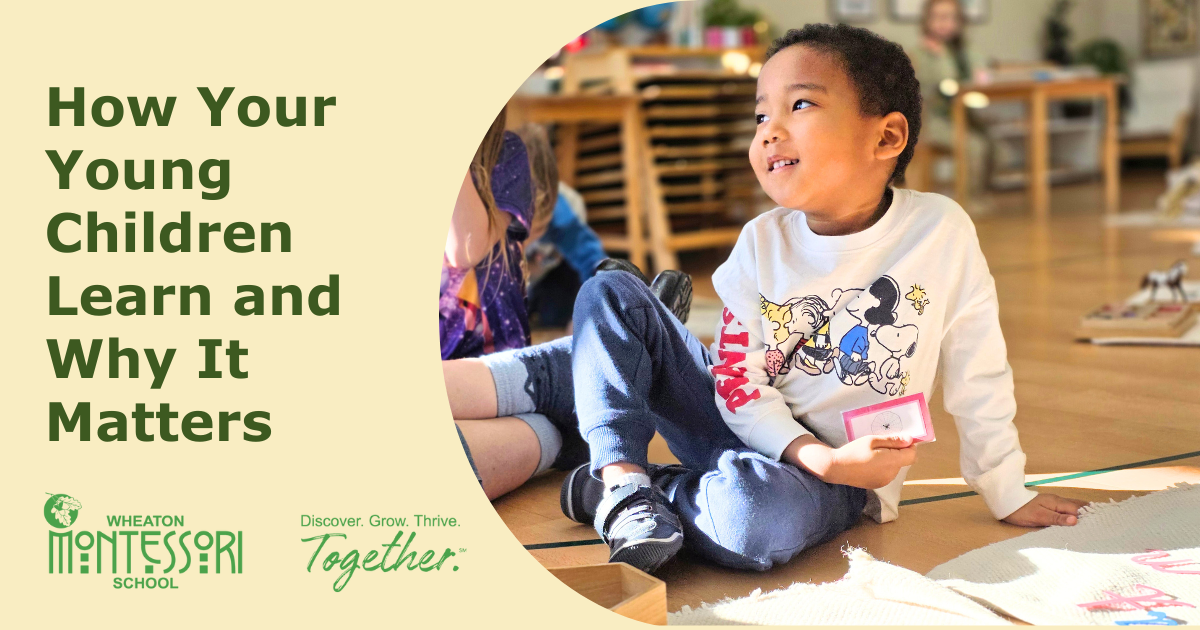
Your young children learn by actively constructing themselves through purposeful work. From birth through age six, learning is not passive or instructional. It is driven from within your child, supported by responsive adults like you and all of my colleagues. This internal passion to learn is also boosted through the campus design and surroundings. Every movement, repetition, and exploration is meaningful work that builds the child’s body, mind, language, and sense of self.
How learning happens
- Active construction through work: Your young children learn by doing. Don’t we all! Movement, using the hands, exploring real materials, and repeating challenging tasks are how the brain develops. This work must be meaningful and appropriately challenging, not busy work.
- Movement and the hand: Development of walking, balance, and refined hand use is foundational. Your children of all ages need freedom to move and manipulate real objects to fully develop coordination, concentration, and foundational academics like writing and adding.
- Language through relationship: Language develops through reciprocal human interactions. Rich spoken language, conversation, naming the world, and storytelling are essential. Wheaton Montessori School eliminates screens and background noise to highlight communication.
- Sensorial exploration of reality: Your children learn the world through their senses. Touching, comparing, carrying, observing, and interacting with real things builds the foundation for imagination, reasoning, and abstract thinking later. Authentic Montessori immerses us in exploration and discovery.
- Sensitive periods: Your children pass through brief, powerful windows of heightened interest and ability, such as for language, movement, social behavior, etc. Wheaton Montessori School teachers observe and offer the right experience at the right time. Learning happens easily and joyfully and feels like play!
- Concentration and normalization: When your children are connected to meaningful work that they choose themselves and repeat, they develop deep concentration, self-regulation, delight in effort, and care for others.
Why This Is Important
- Early experiences shape lifelong learning: Early experiences lay the neurological, emotional, and social foundation for everything that follows.
- Missed opportunities are harder to recover: Skills learned during ideal stages are acquired with ease. When these periods are missed, learning later requires more effort and frustration. My colleagues are passionate about tailoring lessons and their classrooms to match child development (and adolescent development, too!)
- Strong foundations support later independence: Your children deserve rich early support leading to confident, capable, socially aware, and academically prepared people.
- Well-supported children become well-adjusted humans: This approach supports not just academic readiness, but the development of secure, courteous, empathetic children who care about their community and the world.
In short, your children learn best when they are trusted as active learners, supported by attentive adults, and given real, challenging work at the right time. Investing in this early foundation supports not only your child’s success in school, but their lifelong well-being and ability to thrive.