At Wheaton Montessori School, relationships across generations help children build confidence, discover new perspectives, and experience the joy of learning together.
I remember watching a child who was nearly five years old work with a grandparent on the hundred chain.
They sat together and began counting the chain. As they worked, the child showed the grandparent how the chain could be folded into a square of ten, making one hundred.
The child was excited to demonstrate what they knew. They carefully showed how the chain could be arranged into a square, matching the square made from the hundred golden beads.
The grandparent watched as the child worked through the material and made the connection between the chain and the square. There was a sense of discovery in the moment.
I imagine the grandparent was impressed by the way the materials fit together, how one representation connected to another. But what stood out to me most was the child's delight in being able to show this to someone they loved.
It was a lovely moment to witness.
As Thanksgiving approaches, we want to tell you why grandparents and grandfriends, who are special people for us just like grandparents, matter so much at Wheaton Montessori School, and what your child gains from time with someone from another generation.
A Village Bigger Than the Classroom
In our multi-age classrooms, younger children already look up to older ones. Grandparents and grandfriends extend that circle of connection.
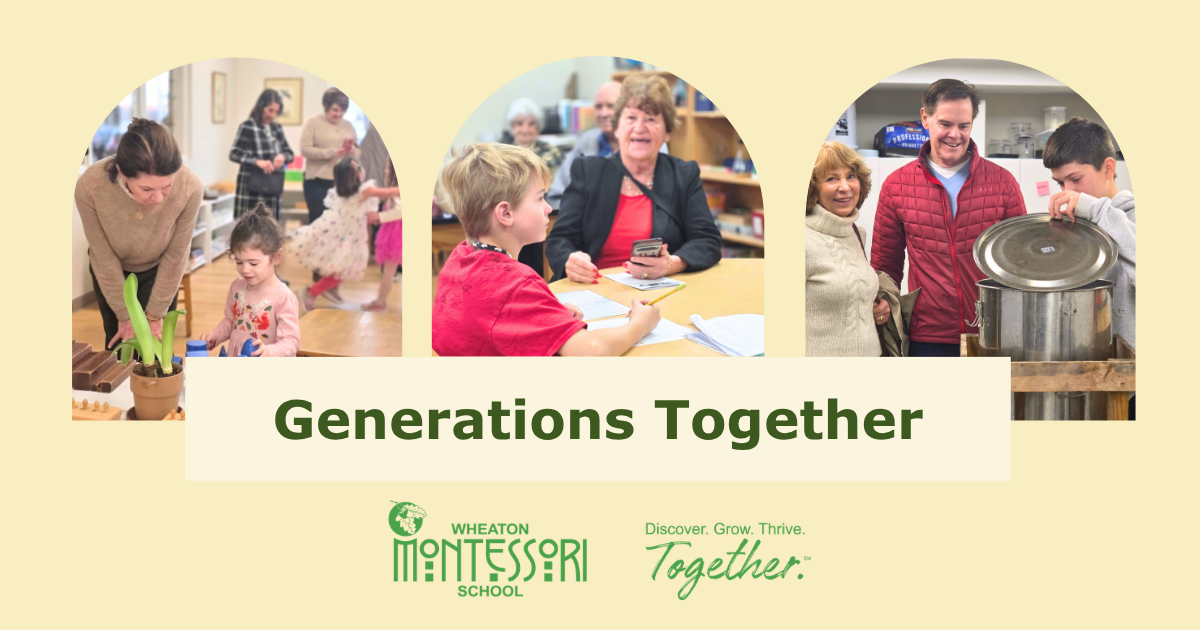
When they share a family tradition, tell a story, demonstrate a skill, or simply sit beside a child and watch them work, both sides feel a sense of belonging. The child learns they are part of a village of people who support them and believe in them. The grandparent learns they still have something to give.
Learning here goes both ways. Children receive wisdom, and they offer gifts of their own.
What Your Child Gains at Each Stage
Primary (3-6 years): Warmth and good manners.
Young children learn through people, not just materials. A grandparent might share a story, show how plant seeds, or watch a child present a work. In those moments, children practice listening, patience, and grace and courtesy with someone who gives them full attention.
A grandparent might sit beside a young child as they carefully arrange flowers in a small vase. The child practices carrying the vase with two hands, offering flowers to others, and taking pride in preparing something beautiful for the community. These simple moments help children experience kindness, care, and consideration firsthand.
Elementary (1st-6th grade): History that talks back.
Elementary students are curious about why the world is the way it is. When they interview a grandparent about life decades ago, history stops being a chapter in a book and becomes a living story. Then the roles flip: students proudly teach their grandparents to use materials like the Bead Cabinet or Checkerboard.
Adolescent (7th-9th grade): Acceptance without the pressure.
Teens are working out who they are and what they’ll do, and they often relax around grandparents and grand friends in a way they can’t always manage elsewhere. A grandparent seems to carry a quiet confidence that life paths have a way of working out, and shows enthusiasm for exactly who a teen is right now, not who they’re supposed to become. Many also offer practical skills, like craftsmanship or business sense, and working side by side on garden projects or service work shows adolescents that their efforts matter beyond today.
There are the small joys: a favorite snack waiting on the counter, an invitation into a grandfriend’s hobby, an extra few minutes past bedtime. These relationships, whether by blood or by choice, are free of the daily responsibilities and expectations that exist between parent(s) and child(ren). Checking homework or chores are finished feels less stressed. That freedom is a gift to the teen, and a real joy for the grandfriend, too.
A teen sat with a grandfriend, working on a small woodworking project, when the conversation turned to music. “Your parents probably think my music is ancient,” the grandfriend joked. The teen laughed and pulled up a favorite song, and soon they were swapping recommendations, two people enjoying each other’s company.
If your teen sometimes seems more open with a grandparent or grandfriend than with you, that’s okay. Having another trusted adult in their corner doesn’t replace your relationship; it adds another source of connection, encouragement, and support as they grow.
Thank You, and an Invitation
To every grandparent and grandfriend who visits, tells a story, or lends a hand: thank you. Your presence leaves a mark on our children.
Don’t have a grandparent nearby? You can “borrow” one. Our grandfriends come from all kinds of families, and a visit takes about an hour with no preparation needed. And for the important people out there who aren’t able to attend our special event, please send a card or email to your grandchild to their attention at school. They can enjoy it in class!
Tomorrow, Tuesday, November 24, we celebrate Grandparents’ and Grandfriends’ Day at Wheaton Montessori School, honoring the generations who enrich our children’s lives with their love, wisdom, and stories. We are grateful for the special connections that help our children grow.