Where Learning Supports Who They Become
Inspired by the Deep Dive on Psycho-Disciplines by David Kahn and Michael Waski
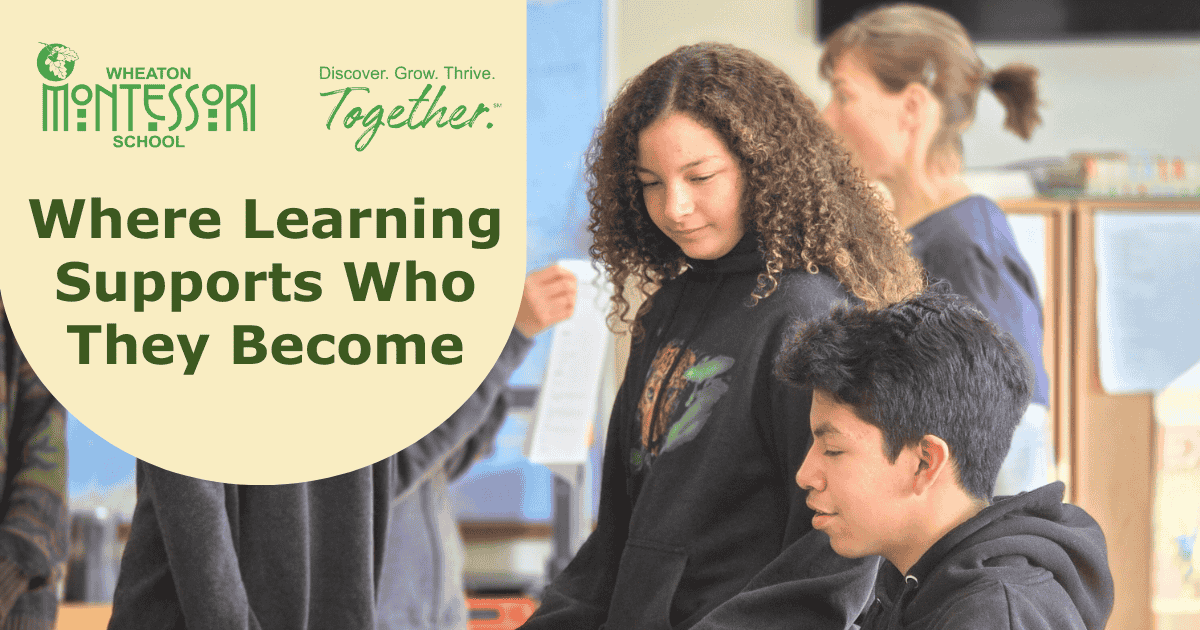
In Wheaton Montessori School’s Adolescent Program, learning is more than content acquisition; it is a Psycho-discipline. A psycho-discipline is the connection of each discipline to the psychology of the developing human. When children and adolescents engage in subjects in a way that aligns with their psychology and developmental needs, the learning becomes internalized, and since discipline's root meaning is connected to “accepting with love”, they are supported to love learning.
At Wheaton Montessori School, every subject your adolescent studies, from math, science, language, and literature to economics, morality, and culture, is intentionally crafted to support who they are becoming. We don’t teach disciplines simply to transmit facts. We use the subjects of humanities, math, social sciences, language, and sciences to strengthen your adolescent’s confidence, character, and capacity to participate meaningfully in society.
This approach is deeply rooted in the Montessori work of David Kahn and Michael Waski, both pioneers of adolescent training programs and adolescent psyche work. They describe these subjects as psycho-disciplines.
Psycho-discipline can be defined as the order necessary for self-construction. When children and adolescents engage with subjects in a way that aligns with their psychology and developmental needs, the learning becomes internalized. It becomes part of your children and adolescents. And when the curriculum is deeply connected and part of each individual, the result is self-construction that is whole, complete, interdisciplinary, and integrated. Wheaton Montessori School staff are trained to understand and respond to developmental needs and to aid your children and adolescents in loving to learn across the curriculum. We do this for adolescents by connecting the academic topics we cover to real-life applications that are meaningful and relatable for the student. Rather than teaching facts and skills in a silo “just in case” students may need them, we first present students with meaningful context and then move to presenting lessons that give them the tools they need to engage with that context, “just in time.”
Psycho-disciplines:
• Engage intellect and emotion
• Build purpose through real work
• Support the drive for belonging and contribution
• Empower independent thought connected to others
• Spark passion and identity formation
Your adolescents learn to navigate complexity by applying their advanced knowledge to real needs. They learn academics best and enjoy them most when they use what they know to strengthen their community and improve the world. This applies whether they are solving problems that arise within their immediate environment or finding opportunities to serve the broader local community.
At Wheaton Montessori School, 7th-9th graders engage in learning that is meaningful to them. They begin with recognizing authentic needs around them, extending the growing season in their gardens, keeping their chickens and bees healthy through the year, and then working to address those needs. When we provide the “big picture” first, students enter academic lessons with a clear understanding of why the content matters. Instead of teaching unit conversions or graphing equations in isolation and waiting for the question, “When am I ever going to use this?”, we begin with harvesting honey and ask, “What do we need to know to bottle and sell this honey? How do we determine the right price?” This is psycho-disciplines in action. Thermodynamics becomes relevant as students prepare their beehives for winter. Through this work, your adolescents also come to understand their value and place in the broader adult community, whether they are partnering with organizations such as People’s Resource Center or volunteering at Northern Illinois Food Bank.
Learning through psycho-disciplines supports who adolescents are becoming and engages the work of the hand, head, and heart. Wheaton Montessori School adolescents don’t learn by memorizing facts, but by engaging and immersing themselves in meaningful work. This provides the means to learn lessons that speak to who the students are and to stick with them for a lifetime.
Why Learning with Purpose
Your adolescents are forming their adult identity right now. They are asking:
How do I contribute?
Where do I belong?
Why does this matter?
At Wheaton Montessori School, psycho-disciplines answer those questions through:
• Meaningful collaboration
• Real-world application
• Guidance from experts and highly skilled mentors
• Leadership and ownership
• Choice and autonomy
Instead of prioritizing the mere transmission of knowledge, we open the doors to further study and provide the order necessary for the formation of maturity and self-respect.
| Adolescent Programs (7th-9th Grades) |
|---|
| · Learn through doing and shared experience |
| · Community-based practical work |
| · Inductive learning through discovery |
| · Collective projects and personal passion-driven contributions |
| This leads toward self-motivation, resilience, and real responsibility. |
Learning Beyond School Walls
• Widening your adolescent’s world
• Creating ownership and accountability
• Integrating learning across subjects
• Providing time and space to practice adulthood
The universe they studied as elementary children with Emily Searcy, Upper Elementary Teacher, Suzanna Mayhugh, Lower Elementary Teacher, and Tracy Fortun, Lower Elementary Teacher, becomes more personal:
“My community and I.”
“My values in action.”
“My role in the world.”
Why This Matters
When knowledge shapes character, adolescents become adults who:
• Think independently and act responsibly
• Reject fractured thinking and fractured morality
• Lead with compassion and clarity
This is education for peace and for life.
Wheaton Montessori School was founded with the principle to approach every aspect of your children’s and adolescents' education to ensure your children and adolescents are not just learning… they are becoming.
Full credit: Inspired by the Deep Dive on Psycho-Disciplines submitted by David Kahn and Michael Waski.
Rebecca Lingo has taken training, workshops, and attended conferences with David Khan and has taken training with Michael Waski. Emily Searcy and Kelly Jonelis have also taken math workshops and training with Michael Waski. Our Primary Teachers, Elizabeth Berdick, Amy Chiste, and Jennifer
Rogers, have attended conferences with David Khan.