
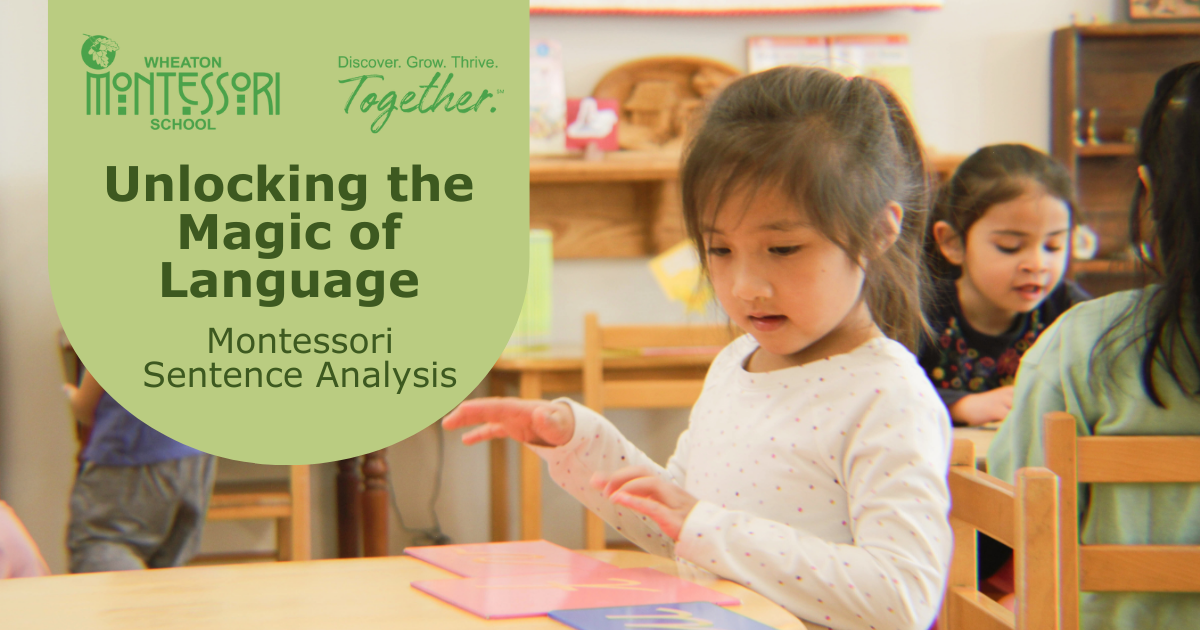
Did you know that the word "grammar" evolved from "glamour"? This linguistic connection reflects an ancient association between language and enchantment. When we introduce Montessori's sentence analysis work, we offer more than just a lesson—we present an enchanting gift! And to enchant you, often our kindergarteners are introduced to analyzing sentences as early reading activities because they are so fun! I wish you could hear the giggles when they reorder subjects and objects such as Mrs. Berdick plants seeds to read “Seeds plant Mrs. Berdick!” at Wheaton Montessori School.
We regularly witness children falling in love with language as they uncover its patterns and structures. At the elementary level, children possess a reasoning mind, an active imagination, and a deep desire for communication. These Montessori sentence analysis activities start young and continue into the lower elementary classrooms appealing to these characteristics, helping children connect as they creatively discover the underlying patterns of our language.
Why Do We Teach Sentence Analysis at Such a Young Age?
- Children are natural pattern seekers. They love to identify and understand structures in the world around them, including language.
- We want them to fall in love with language. By engaging in hands-on grammar work, children develop an appreciation for the beauty of sentence construction.
- Sentence analysis provides clarity. Understanding sentence structure helps children write with greater precision and confidence.
- Analysis leads to synthesis. When children break down sentences, they gain the tools to build more complex and meaningful expressions in their writing.
- As with everything we do at Wheaton Montessori School, it’s more fun and easier to learn during ideal stages.
What Sentence Analysis Involves
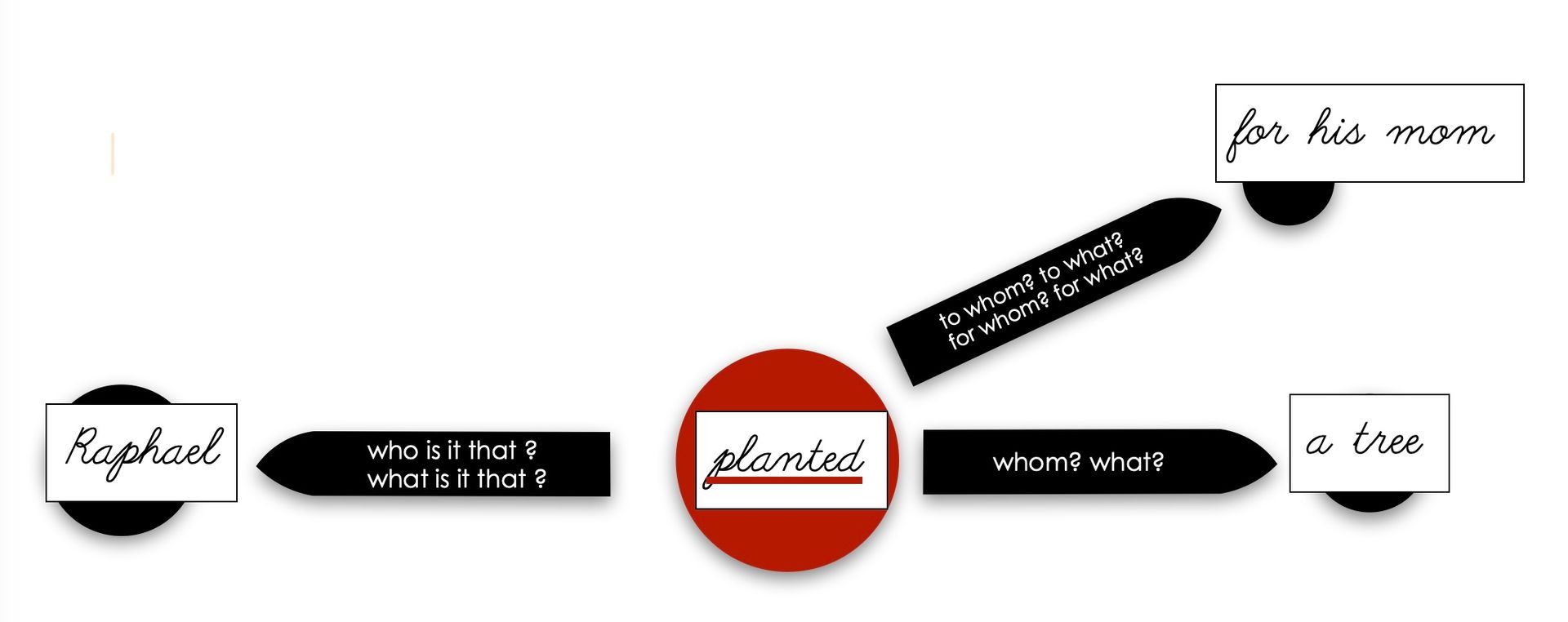
When breaking apart the parts of the sentence, children first identify what brings the sentence to life: the verb (predicate). To identify the subject of the sentence, children ask the questions from one of the arrows emanating out from the action: Who is it that? What is it? By answering those questions, the children can determine the subject.
Let’s use a very simple sentence as an example: Josie jumped. The children first identify the action: jumped. They can cut it out or tear it out to be able to place the word on the red predicate circle. Then they use the black arrows to answer the question: Who is it that jumped? Josie!


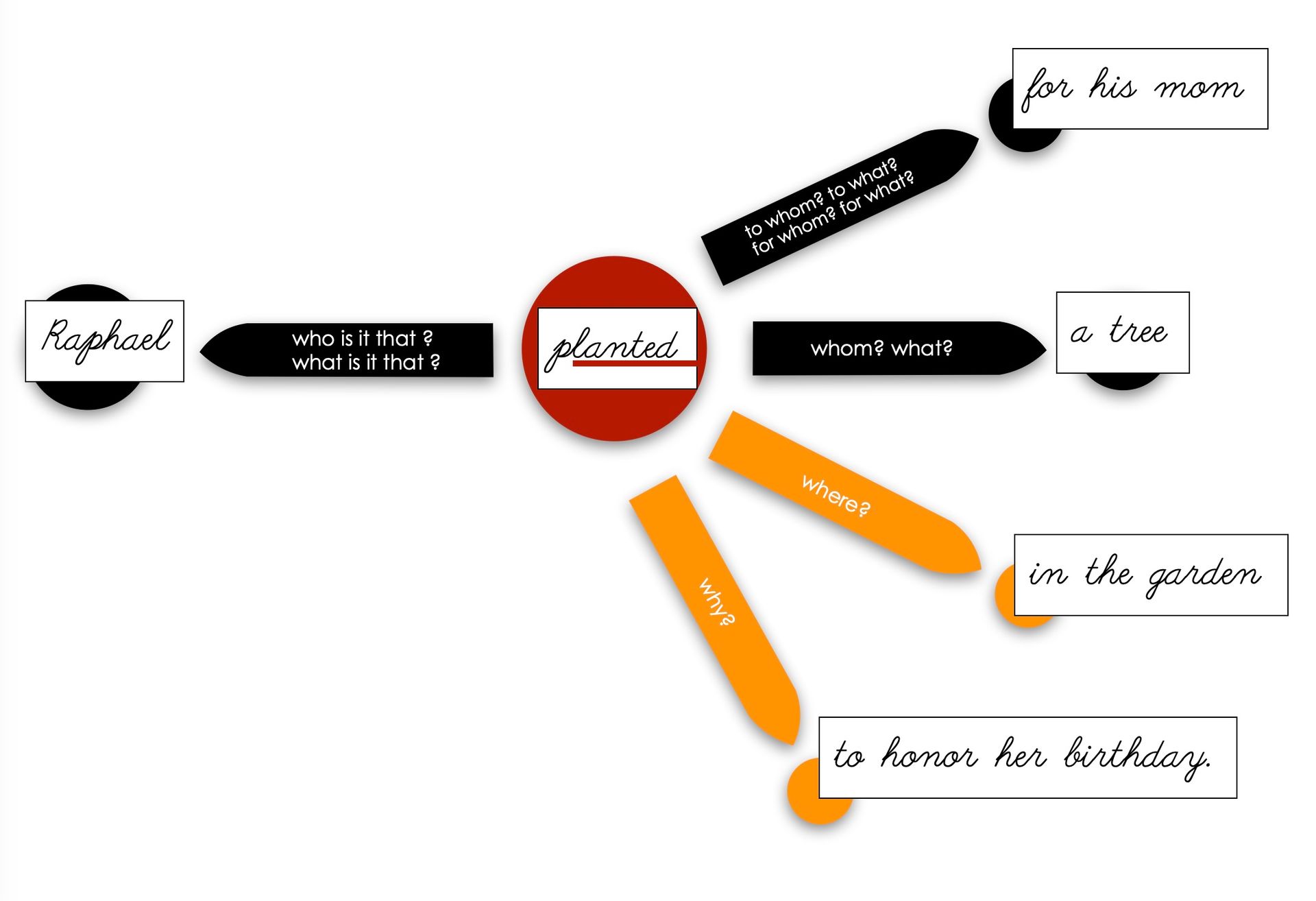
The subject emanates out from the predicate, reflecting standard English sentence structure. We then directly teach other sections of the sentence like direct and indirect objects. For example, Raphael planted a tree for his mom.
Once we introduce adverbials through additional lessons, children take off independently again to create their own. Elementary children excitedly create long sentences by answering the different questions on the arrows. We also explore attributives, compound subjects, compound predicates, and even compound direct and indirect objects.
Where Do They Go From Here?
Children can write their sentences on paper strips or long rolls of paper. The focus is not on achieving 100% correctness but on engaging in the activity and thinking critically about sentence structure.
Children love to play with sentence analysis work! They might challenge themselves to create the longest compound sentence possible, or they might try to include all the adverbial phrases in one sentence.
To deepen their understanding through repetition, children can analyze sentences from various sources: their writing, newspaper or magazines, read-aloud books, graphic novels, non-fiction texts, teacher-created sentences, and sentences from classmates. They love to create sentences for each other to analyze. Plus, student-generated sentences provide organic opportunities for individualized teaching moments.
Montessori sentence analysis serves as a gateway to advanced writing and grammar exploration. As children progress, they refine their understanding of sentence construction, enhancing both their reading comprehension and their ability to write with clarity and sophistication. Ultimately, children internalize essential rules of grammatical construction just by experimenting with creating, deconstructing, and sometimes even reconstructing sentences.
Through work and play with sentence analysis, children develop a lifelong appreciation for the structure and beauty of our language–the glamour of grammar! Current families can sign up to observe our primary and 1st-3rd grade elementary classrooms to watch children analyze sentences by clicking on the links below. It’s not your high school English class!
Primary Classrooms:
Mrs. Berdick’s Primary Classroom Observation
Ms. McClelland’s Primary Classroom Observation
Ms. Chiste’s Primary Classroom Observation
Mrs.
Rogers’s Primary Classroom Observation
1st-3rd Grade Classrooms:
Mrs. Fortun’s Lower Elementary Classroom Observation
Mrs. Mayhugh’s Lower Elementary Classroom Observation
Prospective families with toddlers and children under 4 are encouraged to sign up for a school tour to explore the advantages of our Primary Program, which lays the essential foundation for our Elementary and Adolescent Community Programs.
Open enrollment for summer and fall 2025 will be throughout April and is based on availability for eligible early childhood students. There are limited spots available for new children aged 4 and under for the upcoming summer and fall.
Individual school tours for kindergarten through 9th grade are not available, and the waitlist remains closed for the 2025-2026 School Year. The only exception is considered for students transferring from AMI-accredited Montessori schools that have maintained continuous attendance.