We view our adolescents on the road to adulthood. Physically and mentally, they are no longer children, and they are not yet adults. They are in between. As a result, adolescents are deeply interested in what adulthood means and strongly desire to figure out their part in society.
One thing everyone knows about adulthood is that adults work and pay bills. Of course, adults do much more. We have roles to play in society. We have passions. We have relationships. We have hobbies. All of which contribute to the roles we play in an economic system. Although money is involved, economics is ultimately about our web of interdependence. Every one of us depends upon the work of others.
To try to understand their future roles, adolescents observe the world and are curious about how to make their way as adults do. Although our adolescents may not outwardly show this interest, they are watching their parents. They want to be brought into side-by-side work and are keenly interested in gaining economic independence.
What is Economics (from a Montessori perspective)?
Economics is how people interact with value, and in particular the production, distribution, and consumption of services and goods. Economic independence allows individuals to make valuable contributions to society. By producing something useful and exchanging it for something else, we are connected.
In authentic adolescent Montessori communities, the curriculum includes opportunities to grow food, build useful items, and share services of their choosing. They then experience selling what they have produced, allowing them to buy other goods and services with the money they have earned. Through experiences of production and exchange, adolescents get to practice living humanity’s interdependence. They begin to develop an economic personality and a sense of self-worth and dignity.
Micro-Economies as a Form of Production and Exchange
To provide real-life learning on the road to independence, Wheaton Montessori School students develop and run micro-economies, which are small-scale businesses within the school community and beyond. Our adolescents’ curriculum includes typical academic subjects such as language arts, math, science, physical education, and art.
One of the ingenious ways Dr. Montessori engaged teens in becoming well-rounded individuals is through the development of practical life skills, often referred to as the micro-economy, which includes:
- Budgeting
- Planning
- Inventory management
- Demand forecasting
- Customer service
- Marketing and promotion
- Pricing strategies
- Order fulfillment
All of these are done while building teamwork, fostering creativity and problem-solving skills, and encouraging responsibility and accountability.
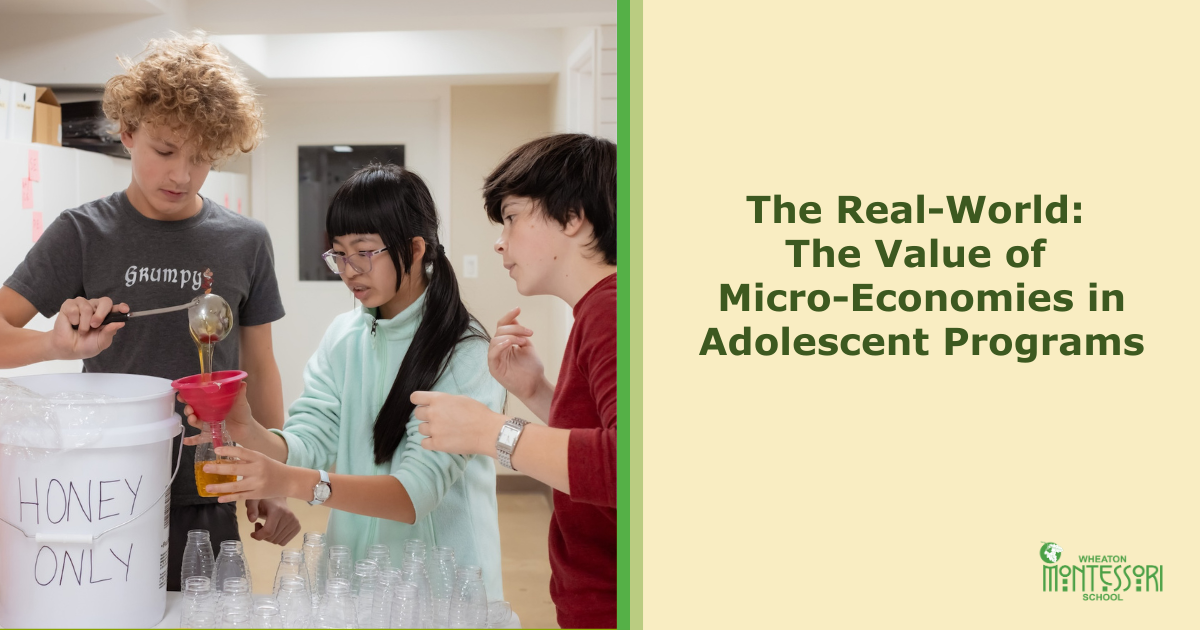
Adolescent micro-economies consist of production and exchange practices through various activities, such as operating micro-farms for produce, raising bees to sell honey, taking care of chickens and selling their eggs, crafting seasonal items or baking goods for sale, and offering childcare services like Lego League. The efforts of these adolescents serve as a microcosm of society, highlighting the importance of labor division.
Money and Morality
As a community, adolescents create rules around their micro-economies. Because adolescents have a sensitivity to justice, they are very interested in exploring money and its morality. As a result, they often grapple with questions like:
What is a fair price to charge?
Should we include our labor when pricing?
How can we do this ethically?
How should we treat our customers? Our suppliers?
How do we want to use our money to express our beliefs and values?
In understanding the role of money within their micro-economies, adolescents also engage in bookkeeping, learn to make projections, and determine the right moments to invest in community initiatives, assessing what percentage of these funds need to be retained for their microeconomy efforts.
Developing Micro-Economies
As adolescents develop their small businesses, they must also explore the scale of their production and exchange. In doing so, we help them consider if the work is immediate, proportionate, and appropriate. For example, a micro-economy should respond to the group's needs and the place. If students return to school in the fall and the gardens are full of herbs, they must figure out how to deal with the abundance of the harvest. The work also needs to fit the group of students' size and ability while being grounded in the community rather than being manufactured or artificial.
Thus, adolescents need to consider what goods and services their community needs and whether they can meet them. For example, adolescents can determine if coffee service would be a hit during morning drop-off, or if a farm stand or marketplace could offer goods that help families and their busy lives.
Long-Term Benefits
At Wheaton Montessori School, adolescents are provided with opportunities to participate in every stage of the production and exchange cycle—from creation to sale—allowing each person to discover numerous ways to engage, acquire new skills, explore their interests, and contribute to the economic well-being of their community.
In addition, through meaningful production and exchange, adolescents build empathy and a service-oriented mindset. The experience of collaboratively creating and implementing micro-economies fosters a sense of purpose and belonging. Ultimately, this work prepares our young people to become active, contributing to members of their communities.
Have you heard of the word valorization?
By supporting these activities in a morally grounded way, we help our adolescents experience valorization. The Montessori concept of valorization emphasizes self-discovery and identity development in adolescents, reflecting the importance of recognizing one's self-worth.
Adolescents realize they have something to offer and are initiated into an economic system that unites people. During this pivotal period of transitioning into adulthood, what could be more essential than recognizing that every young adult has something valuable to offer? What a remarkable way to introduce our global economic system. Is there anything more crucial than supporting each student to find their ethical standards?
It’s truly inspiring to observe how the Wheaton Montessori School Adolescent Program provides hands-on learning experiences. We invite you to schedule a tour to discover how our school equips young individuals to contribute to a brighter future, starting from the primary program through their freshman year of high school.