The Absorbent Mind: Your Young Children's Superpower
Have you ever wondered how your young child seems to learn while they play and go about their day without even trying? A bit after their first birthday, they suddenly begin speaking your language, walking, and mimicking your gestures with astonishing accuracy. Did you teach them these skills for life?
Dr. Maria Montessori described this extraordinary superpower of early learning as the Absorbent Mind, a powerful learning mechanism unique to your children in their first six years of life.
The Absorbent Mind vs. the Adult Mind
Your child's mind is fundamentally different from an adult's mind. Adults learn through conscious effort. We study, repeat, and memorize. We work harder in some areas than others, but it all requires intention.
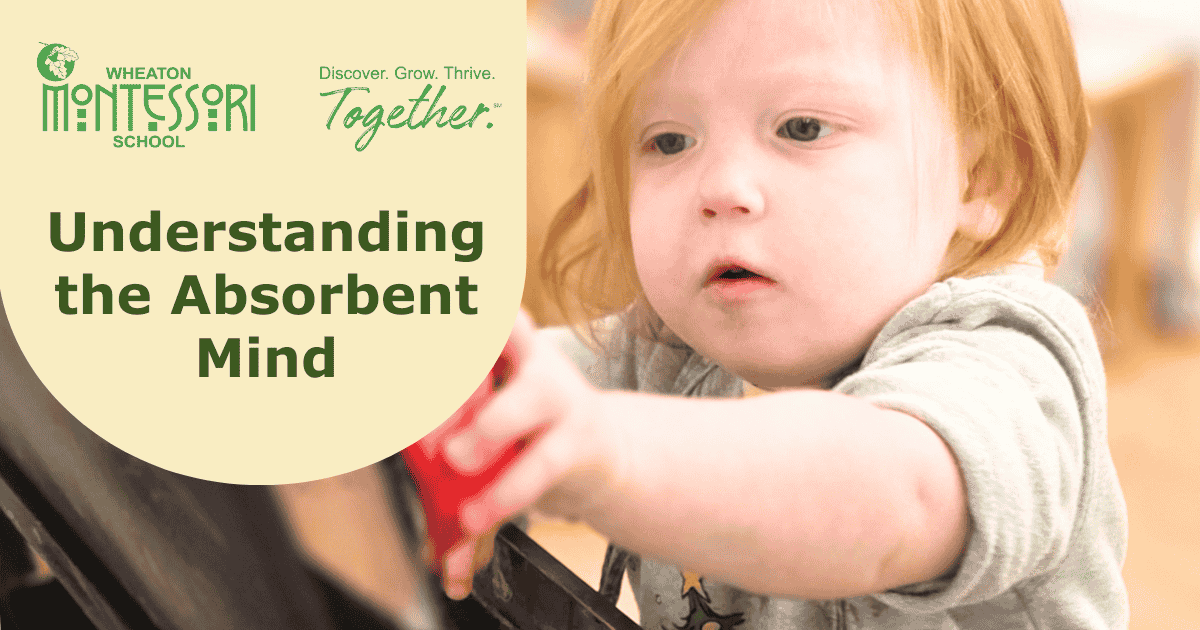
Your children, on the other hand, absorb knowledge directly into their being. They do so continuously and effortlessly as part of their growth. At Wheaton Montessori School, we call this work because your children are applying effort and purpose. Yet it comes so much faster, more thoroughly, and often looks playful. Think how hard they are working when you see their “concentration tongue”.
Your children have remarkable neural plasticity, which shapes their brains in relation to their experiences and surroundings. The young child’s mind absorbs everything, just as it is, without judgment. These impressions do not merely stay in memory; they build your child.
Dr. Montessori compared this difference beautifully:
- Your child’s mind is like a camera: taking in everything at once, ugly or beautiful, chaotic or orderly, useless or meaningful, random or intentional.
- The adult’s mind is like a painter: choosing what to notice, what to ignore, and what to remember, details and big picture, only details, focused or not.
Adults can filter. Your children cannot.
Your children take in language, tone, movement, emotion, atmosphere, and culture without discrimination. This is how they construct themselves and why you are so thoughtful about raising them. This is why our teachers label activities and play as work. Despite the Montessori myths that people say.
“Adults admire their environment, they can remember it and think about it; but your child absorbs it… The things he sees are not just remembered; they form part of his soul.”
— Dr. Maria Montessori, The Absorbent Mind