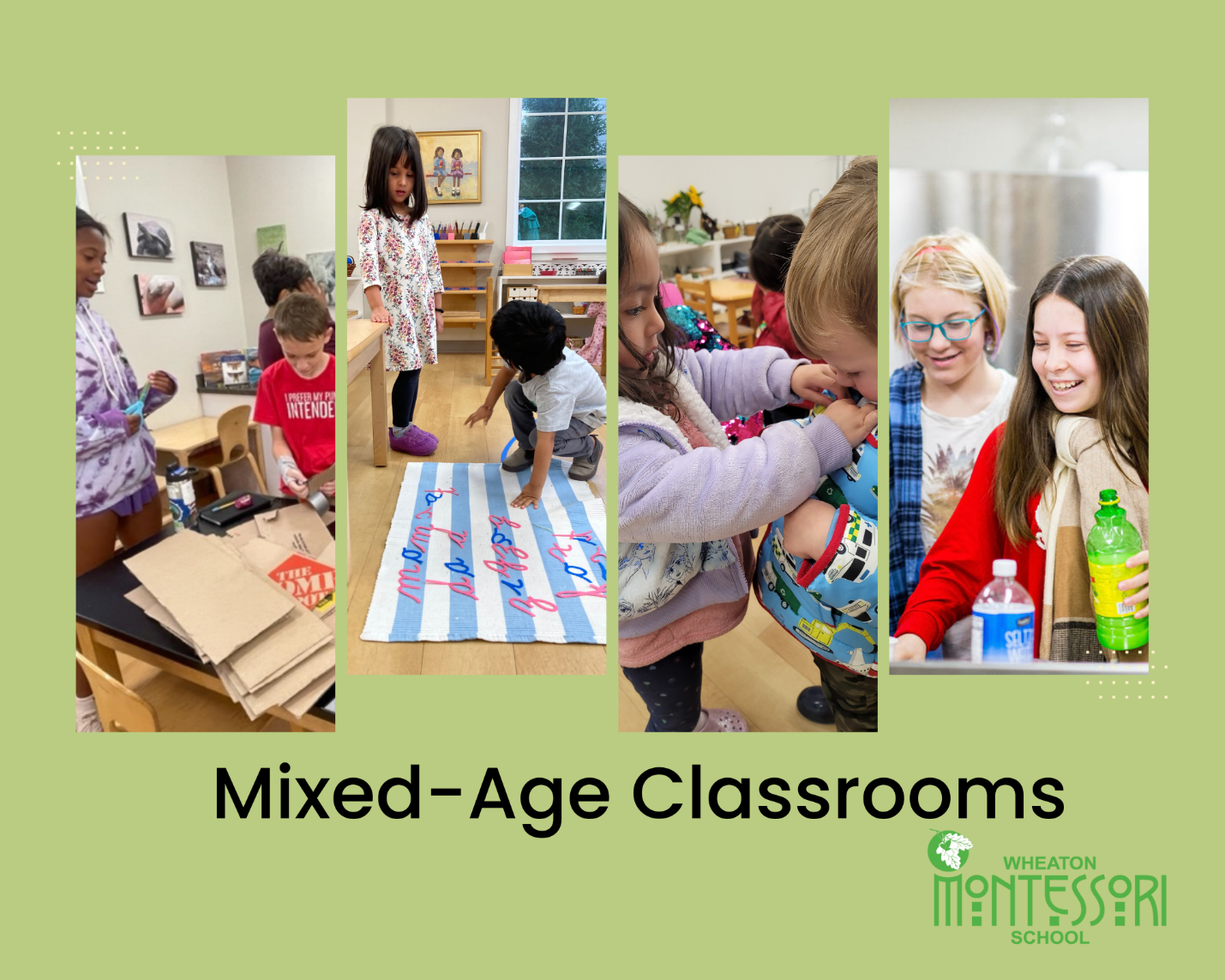
There are many elements that make Montessori education stand apart from more conventional methods. One of the most obvious is our mixed-age classrooms at all grade levels, even high school. Rather than grouping people by a single chronological age, our classroom environments are composed of people spanning across several ages.
You’ll find this method to be a huge benefit to your family.
But...why?
There are so many perks to having mixed-age classrooms. Some of the key points include:
Models and leaders
By having people of different ages together in one room, the younger people enter the environment with a variety of older people that serve as models. It is often the case that people learn best from one another, and when a 6-year-old watches an 8-year-old work, they quickly understand what is expected and what kind of work lies ahead in their future. When an older student chooses, preps, and cooks advanced meals like keema and naan, the 12 year old is inspired to challenge themselves to make Turkish pizza. Students have many opportunities to serve in leadership roles, cultivating skills that are critical as they become independent members of their communities. These older role models get to continue working at their advanced level, meeting their appropriate challenges, and reinforcing their knowledge by sharing it with others.
Skill progression fluidity
Learning is not linear, for any of us. There are periods of rapid growth, periods of steady progress, and times spent in plateau. This is normal and will vary across subject areas for individual people. This is why we don’t believe it makes sense to deliver a prescribed curriculum to all students at the same time, ultimately leaving some people bored and others struggling. Classroom work should not be dictated by a calendar and set curriculum. In our classrooms, students work and progress at their own rates and are supported to reach benchmarks and advance beyond grade level expectations based on their individual abilities.
Strong relationships
When a student is in a class for three (sometimes four for preschoolers) years, it allows the teachers to really get to know them not just as a learner, but as a person. Rather than starting from scratch each September, the student-teacher-parent team is already established and can work together on a deeper level and with greater understanding of strengths and goals than they would be able to otherwise. Consider how important this relationship is during the physical and emotional transformations of the adolescent years.
Enhanced social opportunities
Diversity is important on all levels, and that includes spending time with people of different ages, different skill types, varying abilities, a kaleidoscope of personalities, and beyond. We have so much to learn from each other, and people gain all sorts of skills from their interactions in a mixed-age classroom, like empathy, patience, and open-mindedness. The multi-age groupings at Wheaton Montessori School are determined by the developmental milestones and characteristics of childhood through young adulthood.
Reflection of real life
We would be hard-pressed to find an example outside of conventional schools in which people are sorted into one-year age groups and spend most of their day within such groups. People ultimately need to coexist with others older and younger than themselves within families, work settings, park visits, and social gatherings. Doing so makes for a more enriching environment, replete with a variety of ideas and skills. Multi-age classrooms are a much better approximation of what life is really like, and people are the beneficiaries.
What did Dr. Montessori have to say about it?
Maria Montessori had a way with words. While she was a woman of science who relied heavily on her observations, her descriptions and explanations often captured the heart of her audience. Her discussion of the multi-age classroom:
“Our schools have shown how people of different ages help one another. The younger ones watch what the older ones are doing and ask all kinds of questions, and the older ones explain. This is really useful teaching, for the way that a five-year-old interprets and explains things is so much nearer than ours to the mind of a child of three that the little one learns easily, whereas we would scarcely be able to get through to him. There is harmony and communication between them that is not possible between an adult and such a young child. There is a natural mental osmosis between them. A child of three is also quite capable of taking an interest in the work of a five-year-old, because in fact the difference in their abilities is not that great.
People are concerned about whether a child of five who is always helping other people will make sufficient progress himself…he doesn’t spend his whole time teaching, but has his own freedom and knows how to use it. Secondly, teaching really allows him to consolidate and strengthen his own knowledge, which he must analyze and use anew each time, so that he comes to see everything with greater clarity. The older child also gains from this exchange.”
How we break it down
Obviously, a Montessori school doesn’t place a 3-year-old in the same classroom as a twelve-year-old (although we do love to find opportunities for people to serve together from different periods of growth and development!). Generally speaking, the classrooms take on three-year age spans that roughly correspond with the planes of development.
- Adolescent – Our young adults are together in one community of students in 7th grade through the end of 9th grade. They earn their freshman year credits from Wheaton Montessori School.
- Elementary – We have two lower (ages 6-9) and one upper (ages 9-12) elementary environments.
- Primary/Early Childhood/Preschool & Kindergarten - We combine what others call preschool and kindergarten so that children ages 2.5-6 work and play alongside one another.
We’d love to answer your questions. Contact me, Rebecca Lingo, and if I can’t provide an answer about your specific situation, I’ll have your teacher follow up. We would love to chat with you about how Montessori serves people in a wide variety of ways.