
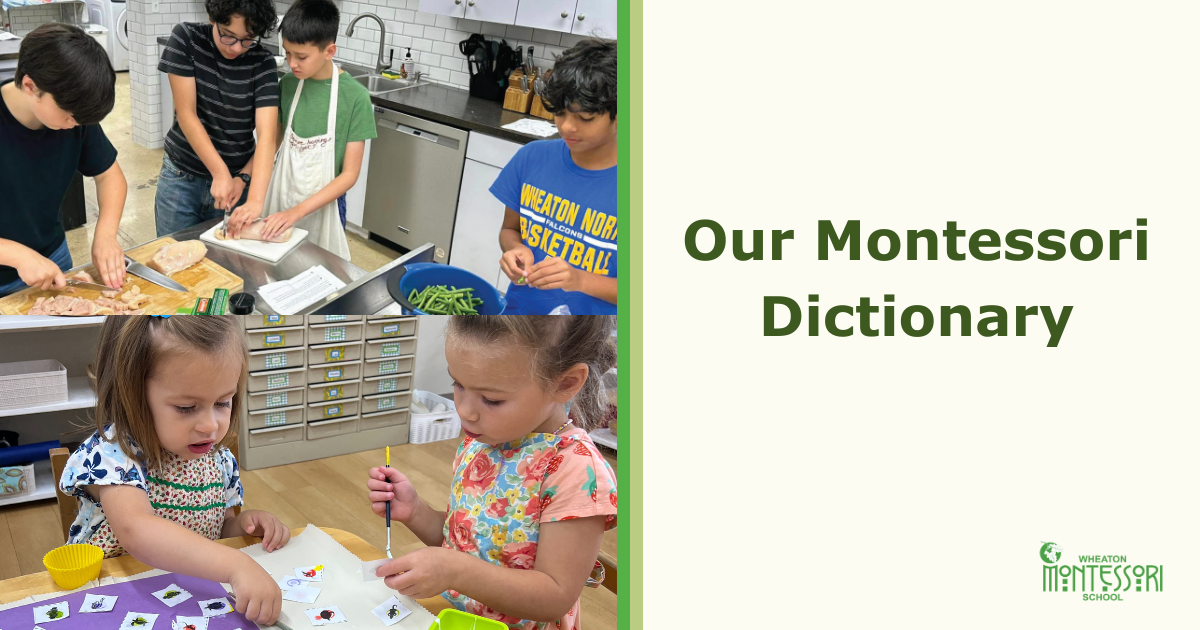
Our Montessori Dictionary
Rebecca Lingo • December 30, 2024

We recognize that Montessori education has lingo that might need a little explanation. In this dictionary post, we’re going to focus on a few terms (some familiar, some perhaps not so familiar) that apply to both the early childhood years and beyond. 


When possible, we’ve quoted from Dr. Maria Montessori, and we encourage you to look at her work. Dr. Montessori was a woman well before her time and her books, such as From Childhood to Adolescence and To Educate the Human Potential, can be a source of insight and inspiration!


Grace and Courtesy


Grace and courtesy are essential aspects of Montessori environments and support children as they develop social relationships. Grace is how we move through the space around us, and courtesy is how we treat each other. 


At Wheaton Montessori School primary classrooms, grace and courtesy are considered one of the areas of practical life. For example, adults give lessons on how to interrupt, how to accept an offering, how to offer help, or how to introduce oneself. These lessons are offered in small groups and the technique used is role-playing. Social scenarios are acted out and provide a model for behavior that is situational. Like all other learning activities, grace and courtesy lessons are practiced and repeated. They provide a respectful way of learning expectations and aiding social skills before proactively supporting each individual and the community as a whole.


Dr. Montessori reminds us of this in The Secret of Childhood: “I have come to appreciate the fact that children have a deep sense of personal dignity. Adults, as a rule, have no concept of how easily they are wounded and oppressed.” We offer grace and courtesy lessons, give children a safe place to practice, and a community of models, and all students will eventually perform these skills independently. 


Human Tendencies


Human tendencies are unconscious, universal drives that support our adaptation to our time and place. All humans are born with innate needs and drives and are wired to adapt to their environment. The human tendencies – to orient, explore, order, abstract, imagine, calculate, work, be exact and repeat, perfect oneself, and communicate and associate with others – help aid this adaptation.  


Dr. Montessori alluded to human tendencies when she wrote about the inner drive she observed in children and how this drive helps individuals construct themselves to develop into maturity: “Their behavior led us to become aware of a fundamental truth, namely that the child works for his inner development and not to reach an exterior aim and that when he has done this work he has not developed a special ability but he has developed something in himself.” 


Prepared Environment


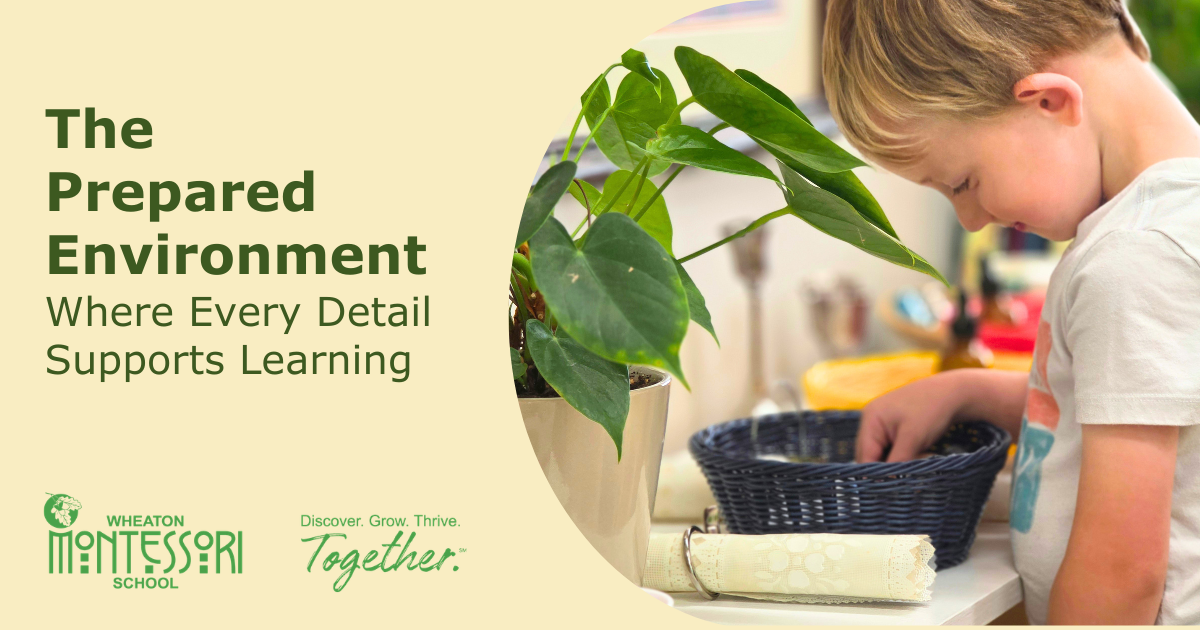
The Montessori environment is carefully prepared so that children can satisfy their human tendencies and thus develop to their fullest potential. The prepared environment takes into consideration what children need at their particular stage of growth, and as individuals on their own trajectory of development. The prepared environment consists of the physical and psychic aspects of the environment, of which the adult is a key part. 


Through interactions in a prepared environment, children can construct who they are as human beings. As they go through this process of self-construction in their environment, children learn, grow, adapt, and create. The prepared environment is part of the triad of the child, the beautiful and complete environment, and the professionally trained adult, all of which are interconnected components. 


Sensitive Periods/Sensitivities


Dr. Montessori was first and foremost a scientist. She was interested in what was happening prior to observable signs of human development. She was curious about what was going on in the mind before the skill manifested itself. For example, she wanted to know what was happening during the many months prior to children speaking their first word. 


Without the high-tech tools that neuropsychologists and psychologists now have to measure brain activity, Dr. Montessori had to rely upon observation. She watched children, took notes, and made charts about what they did. As a result, she discovered that a particular object or aspect of the environment would have an irresistible draw for children. This attraction would last for some time. Children would keep going back to the same activity or element of the environment and would be continually drawn to it. Then the day would come when it held no more interest and something new would be attractive. 


Dr. Montessori observed this phenomenon over and over again, which led her to believe that there must be something innate in children that was driving this interest. Building upon the work of biologists, Dr. Montessori adopted the term, sensitive period, to describe transitory periods of psychic development. Beyond the Montessori world, sensitive periods are now referred to as critical periods or windows of opportunity. 


What does Wheaton Montessori School look like focusing first on grace and courtesy, human tendencies, a prepared environment, and sensitive periods? 


Current families with children of all ages and prospective families with children under 4.5 years of age are invited to attend our Open House on January 16, 2025, at 6:00 p.m. This event will offer comprehensive insights into our school, highlighting the benefits of completing our Primary, Elementary, and Adolescent Community programs, as well as providing a chance to interact with our dedicated teachers.


Current parents are also welcome to schedule a level-up observation to see what your next step is in our partnership.


In addition, prospective families, with young children can schedule a preschool tour and discover how from ages preschool to 9th grade engage in a lifelong journey of learning and discovery. Our waitlist is closed for students in kindergarten through 9th grade for prospective families unless your child is transferring from an AMI Montessori school with continuous Montessori experience.
Materials Spotlight: Sandpaper Letters & Moveable Alphabet
By Rebecca Lingo February 9, 2026
Unlocking Literacy the Montessori Way At Wheaton Montessori School, Montessori literacy materials like Sandpaper Letters and the Moveable Alphabet provide hands-on experiences that connect sounds, symbols, and meaning, building the foundation for confident reading and writing. These materials help children translate the words they hear into the symbols they see, developing strong neural pathways for literacy while fostering independence and a love of language. In this blog, we explore how Sandpaper Letters and the Moveable Alphabet guide children from sound awareness to word building, creating a joyful approach to early literacy. Sandpaper Letters The Sandpaper Letters incorporate decades of insight into how children truly learn to read and write. Sandpaper Letters embody the Science of Reading—connecting sound, symbol, and meaning through hands-on learning and building strong neural pathways for literacy. These timeless Montessori principles continue to align beautifully with what modern science confirms about how your child’s brain learns best. Moveable Alphabet Before handwriting comes word building! The Moveable Alphabet lets your children ‘write’ their thoughts with letters long before they can hold a pencil—bridging the gap between spoken and written language. With literacy materials like the Moveable Alphabet, children communicate their thoughts by building words with cut-out letters—translating the sounds they hear into symbols they can see. This powerful step develops the foundation for reading and writing, helping children understand that words are made of sounds and that sounds can be represented with letters. Because our teachers base every lesson on development, writing comes first—because it’s easier to build words from sounds than to read or decode someone else's written thoughts. Our literacy approach at Wheaton Montessori School is designed to meet each child where they are, providing hands-on experiences that foster confidence, independence, and a lifelong love of reading and writing. From Sandpaper Letters to the Moveable Alphabet, every tool and lesson helps children connect sounds to symbols, build words, and discover the joy of language.
How Geometry Got Its Name
By Rebecca Lingo February 2, 2026
In Wheaton Montessori School classrooms, we like to introduce big ideas with big stories. We offer children a sense of wonder first, sort of like an imaginative doorway, so that when they later study formulas, theorems, and proofs, they already feel connected to the human story behind them. One of these stories is The Story of How Geometry Got Its Name, an introduction to a subject that is far older than the textbooks and protractors we encounter today. In Montessori, Geometry is more than about shapes. It is about human beings solving real problems in the real world. A Problem as Old as Civilization To reintroduce geometry, we time-travel back around 5,000 years to the ancient civilization of Egypt. This was a land shaped by the Nile River, the longest river in the world. Each year, the Nile flooded its banks as snowmelt poured down from the mountains far to the south. The Egyptians depended on this yearly flood as it left behind rich, dark silt that nourished their crops and made life possible in an otherwise harsh desert. But the flood created a challenge, too. It washed away the boundary markers that separated one farmer’s field from another. When the waters receded, no one could quite remember where their land began and ended. Arguments ensued. “This corner is mine!” And the fields needed to be measured and marked again. The First Geometers: The Rope Stretchers To solve this annual problem, the Egyptians relied on a special group of skilled workers called the Harpedonaptai, or Rope Stretchers. These were early land surveyors who used a knotted rope tied at regular intervals and three weights to create a very particular triangle. In our elementary classrooms, we invite a few children to hold a prepared rope at its large knots, forming that same triangle. As they stretch it out and lay it on the ground, many quickly recognize what the Egyptians had unknowingly created: a scalene right-angled triangle. This shape would later become central to the geometry studied by Greek mathematicians. The Harpedonaptai used this simple tool to re-establish field boundaries, set right angles, and make sure the land was measured accurately and fairly. Geometry, in its earliest form, served a deeply practical purpose. From Rope to Pyramid The Harpedonaptai’s expertise was valued far beyond the farmlands. They also helped lay out the foundations of temples, monuments, and even the Great Pyramid of Giza. The base of the Great Pyramid is a perfect square, which is an astonishing feat of measurement and design. The Pharaoh himself oversaw these measurements, but it was the Rope Stretchers who executed them. Their work represents one of humanity’s earliest recorded sciences: the careful measuring of the earth. How Geometry Got Its Name The name geometry reflects this ancient practice. It comes from two Greek words: gê — earth metron — measure Geometry literally means earth measurement. The Egyptians did not use the language of right angles, nor did they classify triangles as we do today. Their work was grounded in practical needs. They needed to solve problems, organize land, and create structures that would endure for thousands of years. Yet their discoveries influenced later thinkers like Pythagoras, who likely traveled to Egypt and learned from their methods. Over time, the simple knotted rope inspired a whole discipline devoted to understanding lines, angles, shapes, and the relationships between them. Why We Tell This Story in Montessori When Montessori children hear this story, something important happens. Geometry becomes more than a set of rules or vocabulary words. It becomes a human endeavor born from curiosity, necessity, and ingenuity. The heart of Montessori education at Wheaton Montessori School is to help children view knowledge not as isolated subjects, but as valuable gifts passed down from earlier generations. When children pick up a ruler, explore angles with a protractor, or classify triangles in the classroom, they are continuing a legacy that began with those early Rope Stretchers, the Harpedonaptai on the banks of the Nile. Through story, students feel connected to the people who shaped our world and to the problems that inspired great ideas. Geometry becomes meaningful, purposeful, and alive, from our preschoolers working with the Geometry Cabinet , to elementary students classifying and measuring angles or using hands-on Pythagorean Theory materials, and all the way through our adolescents. At the adolescent level, geometry moves fully into the real world. Students apply measurement, angles, area, scale, and spatial reasoning through meaningful work across campus, including: Measuring and mapping land for the campus’s Wetland Conservation Area, as well as calculating classroom square footage for recognition and accreditation applications Understanding and applying area, perimeter, scale, and proportion when working with acreage, restoration plans, and campus layouts Designing and situating functional structures such as chicken coops using geometric principles Applying angle classification, measurement, and spatial reasoning through woodworking Using geometry to cut, join, and build accurately, including raised beds, greenhouses, and beehive insulation boxes