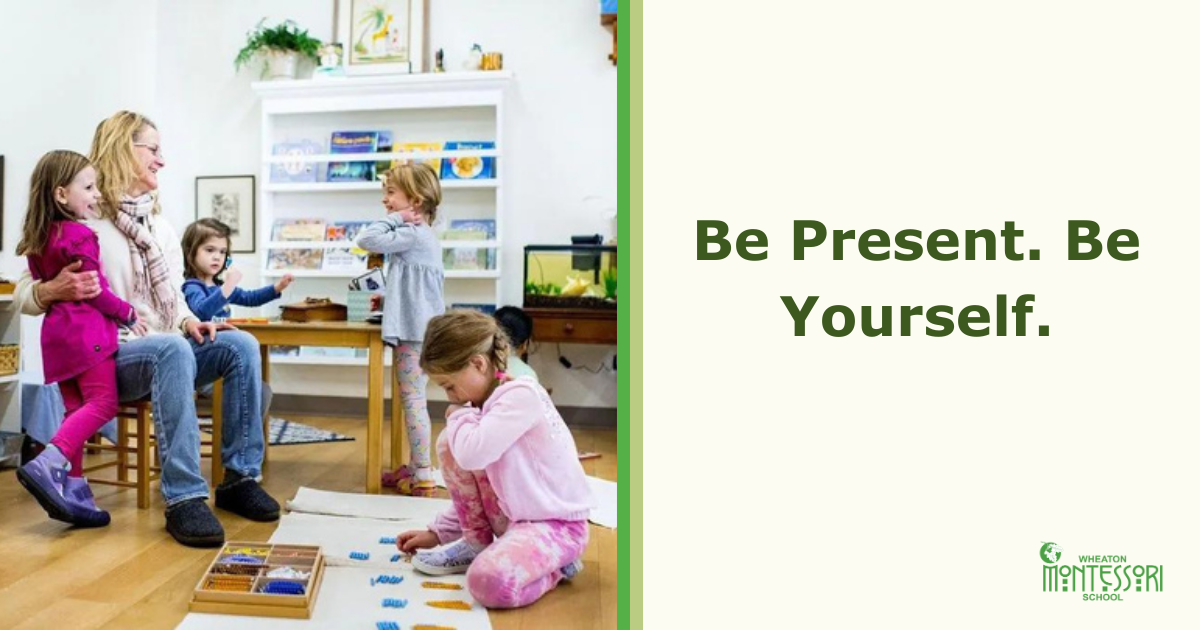
Be Present Be Yourself
Jennifer Rogers • December 23, 2024

Pause beside a busy playground on a sunny afternoon and listen. “Look at me!” children almost always shout to their parents as they swing, climb, slide, and hang from monkey bars. For kids, knowing a parent is watching is affirming, uplifting, and restorative.  


Observation is the foundation of Maria Montessori’s educational method, an essential habit of good teachers and parents. Observation is Montessori’s word for the art of watching and listening with informed intelligence and an enduring investment in the health of a child. She expected adults who worked with children to watch and listen with the intention of aiding the development of children, and the expectation that we too would be transformed by our observations.


Simone Weil described attention as a rare and pure form of generosity. Weil was a mystic and a philosopher, a person now celebrated as one of the great spirits of her time. Writing at the same time as Montessori, she also worked toward a vision of peace. Weil’s writing makes the human aspiration to build a better world seem deceptively simple. For Weil and Montessori, paying attention is a deliberate, simple practice, but also a form of transcendence, a quiet but active prayer for the betterment of the human race.


Weil and Montessori were social activists. They lived in a war-torn world, and were primarily concerned with shattered lives, impoverished families and neglected children. Weil died too young, and was not herself a mother. Montessori was a refugee; her only son did not live with her until he was a teen. Nonetheless, Weil and Montessori shared a determination to be fully present at a particular moment in human history. The attention they gave to the people around them remains the strongest, surest example for parents working to guide their children toward lives of health, purpose, and peace.


Attention  


Being an eyewitness to every milestone of childhood, every trip to the playground, every recital and performance, is not a goal . . .should not be a goal. Some of the first joys of childhood are conversational moments when kids get to describe events their parents did not see. A young child’s dramatic re-telling of her day often has a flimsy relationship with truth, but there is no doubt that kids are enthusiastic storytellers.  


Parents can learn, usually sluggishly, how to listen to a good story without interrupting or stumbling into worry, conflict resolution, or unnecessary analysis. A child’s story will probably be both true and imagined, frustrating and funny. Having a parent fully present, attentive, and engaged is often all that a child needs to feel confident and renewed. 


Two routine events in the life of a young child should whenever possible include a parent’s full, undistracted attention: meals and reading. There are as many ways to be a good parent as there are varieties of good people who love well, but reading to children and eating with children always provides a sure, solid foundation for growth and learning. Presence and attention offered at meals and by reading aloud are, magically, often more than enough for a young child to thrive. Paying attention routinely is, in Weil’s words, generous. To a young child, predictable, personal attention with a parent, a meal, or a book, feels like a gift.


Presence


It is absolutely certain that the secret of future human power lies hidden within humanity as it develops –within young people.

—Maria Montessori, Education and Peace


Montessori’s greatest contribution was not the development of an educational curriculum, though Montessori classrooms are world-renowned. Montessori’s significant and lasting insight was that for children to thrive, parents and teachers must observe.


Parents’ consistent presence and attention does not guarantee our children will grow up to be “just like” us. There is a limited sense in which a parent’s modeling a particular set of values and morals is of lasting value to a child. There is a much deeper, stronger sense in which a fully integrated parent’s ability to be present and attentive nudges a child toward her own unique health and confidence. The difference is huge: instead of imitating, or seeking attention to affirm her sense of self, a child learns to look within.  


A child raised with presence and attention can make mistakes, behave in ways he knows will not be tolerated, change his mind about the role he wants to play in his expanding world, always knowing he will still be loved.


Parenting is never as simple as we’d like it to be, but good parenting happens only when we act in accordance with our beliefs. The best parenting happens when a parent can be fully, wholeheartedly present to meet the needs of a child at particular moments in time, knowing the moment will pass, and that children’s needs change as they grow. Our ability to understand and respond appropriately to a child today may not be the same tomorrow. That is why Montessori insisted on observation. Children grow toward strength and peace within when the people who love them are both present and paying attention.


For those of you who have raised your children with Jennifer as a teacher, visit her during the Open House on January 16 at 6:00 p.m.  


For those of you looking for your next educational environment, we look forward to meeting you during the Open House.


Bio:

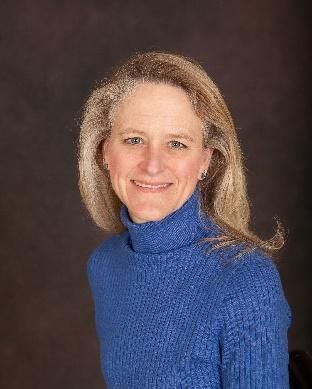
Jennifer Rogers

Mrs. Rogers has been a Montessori teacher for almost 25 years.  She is a primary teacher at Wheaton Montessori School in Chicago’s western suburbs.  Mrs. Rogers has a bachelor’s degree in religious studies and English from Albion College and a master’s degree in theological studies from Candler Seminary at Emory University. She completed AMI primary training in Atlanta, AMI assistants to infancy in Denver, and the AMI Montessori Orientation to Adolescent Studies.  She has also completed the comprehensive and advanced continuum Orton Gillingham training.  In her time away from school Jennifer enjoys baking bread, reading, yoga, and writing.  She also enjoys camping and hiking with her family. When she grows up, she wants to be a Montessori grandma.
Materials Spotlight: Sandpaper Letters & Moveable Alphabet
By Rebecca Lingo February 9, 2026
Unlocking Literacy the Montessori Way At Wheaton Montessori School, Montessori literacy materials like Sandpaper Letters and the Moveable Alphabet provide hands-on experiences that connect sounds, symbols, and meaning, building the foundation for confident reading and writing. These materials help children translate the words they hear into the symbols they see, developing strong neural pathways for literacy while fostering independence and a love of language. In this blog, we explore how Sandpaper Letters and the Moveable Alphabet guide children from sound awareness to word building, creating a joyful approach to early literacy. Sandpaper Letters The Sandpaper Letters incorporate decades of insight into how children truly learn to read and write. Sandpaper Letters embody the Science of Reading—connecting sound, symbol, and meaning through hands-on learning and building strong neural pathways for literacy. These timeless Montessori principles continue to align beautifully with what modern science confirms about how your child’s brain learns best. Moveable Alphabet Before handwriting comes word building! The Moveable Alphabet lets your children ‘write’ their thoughts with letters long before they can hold a pencil—bridging the gap between spoken and written language. With literacy materials like the Moveable Alphabet, children communicate their thoughts by building words with cut-out letters—translating the sounds they hear into symbols they can see. This powerful step develops the foundation for reading and writing, helping children understand that words are made of sounds and that sounds can be represented with letters. Because our teachers base every lesson on development, writing comes first—because it’s easier to build words from sounds than to read or decode someone else's written thoughts. Our literacy approach at Wheaton Montessori School is designed to meet each child where they are, providing hands-on experiences that foster confidence, independence, and a lifelong love of reading and writing. From Sandpaper Letters to the Moveable Alphabet, every tool and lesson helps children connect sounds to symbols, build words, and discover the joy of language.
How Geometry Got Its Name
By Rebecca Lingo February 2, 2026
In Wheaton Montessori School classrooms, we like to introduce big ideas with big stories. We offer children a sense of wonder first, sort of like an imaginative doorway, so that when they later study formulas, theorems, and proofs, they already feel connected to the human story behind them. One of these stories is The Story of How Geometry Got Its Name, an introduction to a subject that is far older than the textbooks and protractors we encounter today. In Montessori, Geometry is more than about shapes. It is about human beings solving real problems in the real world. A Problem as Old as Civilization To reintroduce geometry, we time-travel back around 5,000 years to the ancient civilization of Egypt. This was a land shaped by the Nile River, the longest river in the world. Each year, the Nile flooded its banks as snowmelt poured down from the mountains far to the south. The Egyptians depended on this yearly flood as it left behind rich, dark silt that nourished their crops and made life possible in an otherwise harsh desert. But the flood created a challenge, too. It washed away the boundary markers that separated one farmer’s field from another. When the waters receded, no one could quite remember where their land began and ended. Arguments ensued. “This corner is mine!” And the fields needed to be measured and marked again. The First Geometers: The Rope Stretchers To solve this annual problem, the Egyptians relied on a special group of skilled workers called the Harpedonaptai, or Rope Stretchers. These were early land surveyors who used a knotted rope tied at regular intervals and three weights to create a very particular triangle. In our elementary classrooms, we invite a few children to hold a prepared rope at its large knots, forming that same triangle. As they stretch it out and lay it on the ground, many quickly recognize what the Egyptians had unknowingly created: a scalene right-angled triangle. This shape would later become central to the geometry studied by Greek mathematicians. The Harpedonaptai used this simple tool to re-establish field boundaries, set right angles, and make sure the land was measured accurately and fairly. Geometry, in its earliest form, served a deeply practical purpose. From Rope to Pyramid The Harpedonaptai’s expertise was valued far beyond the farmlands. They also helped lay out the foundations of temples, monuments, and even the Great Pyramid of Giza. The base of the Great Pyramid is a perfect square, which is an astonishing feat of measurement and design. The Pharaoh himself oversaw these measurements, but it was the Rope Stretchers who executed them. Their work represents one of humanity’s earliest recorded sciences: the careful measuring of the earth. How Geometry Got Its Name The name geometry reflects this ancient practice. It comes from two Greek words: gê — earth metron — measure Geometry literally means earth measurement. The Egyptians did not use the language of right angles, nor did they classify triangles as we do today. Their work was grounded in practical needs. They needed to solve problems, organize land, and create structures that would endure for thousands of years. Yet their discoveries influenced later thinkers like Pythagoras, who likely traveled to Egypt and learned from their methods. Over time, the simple knotted rope inspired a whole discipline devoted to understanding lines, angles, shapes, and the relationships between them. Why We Tell This Story in Montessori When Montessori children hear this story, something important happens. Geometry becomes more than a set of rules or vocabulary words. It becomes a human endeavor born from curiosity, necessity, and ingenuity. The heart of Montessori education at Wheaton Montessori School is to help children view knowledge not as isolated subjects, but as valuable gifts passed down from earlier generations. When children pick up a ruler, explore angles with a protractor, or classify triangles in the classroom, they are continuing a legacy that began with those early Rope Stretchers, the Harpedonaptai on the banks of the Nile. Through story, students feel connected to the people who shaped our world and to the problems that inspired great ideas. Geometry becomes meaningful, purposeful, and alive, from our preschoolers working with the Geometry Cabinet , to elementary students classifying and measuring angles or using hands-on Pythagorean Theory materials, and all the way through our adolescents. At the adolescent level, geometry moves fully into the real world. Students apply measurement, angles, area, scale, and spatial reasoning through meaningful work across campus, including: Measuring and mapping land for the campus’s Wetland Conservation Area, as well as calculating classroom square footage for recognition and accreditation applications Understanding and applying area, perimeter, scale, and proportion when working with acreage, restoration plans, and campus layouts Designing and situating functional structures such as chicken coops using geometric principles Applying angle classification, measurement, and spatial reasoning through woodworking Using geometry to cut, join, and build accurately, including raised beds, greenhouses, and beehive insulation boxes