In this four-part series, we will explore the four stages of development: Infancy (birth to age 6), Childhood (ages 6 to 12), Adolescence (ages 12 to 18), and Maturity (ages 18 to 24). By understanding these developmental stages, we can better assist young people in becoming capable, independent, and fulfilled individuals. This blog will cover the Infancy and early childhood stages of development.
At Wheaton Montessori School, education goes beyond learning lessons; it is an exploration that respects and nurtures each child's unique growth stage. We see children as individuals embarking on a lifelong journey of self-discovery.
From the moment of birth, children are driven by powerful internal forces that guide their growth and help them adapt to their unique time, place, and culture. This remarkable ability to evolve and adapt is a defining trait of humans.
Our approach to education is built upon this profound understanding of human development and is aligned with the developmental science of how children learn naturally. Dr. Maria Montessori dedicated her life's work to researching how children grow and change over time, identifying key developmental stages that shape their path to maturity. Through her scientific observations, she identified four distinct planes of development, each with its unique characteristics and needs.
Infancy (birth to age 6)
The first plane of development is an extraordinary period of psychological and physical growth. Newborns enter the world entirely dependent, unable to move or communicate. Yet, within just six years, they are walking, talking, and asserting their independence with intellect and will.
Characteristics of the First 6 Years
During this transformative stage, children require ample sleep to support their rapid development. When they are awake, their curiosity knows no bounds. They explore their surroundings with boundless energy, using their senses to touch, smell, taste, hear, and examine everything in their environment.
Conquest of Independence
One of the primary goals during this stage is achieving functional independence. Children are eager to take care of their own needs and are naturally inclined to observe and imitate the actions of adults. The mantra of children at this stage is: “Help me do it myself!”
Sensitive Periods
Children in the first plane experience sensitive periods—windows of opportunity when they are uniquely receptive to acquiring essential skills.
Movement: Young children need movement to develop brain-body integration.
Order: They crave order to make sense of their surroundings, learning what happens and how objects are used.
Language Acquisition: This is a critical period for language development, during which children absorb words and speech patterns effortlessly.
These sensitivities drive children’s development, shaping their understanding of the world.
Observable Milestones
One of the most profound achievements in this phase is the acquisition of spoken language. Talking to newborns, for example, stimulates vocal cord development, and astonishingly, their vocal cords vibrate when adults speak to them. From being essentially mute at birth, toddlers can have a vocabulary of around 200 words by age two and an impressive 10,000 words by the end of this phase. It is essential to provide a language-rich environment during these formative years.
Physically, this period is one of monumental growth. Children progress from being immobile to sitting, crawling, walking, speaking, and independently eating. As adults, we must be mindful of support rather than hindering this development. We want to offer assistance rather than limit opportunities for our children!
Ages 0 to 3 and Ages 3 to 6
Ages 0 to 3: During this phase, children absorb the world around them and do so without any filters. It’s important during this time that adults respect children’s natural developmental path.
Ages 3 to 6: During these years, children become more aware of their actions and motivations. This is when we see the emergence of children’s willpower and the powerful drive to classify and understand their environment. Children become more conscious learners.
As they grow, children naturally identify patterns, similarities, and differences based on their experiences. They construct their understanding of the world, and active experiences in their environment play a crucial role in shaping their cognitive development.
Social Development Ages 0-6
Babies form strong bonds with their primary caregivers and family, finding comfort in a small social circle. They prefer solitary exploration and engage in parallel play.
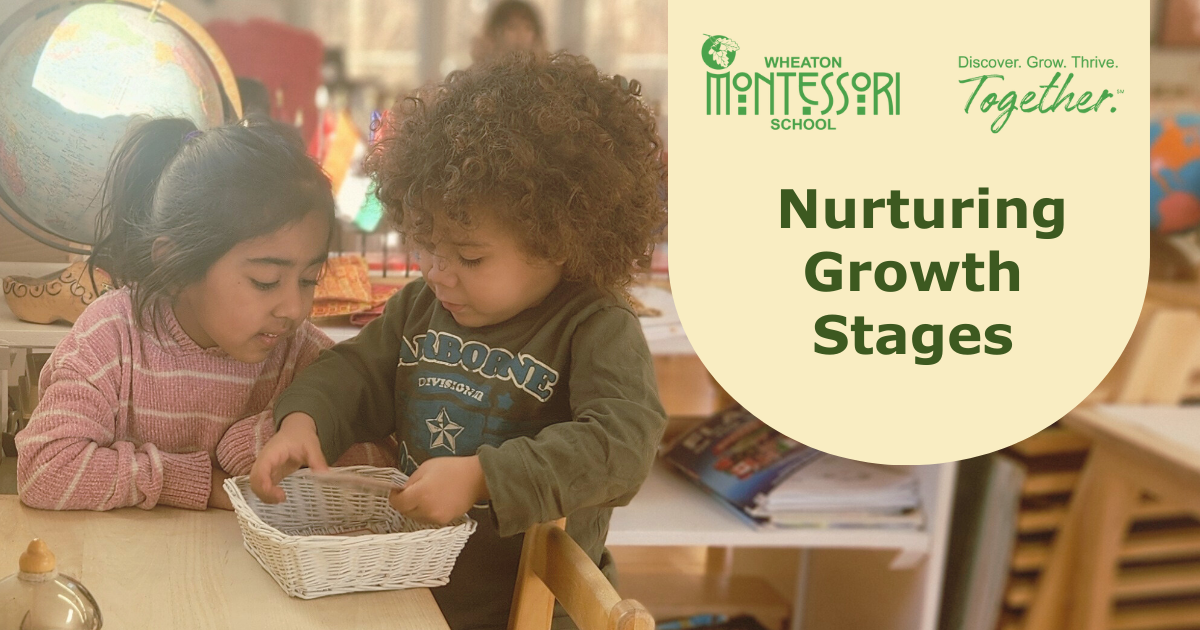
Toddlers begin to seek broader social experiences beyond their families. They need opportunities to interact with peers and engage in community life, which helps foster their independence and social development. This is where Wheaton Montessori School plays a vital role. In our multi-age classrooms, our Primary Program (2.5-6 years) adapts to support the evolving needs of children at this phase of growth. The program provides a harmonious and peaceful environment where the curriculum focuses on the individual needs of the child, fostering self-esteem, inner discipline, and a passion for lifelong learning.
The teachers prepare and present lessons that enhance understanding through real, meaningful, and purposeful activities, all within a nurturing environment.
Wheaton Montessori School’s Nurturing Environment Includes:
Freedom to Explore: Children are inspired to safely explore and repeat work as often as necessary for mastery. Learning in the multi-age classrooms is coupled with daily outdoor recess throughout the year, laying the groundwork for healthy and active lives.
Language Exposure: A rich linguistic environment that helps children build vocabulary and develop confidence in self-expression.
Participation in Daily Life: Involvement in practical life activities helps children develop independence and a sense of belonging.
Cultural Experiences: Exposure to family traditions, rituals, and cultural practices helps children adapt to their culture and understand their place within it.
As children grow during this stage of life, they gain valuable lessons about cooperation, sharing, and responsibility by being a part of a supportive community. We foster environments that nurture children’s growth, independence, and exploration.
We invite you to visit our school to see how our community meets the needs of our youngest children, where growth is not just a goal but a foundational principle.
We invite current families to schedule their Primary Classroom Observation by clicking on the links below.
Mrs. Berdick’s Primary Classroom Observation
Ms. McClelland’s Primary Classroom Observation
Ms. Chiste’s Primary Classroom Observation
Mrs. Rogers’s Primary Classroom Observation
Prospective families with toddlers and children under 4 are encouraged to sign up for a school tour to explore the advantages of our Primary Program, which lays the essential foundation for our Elementary and Adolescent Community Programs. Priority enrollment will be granted to those who enroll before March 15.
Our waitlist for kindergarten-9th grade for Fall 2025 is currently closed. Please check back in April to see if the waitlist is open then. Individual tours will only be offered for kindergarten through 9th grade if the waitlist is open. New student transfers to our elementary and adolescent programs must be from a Montessori school.