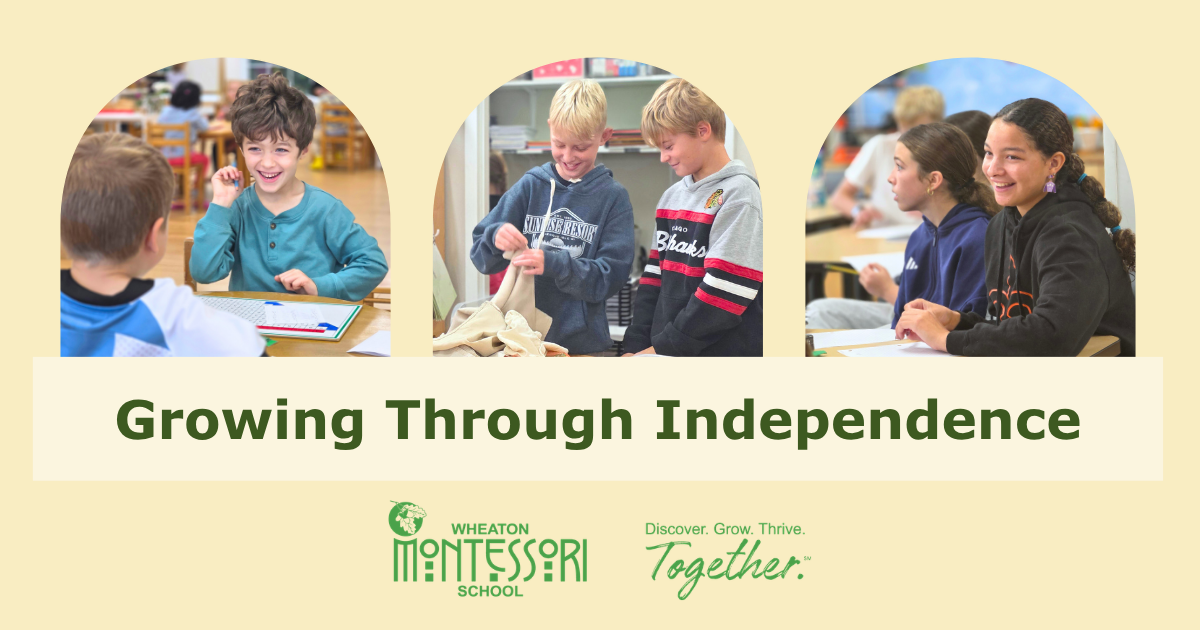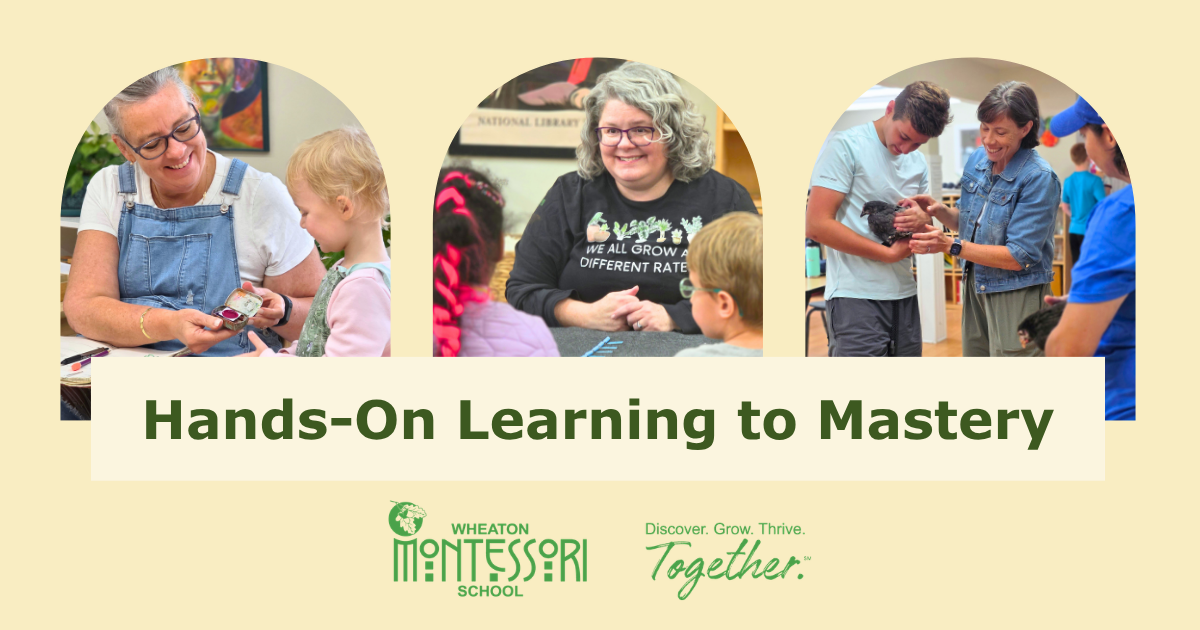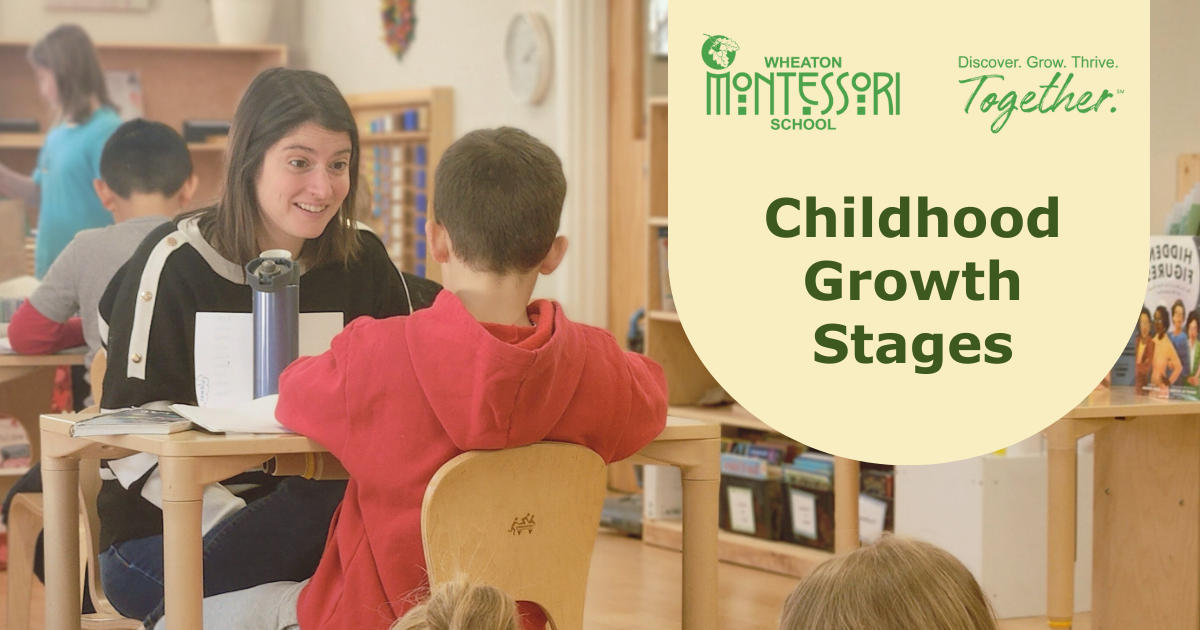
Understanding human development at each stage fosters optimal growth. This belief forms the foundation of Montessori education, which is deeply rooted in the developmental needs of children. Each stage of development has unique needs and capacities, and our teachers’ extensive knowledge empowers us to provide optimal education for students at every learning stage at Wheaton Montessori School.
This blog is the second of a four-part series exploring the stages of development: Infancy (birth to age 6), Childhood (ages 6 to 12), Adolescence (ages 12 to 18), and Maturity (ages 18 to 24). This blog will cover the Childhood stage of development.
Childhood (ages 6-12) Characteristics
At the core of this stage are several observable characteristics.
Physical Sturdiness and Stability
Children in this stage experience a steady period of physical growth. They lose their primary teeth and gain adult teeth. Their skin loses its baby softness. Their hair even gets coarser and darker. Their body becomes leaner and stronger, with the soft, rounded contours of early childhood giving way to a more defined physical form. Despite these changes, growth slows down compared to the rapid pace of the first plane. This time also brings greater stability in health and coordination.
Reasoning and Abstraction
While young children under 6 years of age absorb information effortlessly and even unconsciously, the elementary age is marked by a growing capacity for reason and abstraction. No longer content with simply being told facts, children seek to understand the underlying causes of things. They ask “why” questions and develop the ability to think logically and critically about the world around them. Their imagination flourishes and they love being able to transcend time and space, mentally traveling through history or exploring possible futures.
Intellectual Capacities
This is a time when children use their minds to become intellectual explorers. This phase fuels their studies of mathematics, history, geography, art, and music. Our classrooms provide extensive opportunities for children to explore these subjects in greater depth than state curriculum standards would assume. Their journey toward independence extends beyond the academic to include a growing capacity for social reasoning and character growth.
Socialization
One of the defining features of elementary children is their social nature. Children at this age exhibit a strong need to collaborate with peers. They love to experiment with their clubs and groups, creating their own rules, roles, and expectations. These experiences allow them to practice social interactions and develop their conscience. Children need opportunities to practice and work out social dynamics differently than adult-directed activities (e.g. after-school sports and extra-curriculars). At Wheaton Montessori School, children can practice conflict resolution, resourcefulness, and critical thinking in safe community situations to increase confidence and reduce anxiety. This is an ideal way to learn.
Moral Development and a Sense of Fairness
Elementary-aged children go through a phase when they question the decisions and actions of others. Children at this stage are sensitive to fairness and justice and are likely to voice concerns when they perceive inconsistencies. This is when we frequently hear, “It’s not fair!” This stage is about the exploration of right and wrong and questioning rules and authority. The drama that unfolds in the classroom is often part of this process, as children navigate the complexities of social rules and develop their character strengths.
A Fascination with the Extraordinary
Students are fascinated by superheroes, mythical creatures, and fascinating civilizations, Their imagination is sparked by the idea of powers beyond the ordinary, and they are eager to explore cultures and histories that seem larger than life. This fascination with the exceptional provides them an avenue for exploring concepts of heroism, strength, and the human condition.
A Supportive Learning Community at Wheaton Montessori School
In our multi-age classrooms, our Elementary Program (1st-6th grade) functions as a happy, supportive, and diverse community, focusing on personalized learning, critical thinking, and collaboration. Each student’s unique interests are valued, and their creativity is nurtured. Students are encouraged to work both independently and in groups. Our specialized classrooms are designed to foster collaboration while allowing space for individual exploration. Group activities allow children to develop their social skills, negotiate rules, and practice taking on different roles within a community. Through these experiences, they strengthen their identity and belong within a small community.
Children in this stage also have a thirst for knowledge that goes beyond what is easily accessible. Authentic Montessori education encourages “Going Out” experiences—trips beyond the school to explore the wider world. These excursions allow children to engage in real-world situations, develop planning and execution skills, and build a deeper understanding of the subjects they are studying. Children are active participants in the world around them.
Montessori referred to the educational experience in the elementary years as "cosmic education”, meaning children are introduced to the universe as a whole and its interconnectedness. The Montessori curriculum for this stage revolves around the Five Great Lessons, which invite children to discover more about the universe, the geologic formation of the earth, plants and animals, humans, and written language and mathematics. From these lessons, all areas of study—botany, geography, history, zoology, language, and more—emerge, inspiring awe and gratitude for the universe and humankind’s place within it.
Support from Home and School
While elementary children are eager to explore beyond the family and classroom, they still require strong support from their home, school, and class community. Social activities become increasingly important, as group work provides them with the opportunity to practice collaboration, good judgment, and self-expression. A strong, supportive environment—both at home and at school—helps children navigate this important stage in their development. This ideal support is a delicate balance between safety, structure, and responsibility AND limitless knowledge and real experiences.
Explore how our elementary classroom environment effectively supports the needs of six- to twelve-year-olds while fostering deep learning. Current Primary Families are invited to visit one of our Lower Elementary Classrooms and then continue with an Upper Elementary Classroom visit to gain a comprehensive perspective of the entire Elementary Program. Our Lower Elementary Families are invited to schedule an Upper Elementary classroom visit to see their next level up. To schedule the visits, click on the links below.
Ms. Searcy’s Upper Elementary Classroom Observation
Mrs. Fortun’s Lower Elementary Classroom Observation
Mrs. Mayhugh’s Lower Elementary Classroom Observation
Prospective families with toddlers and children under 4 are encouraged to sign up for a school tour to explore the advantages of our Primary Program, which lays the essential foundation for our Elementary and Adolescent Community Programs. Priority enrollment will be granted to those who enroll before March 15.
Our waitlist for kindergarten-9th grade for Fall 2025 is currently closed. Please check back in April to see if the waitlist is open then. Individual tours will only be offered for kindergarten through 9th grade if the waitlist is open. New student transfers to our elementary and adolescent programs must be from a Montessori school.