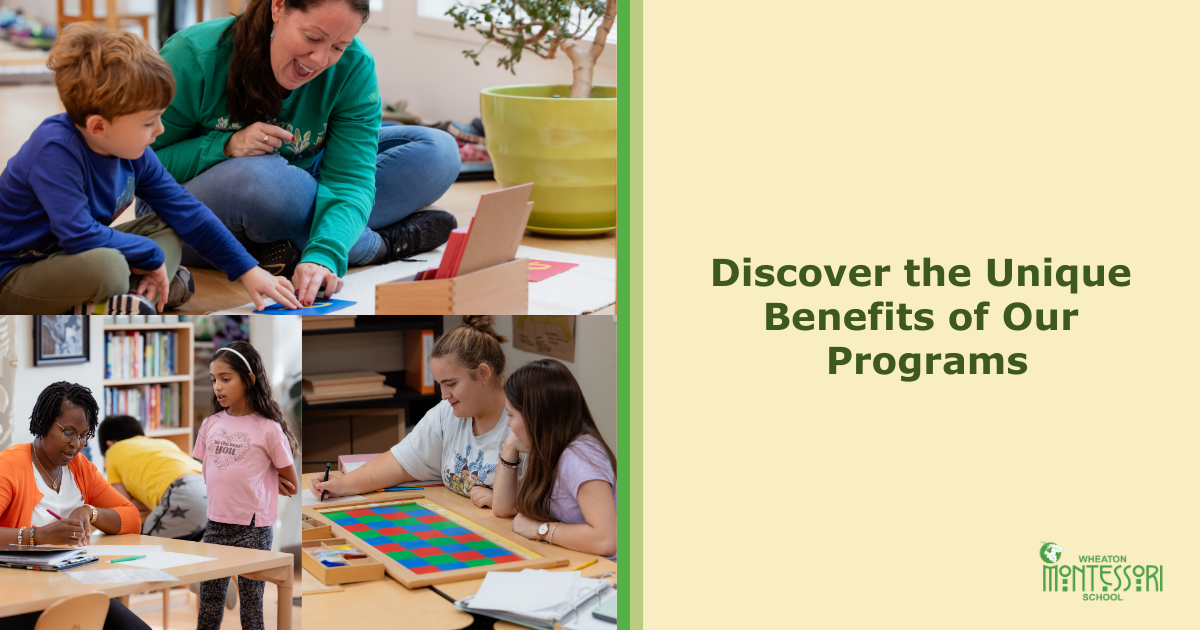
Discover the Unique Benefits of Our Programs
Rebecca Lingo • February 24, 2025

Wheaton Montessori School is committed to providing an authentic Montessori education that focuses on each student’s needs, enabling them to discover, grow, and thrive in their unique potential grounded in authentic Montessori principles that continue to be proven and backed by scientific research on human development. We exceed the international standards of the Association Montessori International (AMI).


Our vision is to cultivate independent, confident, and empathetic children who are equipped to handle real-life challenges while making a positive impact on the world.


Explore the Distinct Advantages of Our Programs


Personalized Education

Your child has unique potential. We unlock this through personalized guidance and support. Your child’s individuality is celebrated as they learn at their own pace and discover, grow, and thrive in a nurturing and respectful environment.


Leadership

Children of various ages work and play together in multi-age class communities. Each learner begins with their strengths and talents and progresses to their fullest potential, teaching and assisting peers to gain leadership skills.


Screen-free Learning

Our classrooms are active and hands-on. AMI-trained teachers and their assistants observe and guide all academic work and social development. Our older students use screens judiciously as an educational tool, while the bulk of their learning is done with Montessori manipulative materials and experiences.


Commitment to Diversity, Equity, Inclusion, and Justice

Wheaton Montessori School is committed to participating in and honoring a diverse community and prioritizes cultivating an inclusive environment and education through open-mindedness, empathy, understanding, communication, and respect. This important work emphasizes peace now, tomorrow, and in our future world.


Multi-age Classrooms

All learners are celebrated as individuals. Multi-age classrooms mean no child is required to wait, as they do in conventional schools, for same-age peers to progress within the curriculum or be rushed past full understanding when they would benefit from a little more time to attain mastery. Each learner deserves to be surrounded by others who inspire and challenge and have opportunities to mentor others.


Engaged Classroom Communities

Teachers guide, model, and assess so each learner has the support and tools to reach their full potential. We believe teaching to the individual’s challenge level fosters healthy and positive relationships. The result is visible in our classrooms, where academic and social skills are interwoven. Bright, warm, and inviting environments are filled with hands-on materials, biological specimens, music, books, and cultural artifacts from early childhood through freshman year of high school. Learners work and play individually and in small groups with prudently designed student-teacher ratios.


Cursive Writing

The cognitive and neurological benefits of learning cursive writing include improved brain function, enhanced memory retention, and better self-regulation skills. Our youngest students learn cursive naturally during preschool emphasizing fine motor skills.


Current families can arrange their classroom visits by clicking on the links below.


Adolescent Community Classroom Observation

Ms. Searcy’s Upper Elementary Classroom Observation

Mrs. Fortun’s Lower Elementary Classroom Observation

Mrs. Mayhugh’s Lower Elementary Classroom Observation

Mrs. Berdick’s Primary Classroom Observation

Mrs. McClelland's Primary Classroom Observation

Ms. Chiste’s Primary Classroom Observation

Mrs. Rogers’s Primary Classroom Observation


Prospective families with toddlers and children under 4 are encouraged to sign up for a school tour to explore the advantages of our programs, which lay the essential foundation for our Elementary and Adolescent Community Programs. Priority enrollment will be granted to those who enroll before March 15. Our waitlist for kindergarten-9th grade for Fall 2025 is currently closed. Please check back in April to see if the waitlist is open then. Individual tours will only be offered for kindergarten through 9th grade if the waitlist is open.
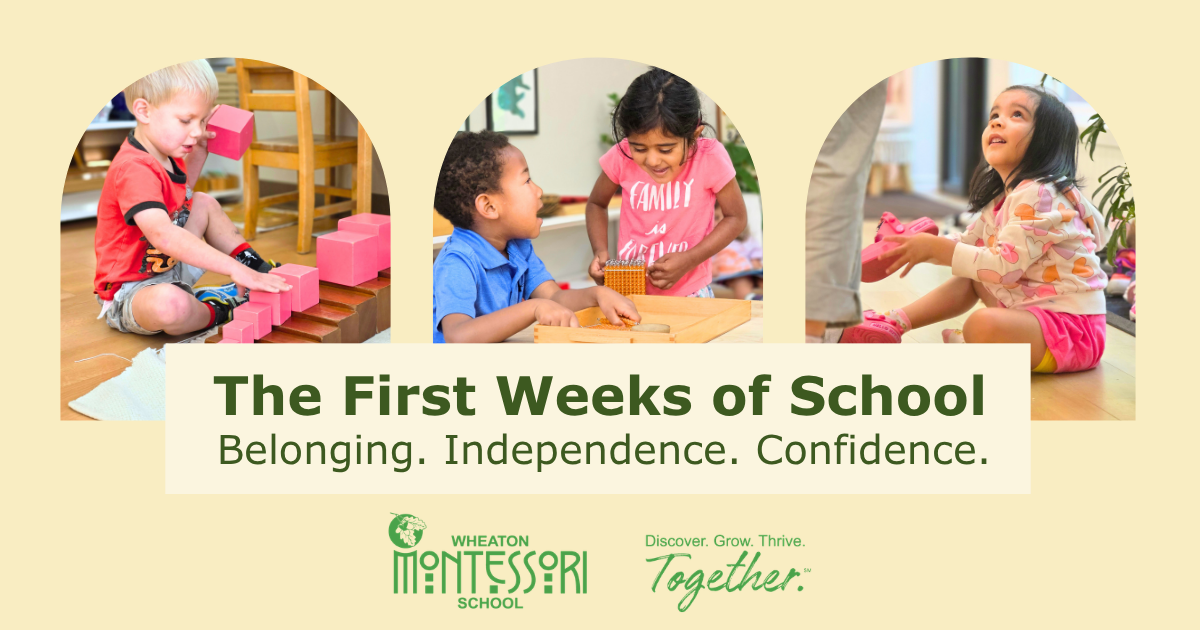
Child reaching for an object,
By Rebecca Lingo January 26, 2026
Learn how the Montessori Absorbent Mind empowers young children to effortlessly absorb language, culture, and behavior, and how parents can nurture it.
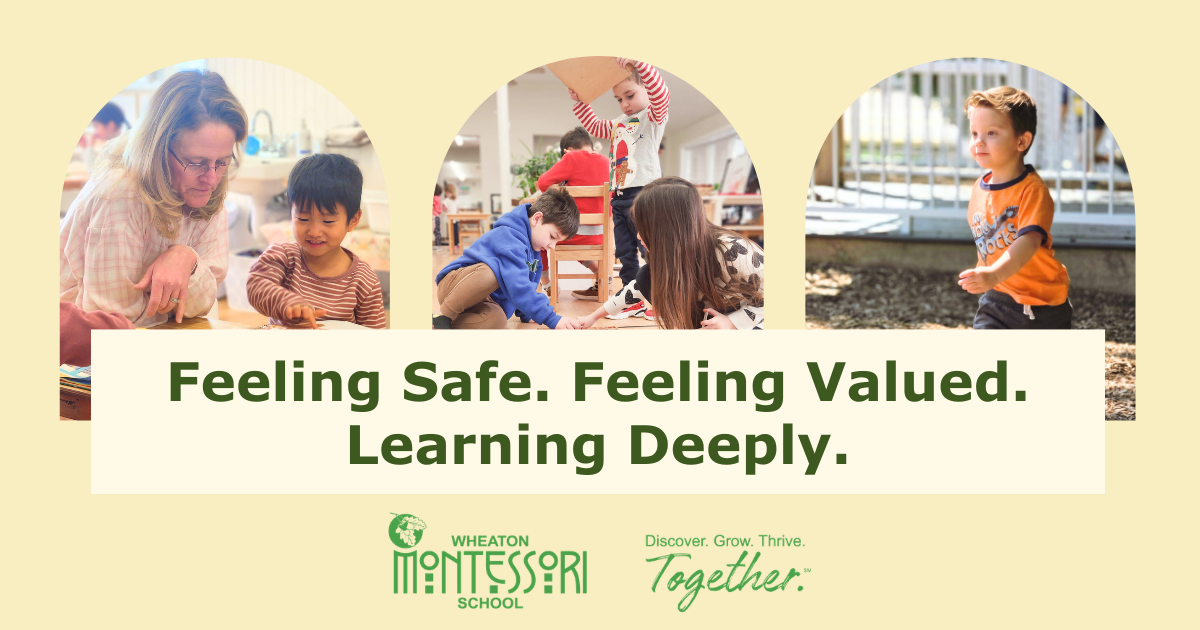
Children outside a building; title
By Suzanna Mayhugh, Lower Elementary Teacher January 19, 2026
Montessori Mayhem? Pint-Sized Pandemonium? When I give tours of the Elementary classrooms or welcome new parents to the Elementary program at Wheaton Montessori School, some parents believe that students are allowed complete freedom, as if the classrooms are a beautiful den of chaos and anarchy. Indeed, this is one of the biggest misconceptions about Montessori education. (The biggest misconception being, in my experience, that Montessori isn’t “real world” education. But as we say in our lessons, “That’s a story for another day.”) While Montessori classrooms DO give children the freedoms they require and deserve, it’s not an unlimited free-for-all with an adult watching from an observation chair! Freedom is always balanced with responsibility, to oneself and to the community. These values, freedom and responsibility, are essential for creating a happy, busy, humming classroom where children thrive. What Does Freedom Mean in Our Classroom? “Freedom” in the classroom means that students are encouraged to make choices about their learning. Just as in our Primary classrooms at Wheaton Montessori School, students are free to choose their work, their seat, and their work partners. They are free to move about the classroom and do not need to raise their hands to visit the restroom, get a drink of water, or ask a question. Let’s look at a few of these freedoms more closely. Students are Free to Choose Their Work. For example, they may choose which book to read, choose a work partner to research a chosen topic, or practice a tricky bit of a lesson over and over. They are also able to choose how they will show their understanding. They might present their understanding through a poster, a diorama, a model, a handmade book, or an enormous amount of cardboard and hot glue. These choices empower students to take charge of their education and express themselves in ways that suit their interests and strengths, something a standardized test or a worksheet can never do. However, freedom in the classroom ALWAYS has limits. For example, students are free to choose their work, but choosing NOT to work is not an option. They are free to choose their work from the lessons that have been presented to them. While students may choose their reading material, it must be appropriate for their reading level and classroom guidelines. When students select a partner, they must do so respectfully and inclusively. When students create projects and work output, they must do so with care, make proper use of materials, and in a way that shows what they understand about their topic. Additionally, these choices should never disrupt their own learning and construction, or that of their peers. The Role of Responsibility In a true Montessori classroom, freedom comes with responsibility. And that responsibility can sometimes be uncomfortable at first. Students are expected to care for classroom materials, such as returning books and lesson materials to the shelf, taking part in classroom jobs, keeping a record of their work in their work journals, and handling art supplies properly. They are responsible for practicing their lessons and completing chosen follow-up work, listening attentively during lessons or when a classmate is sharing a presentation or thought, and helping classmates when needed and available. A student is not free to use materials in a way that damages or wastes the classroom supplies or puts anyone in harm’s way. Freedom within our classroom never allows for harming oneself, others, or the classroom materials. Healthy boundaries, limits, and structures are consistently communicated in advance with clarity and respect, ensuring practicality and alignment within the community. Classroom expectations and rules are collaboratively developed and agreed upon by the community. In order to foster a positive learning environment, both students and teachers are expected to adhere to the shared expectations and responsibilities. When necessary, the classroom adult will address students and reiterate expectations and boundaries in a firm yet considerate manner. This balanced approach is effective only when maintained consistently throughout each day. What Might it Look Like When the Balance Needs to Shift? The adults in the classroom are constantly observing the children to be sure that each child has as much freedom as they are ready for, providing them space, room, and opportunities to show their strengths, and make their own choices throughout the day. When that freedom is too much, a teacher might need to provide more lessons in how to use materials that have been damaged or used improperly, limit work partner choices, or have a student sit with the teacher while they practice lessons or work with precious art materials. The adults will be watching for the perfect moment to allow the child increased freedom within the classroom, and within the limits of the understood responsibilities. How Freedom and Responsibility Work Together Finding the right mix of freedom and responsibility is something we work on together every day in our classroom. Montessori teachers are specially trained to guide this balance, helping students practice important skills like making good choices, solving problems, and learning self-control. When children are trusted to make decisions, they also learn to take responsibility for those choices. Experiencing the natural consequences of their actions helps them become kind, thoughtful, and capable members of their community who understand how their choices affect others. What Does This Have to Do with Parents? Your support at home makes a big difference. By working together, we can help your child thrive both at school and at home. Encouraging your child to take responsibility for their actions and decisions reinforces what they learn in class. Yes, it can be uncomfortable, but it is necessary. It also becomes easier, more comfortable, and needs to be practiced less often when practiced consistently (like most things!). This supportive consistency across settings, at home and at school, helps children feel confident, cared for, and increasingly independent.