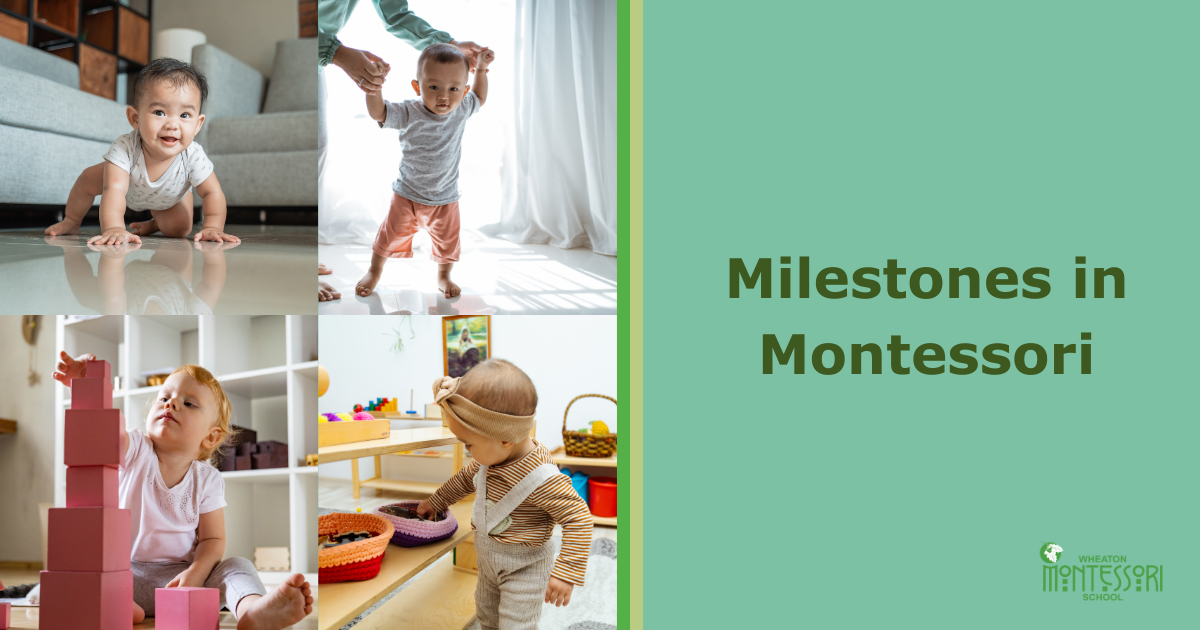
Our extensively trained teachers look at milestones for babies and toddlers through three key lenses: movement, language, and social/emotional development. Each child progresses at their own pace, so while the sequence of milestones is common, the timing varies. Here’s a brief guide to movement, language, and emotional development to support your child’s unique journey as they continue to grow into remarkable young people.
Movement Milestones
Physically, our infants and toddlers are experiencing rapid and intense changes. They are interacting with the world through movement and their senses. In Montessori, we call this the time of the “unconscious absorbent mind” because children are absorbing everything around them with no filter. Through movement, they begin to make sense of their surroundings, family, and culture. Let’s dive deeper into three aspects of movement: myelination, equilibrium, and hand development.
Myelination
Newborns' movements are initially reflexive, like sucking and grasping, but they become more controlled as the process of myelination takes place, which allows electrical signals to pass more quickly from the brain to the muscles.
Give your child plenty of freedom to move to support their development. Keep them out of restrictive devices like car seats and carriers as much as possible and let them reach, grasp, and struggle within reason. These tasks are essential for building strong neural connections.
Equilibrium
Gross motor skills help children develop equilibrium or balance. Babies start by lifting their heads, rolling, and eventually sitting upright. Tummy time plays a crucial role in helping them develop strong neck and torso muscles, which are the foundation of movement.
By 12 to 18 months, most children begin walking and carrying objects. Over the next couple of years, they refine their balance and coordination, running, climbing, and jumping with more confidence. Encouraging these activities are key to their physical development.
Hand Development
Fine motor skills also emerge in the first few years. What starts as reflexive hand movements soon evolves into deliberate control. Babies initially use a raking grasp, which eventually becomes a precise pincer grasp around nine months.
From 10 to 18 months, children gain more control over their hands and fingers, learning to point, stack blocks, and scribble. By age three, they can easily use utensils for feeding and can pick up small objects between their thumb and forefinger. Offering your child opportunities to practice these fine motor skills—like playing with blocks or creating art—boosts this essential area of development.
Language Milestones
Just like movement progresses from slithering to creeping to walking, language skills progress from babbling to talking. Movement and language development move in parallel until about six to eight months of age, at which point one may dominate while the other often plateaus for a bit and then takes off a little later.
Language development follows two threads: expressive and receptive language.
Receptive Language
Receptive language is how our children understand the language around them. Our babies love hearing the voices their adults and they pay attention to their faces. Eventually, around four to six months, they begin to understand specific words, like no, and the meaning behind tones of voice. This is also when they begin to play social games, such as “peak a boo.”
During the first year, our little ones start to understand simple commands and gestures, which evolves by about 12 months to understanding instructions and going or pointing to familiar objects when named. From 24 to 36 months, toddlers are typically able to follow two- to three-step instructions and understand spatial concepts like “in,” “on,” and “under.”
Expressive Language
Expressive language involves how children communicate with the world. Early expressions come through body language and crying, which later evolve into cooing and babbling. Between four and six months, our babies vocalize pleasure and displeasure, babble with consonant sounds, put vowels together, and even try to repeat sounds they hear. In the six-to-eight-month range, our little ones continue babbling and start to drop unused language sounds for the home language(s) they hear.
From eight to ten months, their babbling incorporates consonant-vowel combinations (e.g. “ba, da, ma”) and differentiated babbling may start to resemble real words. They will also begin to use more gestures such as pointing, waving, and reaching to show their interests, needs, and even things they do not want. From 10 to 12 months, this kind of babbling continues, and they may even combine gestures with words.
After 12 months, we begin to see an explosion of expressive language with vocabulary expanding at an impressive rate. They start by using single words, usually nouns, and this may include using one word for several objects. Then between 18 and 24 months, our children acquire eight to twelve new words a month, and after about 50 words this increases exponentially. This is also when we hear children use two-word phrases with nouns and verbs.
While they’re three, our little ones can use pronouns, ask questions, and string together sentences to communicate their needs and experiences to be understood most of the time.
Emotional Milestones
Emotional development, the ability to understand and express emotions, is largely shaped by a child’s social relationships. During their first year, babies notice emotions in others and respond to social cues. They may express their own needs and show interest in caregivers. During early preschool years, children can regulate their emotions better and express a broader range of feelings.
To support emotional growth, it’s important to maintain a calm, consistent environment. Show warmth and affection, encourage the expression of emotions, and teach strategies for managing big feelings like frustration or sadness.
Social Milestones
Social development enables children to form positive, rewarding relationships with others. In their first year, babies are focused on bonding with caregivers. They’re learning how to engage, gain attention, and participate in simple social interactions.
By 12 to 24 months, children start engaging in back-and-forth interactions and begin developing empathy. Between 18-24 months, children are able to pretend play. Parallel play—where they play alongside others but not directly with them—often evolves into cooperative play. At this stage, children start sharing, taking turns, and communicating more effectively with peers.
You can nurture social growth by modeling healthy relationships, reading your child’s social cues, and facilitating interactions with other children.
Healthy Development
Our infants and toddlers are going through a dramatic change in terms of a sense of self and their attachments. It’s important to remember that children follow a common sequence in their development, but not always a common timing. We offer these milestones as a reminder for how to remove obstacles to children’s development, while also supporting their own unique path as they grow into amazing young people.
Our current families are invited to visit their classroom and observe work-in-progress. This is also a great opportunity for our families with the youngest students to observe how we support their children as they develop in amazing ways. Click on the below links to schedule your classroom observation.
Adolescent Community Classroom Observation
Ms. Searcy’s Upper Elementary Classroom Observation
Mrs. Fortun’s Lower Elementary Classroom Observation
Mrs. Mayhugh’s Lower Elementary Classroom Observation
Mrs. Berdick’s Primary Classroom Observation
Ms. Carr’s Primary Classroom Observation
Ms. Maria’s Primary Classroom Observation
Mrs. Rogers’s Primary Classroom Observation
Prospective families are invited to schedule a tour and discover how Wheaton Montessori School nurtures your child's growth from the age of 2.5 all the way through to 9th grade.