Grammar study opens the world of words up to us. Deep understanding of grammar makes the world come alive. When we have fun with grammar like your children do at Wheaton Montessori School, lessons and practice feel like play!
One of the best parts of a Montessori education is that learning is so much fun! At Wheaton Montessori School, we provide hands-on activities and experiences that engage children’s hearts and minds to help them grasp abstract concepts for mastery.
Our young pre-k and kindergarten students will work with the farm or story house to learn the function that parts of speech play. This experience prepares young children for the Grammar Boxes which are used in 1st through 6th grades to continue learning about parts of speech through exciting experiences and manipulatives.
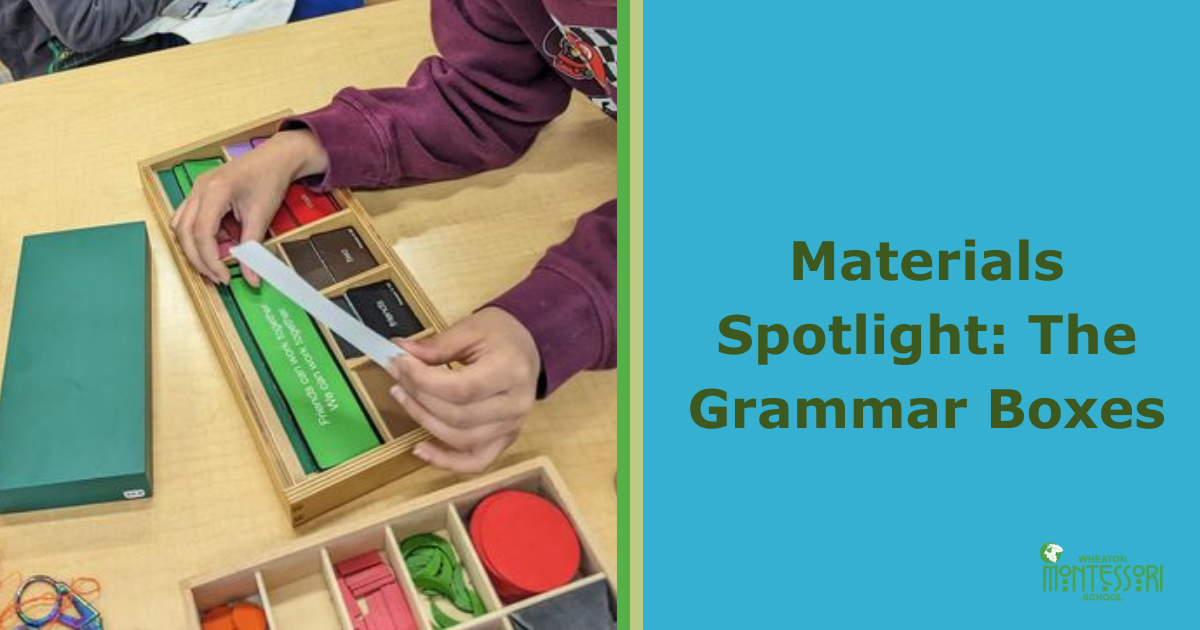
The Grammar Boxes are materials that involve reading, interpretation, acting, art, movement, pattern-finding, and poetry. Grammar is an experiential and joyful process that children get to play with and embody. Grammar work in our elementary classrooms is a group activity. Our gregarious elementary-aged children love to be together with friends to draw them into lessons. Friends and grammar!
The Activity
We start with little games to introduce the part of speech. For example, we provide commands, like skip, run, hide, hum, and so on, to experience the role the verb plays. Next, we select the grammar box and filler box to match the part of speech. Children fill the grammar box with the various cards, choose one of the sentence cards, and read the sentence. Using the one-word cards, they build the sentence by looking through the smaller compartments in the grammar box to find each word.
In the preposition grammar box, one of the sentences states, “Lay the pen with the pencil.” When children look for each of the words, they will find that “pen” and “pencil” are on black cards because they are nouns. “Lay” is on a red card because it is a verb. “The” is on a tan card because it is an article. The new type of word – “with” – is a preposition. Children build the sentence and then act it out.
The next sentence on the card is the same except for one variation. “With” changes to “behind” so the sentence reads “Lay the pen behind the pencil.” So, children keep the constructed sentence but just change the one card. They act out the sentence again, experiencing how changing the preposition changes the sentence in a certain way. The final sentence on the card reads “Lay the pen beside the pencil.” This acting and playing with what happens when one-word changes provides an experience of the parts of speech.
We also share key phrases that highlight the function of the part of speech. For example, when working with pronouns, we’ll state, “This kind of word stands in place of a noun.” The children come to appreciate how words do important work just like they do. As a result, they experience an inspired interest in the functions performed by different words.
Continued Exploration
Once children have mastered this first step, the Grammar Box materials offer multiple forms of follow-up to promote deeper understanding. Dr. Montessori was brilliant at scaffolding academics to allow everyone to work at exactly their level of challenge.
Symbolizing
We link each part of speech with a color-coded symbol. For example, nouns are represented by black triangles and verbs by red circles. Children love to “symbolize” the grammar box sentences, as well as sentences they have written or even sentences from books. This practice is essentially an early form of sentence diagramming and children begin to notice visual patterns in the structure of sentences.
Quizzing
We can also play a little game to quiz children on the parts of speech and their functions. One form of this is to cover all the smaller, labeled compartments with color-coded paper. We might prompt the children, “What is the name of the word that told you the action?” They’ll call out “verb!” And we reveal (or they will check) the answer by removing the red slip.
Transposing
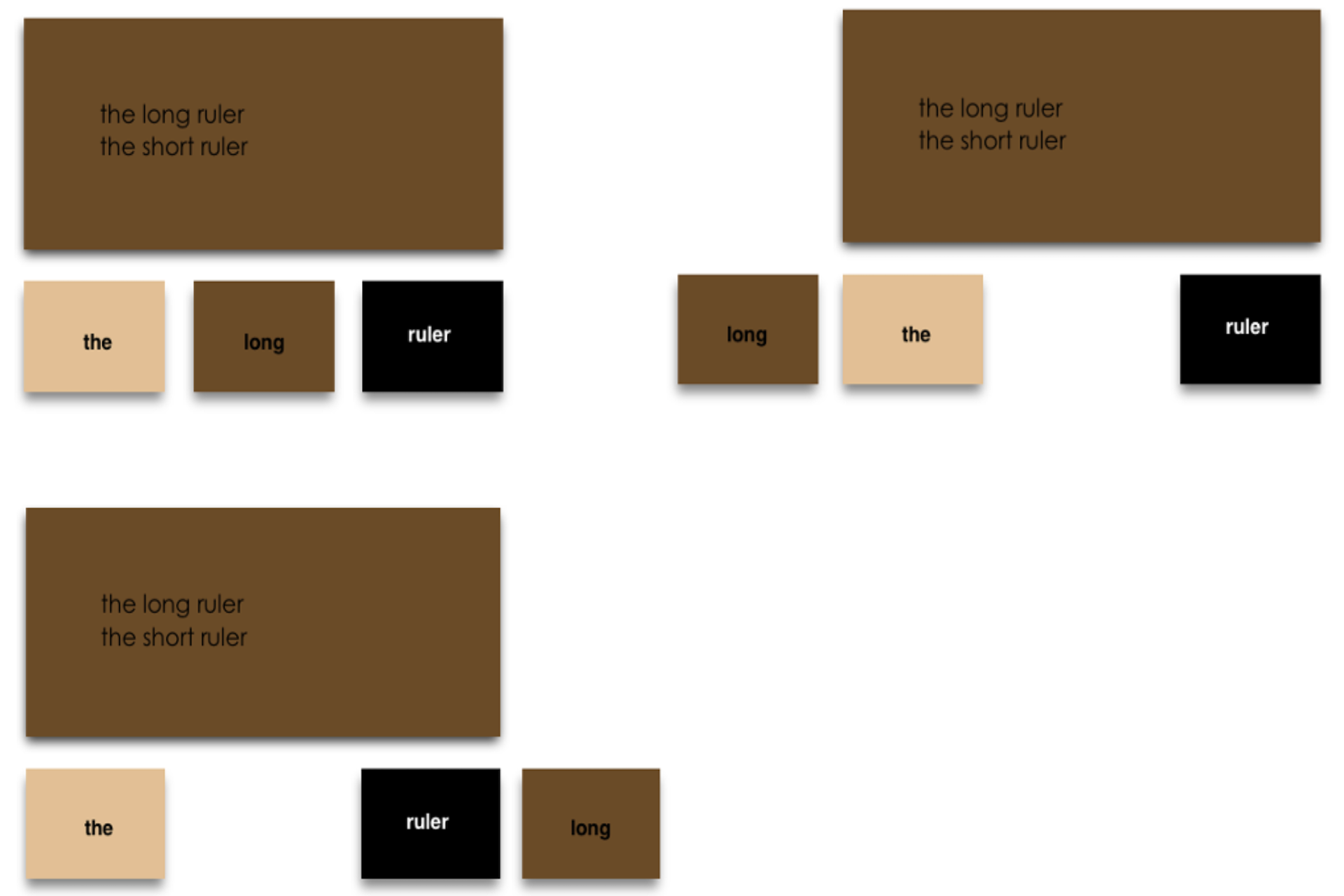
When we move words around in a sentence or phrase, the meaning may remain essentially the same, change dramatically, or be lost entirely! So, with the grammar box cards, we play around with shifting the order of the words in the constructed sentences and phrases. This highlights the importance of word order in our language and also opens up some creative thinking about poetic phrases (which often enlivens the imagination of young poets!).
Reading Commands
Children also love using the command cards that accompany each grammar box. These cards encourage dramatic interpretation and build reading comprehension. Children interpret nuances as they explore gradations in vocabulary and eventually even how subtle shifts in vocabulary can impact meaning or interpretation.
Extensions
We don’t stop there. We initiate a deeper study into classifications within each part of speech. For example, a study of the verb moves to an examination of the differences between action and linking verbs, a study of voice and mood, and an exploration of the tenses.
Extension work also includes more complex and detailed written work, a study of synonyms, further exploration of ideas presented in the introductory work, and research related to the parts of speech and the history of our language.
Elementary children love the extraordinary, the peculiar, and the unusual. Carefully selected words in the Grammar Boxes help spark this fascination, drawing the children into a study of the science of the English language.
Although work with the Grammar Boxes helps children learn about and understand the functions of the different parts of speech, the lessons also demand a great deal of active and physical expression which supports children’s powers of expression.
This is what “reading comprehension” really is and why school systems struggle mightily with reading fads. Thank you, Dr. Maria Montessori, for being so thorough over 100 years before the science of reading went viral. Because of her work, we can observe the quality and sophistication of children’s understanding by the precision with which each child carries out the actions required by any particular grammar box text.
Our Adolescent community continues to build on their primary and elementary’s extensive knowledge through projects and reports. Our alumni return to share that our academic requirements are harder than their later schools and that they feel more prepared than peers who did not attend Wheaton Montessori School.
The Importance of Grammar
A good grasp of grammar empowers us to communicate and interpret others’ communication with greater clarity and understanding. Thus, our goal is to help each child wield their language with accuracy and power. Grammar work in elementary invites a rich vocabulary and fosters an expansive use of our language in all of its expressions.
Grammar work is an exciting, fun, and intellectually stimulating activity in Montessori classrooms. Come see grammar at all levels once observations have opened up. I, Rebecca am always ready and willing to walk with you around campus to see where your child is headed.