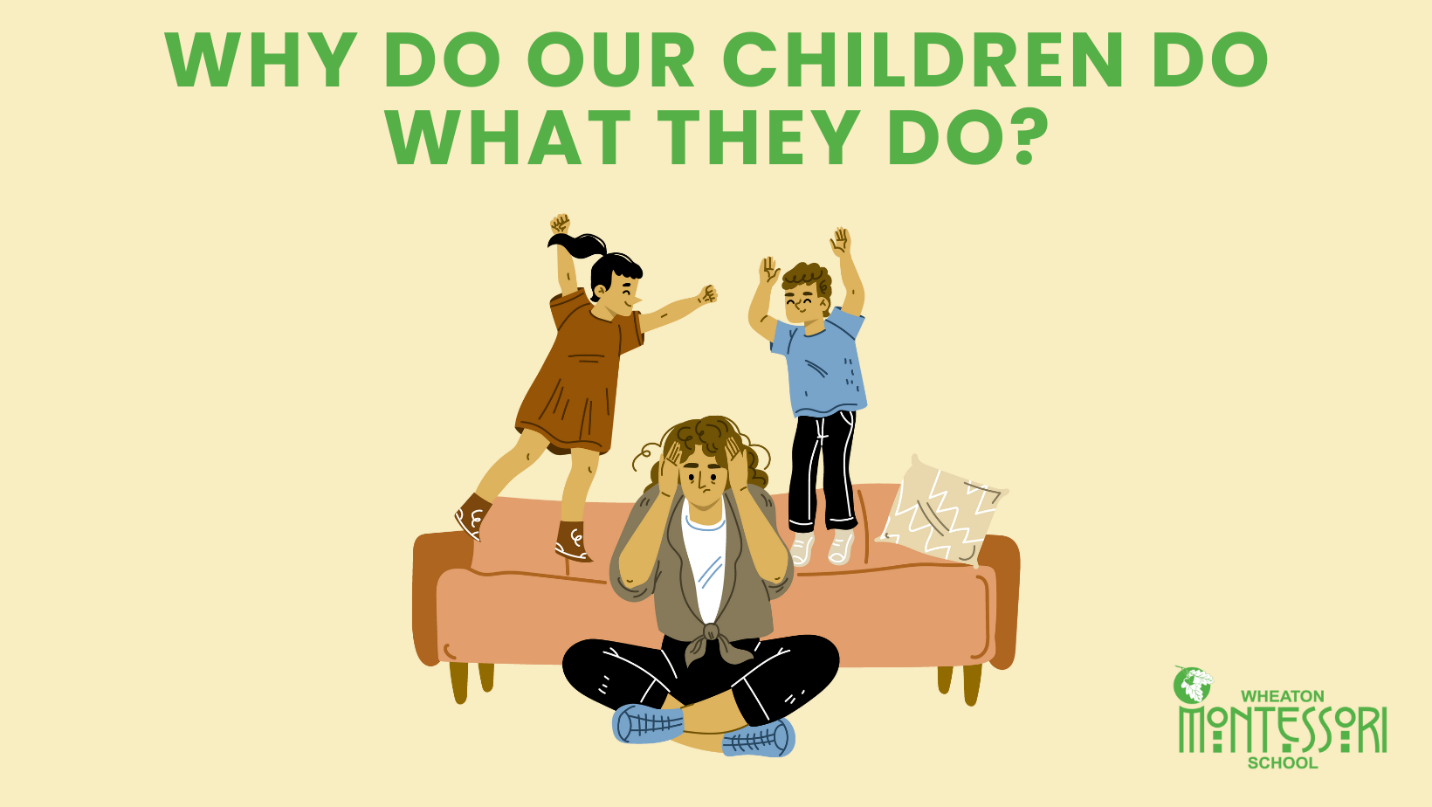
Why Do Our Children Do What They Do?
Rebecca Lingo • March 25, 2024

The scene may feel familiar, jumping on furniture or sitting down for a family dinner where our youngest starts tapping their spoon against a bowl, fascinated by the sound it makes. Our middle child begins asking a series of questions: “What does it mean to get an education? Why do people go to school? Why was Malala shot? Why are there wars?” Our oldest starts getting frustrated with the other two, wanting them to follow directions and have their dinner places in order.


In that chaotic moment before dinner, it’s easy for exasperation to take over. As adults, we might sometimes wonder what in the world propels our children. Really, what are they thinking when they try making holes by poking the table with a fork?


Innate Human Tendencies


We are born with innate human characteristics. We are hard-wired to explore, work, connect, and communicate. We crave order in our surroundings. We imagine possibilities. We create. We need to orient to what is around us, move our bodies, and wonder about the how and why. These human tendencies are unconscious, universal drives and they are at play our whole lives.


The newborn has familiar landmarks when hearing their mother’s heartbeat. When allowed to be on the floor, the infant rotates their body and moves in amazing ways. This drive to move propels babies into scooting, crawling, and eventually coming to that upright position that frees them to use their hands to explore the environment. 


We recognize these needs in our infants, yet that vital life force is powerful for older children, too. When our children are exploring the noise of the spoon against the bowl, they aren’t trying to aggravate us. They are just exploring cause and effect and delighting in the auditory result. When your teenager wants to stay in their bedrooms, they aren’t rejecting family, but fulfilling a desire for mental solitude.


Awareness of Internal Drives


Knowing that children are compelled by basic human tendencies, let’s explore these tendencies and help our children become their best selves. 


Your home and Wheaton Montessori School provide children with a sense of order. Knowing where one’s things go and how to help contribute to a task provides children with a sense of security and belonging. Just think about the feeling of uncertainty you can get when you visit someone’s home and don’t know whether to take off your shoes, where to hang your coat, or even how to be useful. By making sure our children feel welcome and purposeful and providing consistent routines, we help children develop an orientation to the world that they carry into all future settings.


You and your teachers prepare children for routines and offer accessible spaces that allow them to participate in the functioning of the day. They can help set the table, feed the cats, gather the laundry, prepare their lunches, and so much more. By participating in a meaningful way, they feel significant and ultimately more confident.


Our children’s constant questioning merely comes from a need for intellectual exploration. These big questions speak to their newfound mental ability to ponder expansive ideas about the world. As our children venture into new territory, either physically or intellectually, they benefit from opportunities to test their ideas and make connections to what they already know.


As social beings, we have to learn ways to collaborate effectively. The earliest humans had to cooperate to survive. An older child trying to force cooperation may just need some light support to find a way to communicate and connect with younger peers or siblings, rather than lapsing into exasperation. 


Supporting Development


Human tendencies are unconscious, universal drives that support our adaptation to our particular time and place. We are hard-wired to adapt to our environment! The human tendencies – to orient, explore, order, abstract, imagine, calculate, work, be exact, perfect oneself, and communicate and associate with others – help aid this adaptation. They provide the internal drive to become our best selves. 


Have you heard the phrase “Follow the child”? At Wheaton Montessori School, our classrooms and curriculum are designed with these human tendencies in mind, with particular attention to how these innate drives manifest themselves at different stages of development. Constructing curricula and classrooms around students' developmental needs and stages is exactly what Dr. Maria Montessori purposely designed and the benefits of these approaches supported. 


Thanks to our Montessori training and commitment, we recognize, honor, and support innate characteristics in children so we aren’t obstructing their important development. Our children reach amazing heights with Montessori support. Please contact us to observe classrooms or tour the campus.
Adolescent Seminar Observation Ms. Searcy’s Upper Elementary Classroom Observation Mrs. Fortun’s Lower Elementary Classroom Observation Mrs. Mayhugh’s Lower Elementary Classroom Observation Mrs. Berdick’s Primary Classroom Observation Ms. Carr’s Primary Classroom Observation Ms. Chiste’s Primary Classroom Observation Mrs. Rogers’s Primary Classroom Observation
How Geometry Got Its Name
By Rebecca Lingo February 2, 2026
In Wheaton Montessori School classrooms, we like to introduce big ideas with big stories. We offer children a sense of wonder first, sort of like an imaginative doorway, so that when they later study formulas, theorems, and proofs, they already feel connected to the human story behind them. One of these stories is The Story of How Geometry Got Its Name, an introduction to a subject that is far older than the textbooks and protractors we encounter today. In Montessori, Geometry is more than about shapes. It is about human beings solving real problems in the real world. A Problem as Old as Civilization To reintroduce geometry, we time-travel back around 5,000 years to the ancient civilization of Egypt. This was a land shaped by the Nile River, the longest river in the world. Each year, the Nile flooded its banks as snowmelt poured down from the mountains far to the south. The Egyptians depended on this yearly flood as it left behind rich, dark silt that nourished their crops and made life possible in an otherwise harsh desert. But the flood created a challenge, too. It washed away the boundary markers that separated one farmer’s field from another. When the waters receded, no one could quite remember where their land began and ended. Arguments ensued. “This corner is mine!” And the fields needed to be measured and marked again. The First Geometers: The Rope Stretchers To solve this annual problem, the Egyptians relied on a special group of skilled workers called the Harpedonaptai, or Rope Stretchers. These were early land surveyors who used a knotted rope tied at regular intervals and three weights to create a very particular triangle. In our elementary classrooms, we invite a few children to hold a prepared rope at its large knots, forming that same triangle. As they stretch it out and lay it on the ground, many quickly recognize what the Egyptians had unknowingly created: a scalene right-angled triangle. This shape would later become central to the geometry studied by Greek mathematicians. The Harpedonaptai used this simple tool to re-establish field boundaries, set right angles, and make sure the land was measured accurately and fairly. Geometry, in its earliest form, served a deeply practical purpose. From Rope to Pyramid The Harpedonaptai’s expertise was valued far beyond the farmlands. They also helped lay out the foundations of temples, monuments, and even the Great Pyramid of Giza. The base of the Great Pyramid is a perfect square, which is an astonishing feat of measurement and design. The Pharaoh himself oversaw these measurements, but it was the Rope Stretchers who executed them. Their work represents one of humanity’s earliest recorded sciences: the careful measuring of the earth. How Geometry Got Its Name The name geometry reflects this ancient practice. It comes from two Greek words: gê — earth metron — measure Geometry literally means earth measurement. The Egyptians did not use the language of right angles, nor did they classify triangles as we do today. Their work was grounded in practical needs. They needed to solve problems, organize land, and create structures that would endure for thousands of years. Yet their discoveries influenced later thinkers like Pythagoras, who likely traveled to Egypt and learned from their methods. Over time, the simple knotted rope inspired a whole discipline devoted to understanding lines, angles, shapes, and the relationships between them. Why We Tell This Story in Montessori When Montessori children hear this story, something important happens. Geometry becomes more than a set of rules or vocabulary words. It becomes a human endeavor born from curiosity, necessity, and ingenuity. The heart of Montessori education at Wheaton Montessori School is to help children view knowledge not as isolated subjects, but as valuable gifts passed down from earlier generations. When children pick up a ruler, explore angles with a protractor, or classify triangles in the classroom, they are continuing a legacy that began with those early Rope Stretchers, the Harpedonaptai on the banks of the Nile. Through story, students feel connected to the people who shaped our world and to the problems that inspired great ideas. Geometry becomes meaningful, purposeful, and alive, from our preschoolers working with the Geometry Cabinet , to elementary students classifying and measuring angles or using hands-on Pythagorean Theory materials, and all the way through our adolescents. At the adolescent level, geometry moves fully into the real world. Students apply measurement, angles, area, scale, and spatial reasoning through meaningful work across campus, including: Measuring and mapping land for the campus’s Wetland Conservation Area, as well as calculating classroom square footage for recognition and accreditation applications Understanding and applying area, perimeter, scale, and proportion when working with acreage, restoration plans, and campus layouts Designing and situating functional structures such as chicken coops using geometric principles Applying angle classification, measurement, and spatial reasoning through woodworking Using geometry to cut, join, and build accurately, including raised beds, greenhouses, and beehive insulation boxes
Child reaching for an object,
By Rebecca Lingo January 26, 2026
Learn how the Montessori Absorbent Mind empowers young children to effortlessly absorb language, culture, and behavior, and how parents can nurture it.