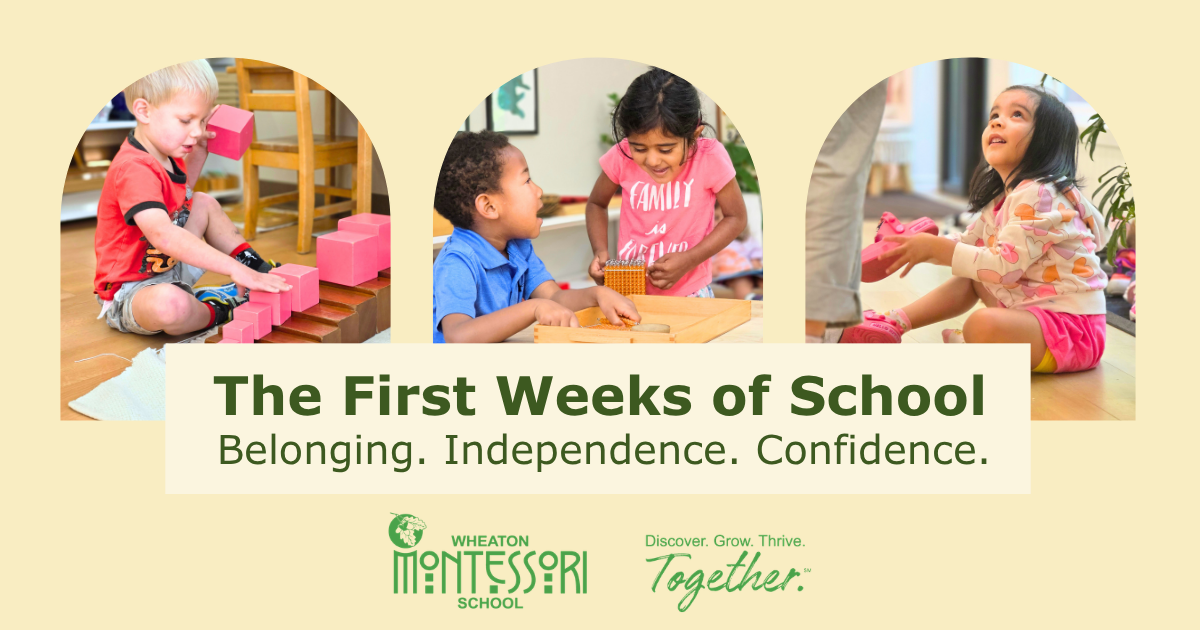
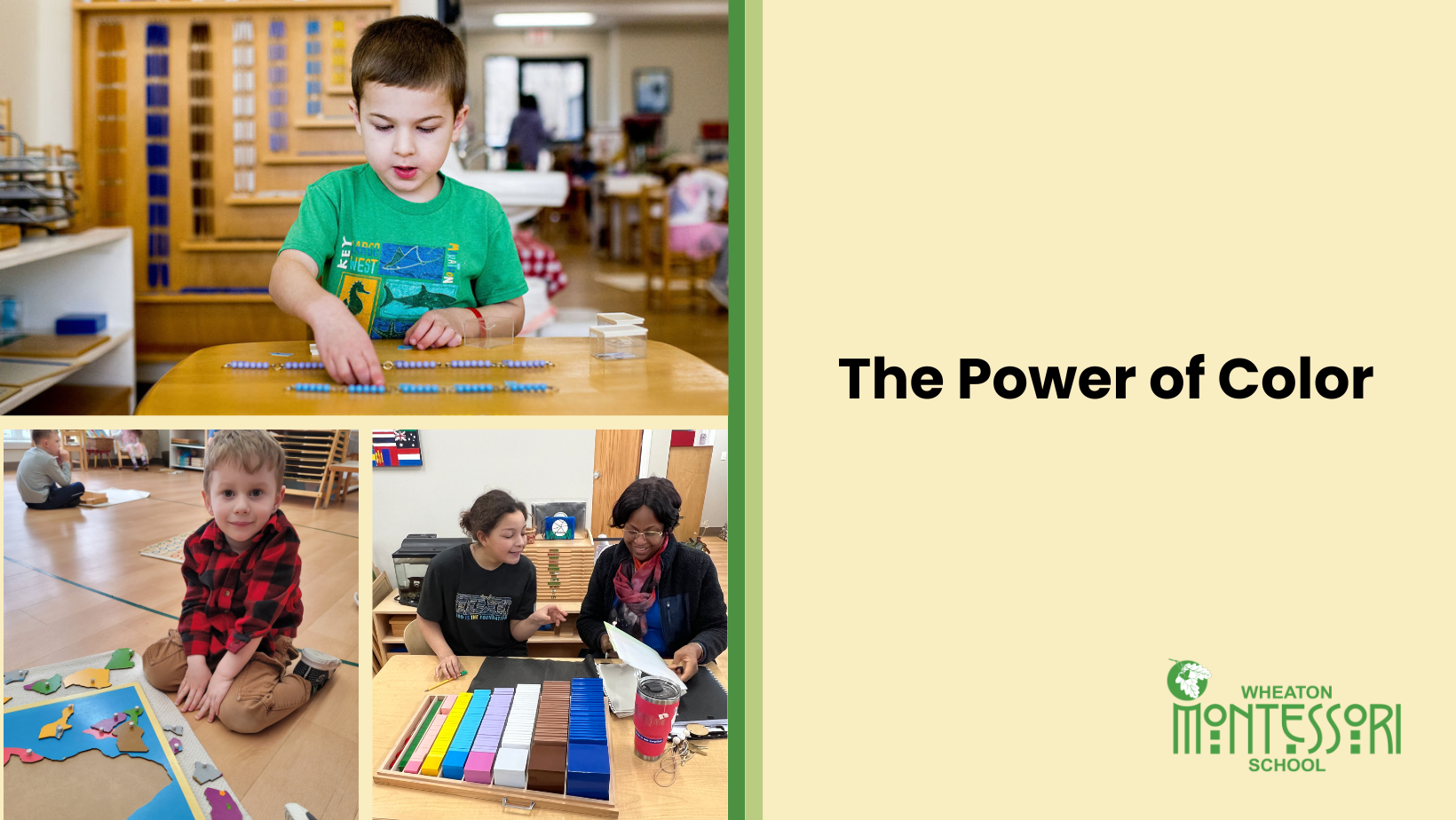
When you look inside our Wheaton Montessori School classrooms, you’ll notice the general attractiveness and warm quality of the room. As you peruse the environment, you may also notice the array of colorful materials on the shelves and how they stand out in contrast to some of the neutral feel of the rest of the room.
These colorful learning materials are designed for beauty so that our young children will be drawn to them. However, this isn’t the only reason Montessori materials have distinct colors. The color-coding also helps with organization and structure in the learning environment, and perhaps even more importantly, plays an important role in facilitating children’s cognitive development.
Creating External and Internal Order
In our toddler and primary classrooms, practical life—activities like scrubbing a table, cleaning a window, watering a plant, or creating a flower arrangement—are set up so that all of the objects for a particular activity are coordinated by color. This way young children can rely on visual cues to know what objects go together and to independently access supplies.
Sensorial materials often use color to help isolate a quality and help children develop their perception. For example, when discriminating dimensions with the pink tower, all of the cubes are the same shade of pink. Color coding is also used to help children pair two identical sets of materials, like when matching sounds with the sound cylinders.
These forms of color-coding help children with both the organizing of their surroundings and in constructing an internal sense of order.
Integrated Throughout
Color-coding gets even more interesting as children use academic subjects, like language, mathematics, and geography.
When our primary children begin to use puzzle maps, they start with the continent map, a two-dimensional representation of Earth, and the continent globe, which shows the planet as a sphere. The puzzle map and the globe show the continents, and each is painted a distinct color: North America is orange, South America is pink, Europe is red, Asia is yellow, Africa is green, Oceania is brown, and Antarctica is white. As children begin to learn the physical representation of each continent, they also associate a color with that continent. All other learning materials that involve the continents–such as picture packets, information cards, or booklets–maintain this color scheme.
In the math materials, children learn to associate a quantity with both the number of beads represented and the color of those beads. The beads are the same size but change only by the number on the bead bar and the color. So, a ten bar is always constructed of ten gold beads, a nine bar with nine dark blue beads, eight with brown, seven with white, six with light purple, five with light blue, four with yellow, three with pink, two with green, and one with red. This color scheme is consistent throughout all the math materials that use the bead bars, from the simplest lessons in the primary to advanced cubing and cube roots in the elementary and beyond.
Similarly, there is clear and consistent color coding in other materials and concepts, such as with the hierarchy of numbers to designate place value or the role of different parts of speech with the grammar materials.
Strengthening Neural Pathways
While this color coding does continue to help with organization and structure, the color also helps children with their cognition and memory. Color has long been used as an effective tool in marketing, through brand recognition, consumer attitude, and purchasing decisions.
How the brain processes color impacts our children’s attention, comprehension, and retention. Dr. Maria Montessori may not have had all the current-day studies at her disposal, but she did recognize the power of color in the learning process.
We now know that color connects neural pathways and integrates different forms of intelligence, which allows learners to construct more consolidated meaning and make deeper cognitive connections with content.
When learning the quantity of six, children count the six light purple beads on the bar to determine the quantity of six. At the same time, neurologically they are creating pathways in their brain for quick and easy recall when they see the light purple bead bar so they can immediately think “six” in the future rather than having to count the beads.
Later, when children start to use the bead bars for advanced work with compound multiplication, the distributive law, squaring, cubing, and so much more, the neural connections they have are strengthened by both a clear and concrete understanding of the quantity and the associated color.
Leading to Abstraction
The color-coding in math, language, and other subjects also helps children move from the very concrete to more abstract and symbolic representation.
Because they learn to associate nouns with black equilateral triangles and verbs with red circles, as children analyze sentence structure, they can begin to parse out the subject and predicate by using those two color-coded shaped symbols.
Our early math materials use color coding to assist pre-kindergarten students in using numbers into the thousands. We use colors to represent place value: colors–units are in green, tens are blue, and hundreds are red. Our kindergarten students can better conceptualize the pattern in the numerical hierarchies because unit thousands are also green, ten thousands are blue, hundred thousands are red, and then unit millions are green, and so on. We know it’s confusing to read. Ask your primary teacher to point this out when you observe.
This color-coding also helps when we move into operations with larger numbers and quantities. When children move from very tangible representations of a bar of ten beads to represent ten and a square of one hundred beads to represent a hundred, they use small, color-coded tiles with just the color and number. Thus, children can manipulate a blue tile with 10 printed on it and a red tile with 100 printed on it, and (thanks to the neural pathways established) fully understand what those tiles represent as they add, subtract, multiply, and divide.
A Powerful Aid
The power of color is fully integrated throughout classrooms at Wheaton Montessori School and provides an amazing aid to children’s cognitive development. In addition to helping memory and learning, the color brings beauty and appeal to our learning environments while also supporting children’s independence!
We recommend coming to see this for yourself. There are so many examples of how color brings learning to light.
We are enrolling children who will be between 2.5 and 4 for summer and fall 2024 start dates. Prospective families are invited to schedule a school tour by clicking on this link for a green tour button or the green Schedule a Tour button on the upper right-hand corner of this page.