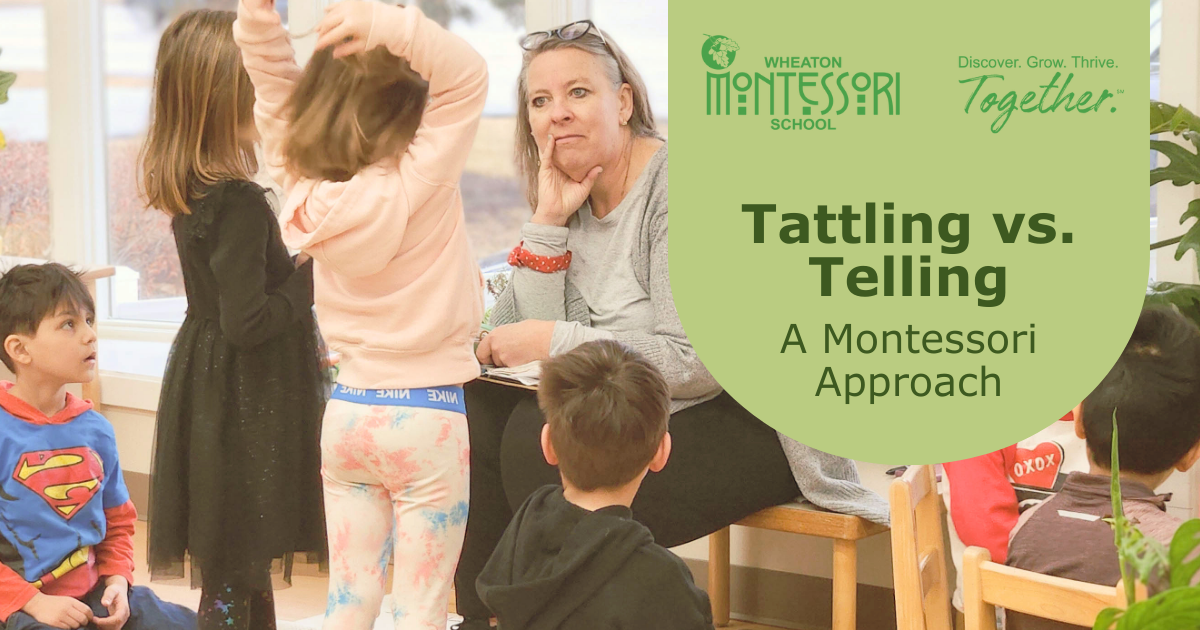
How often have our little ones run up to us to spill forth their grievances about other children? Sometimes, these reports are about broken rules. Sometimes, they are about hurt feelings. Sometimes, they may even be attempts to get others “in trouble.” It’s most likely to occur as children recount the moments of their day that stand out or just as children are preparing for sleep.
In these moments, we just want to comfort our “babies”. Today let’s analyze the ways that our teachers at Wheaton Montessori School determine how to respond and support our children in their vast experiences and deep training techniques.
Underlying Issues
When children come to an adult for help in class or on the playground, typically they try to figure out the rules, both explicit and implicit, as well as how those rules are enforced. Which rules are critical? Which rules can be bent or broken? When should someone intervene?
Coming for help can be because they reached the point that enough is enough. In this case, the "tattling" is a plea for help.
We can remember that children are in the process of creating their value system, and this is especially so for elementary-aged children who have a heightened sense of justice and are often acutely attuned to what is or isn’t fair.
We believe children may need support with figuring out the intricacies of rules and which are the most important. Or maybe they need encouragement so that they can remind classmates about the rules and how they deserve to be treated.
We think this child asking for affirmation, clarification, understanding, or confirmation. With encouragement can they remind others of rules in this situation. Does this child have enough experience to predict what will happen next?
A Step-by-Step Approach for Adult Intervention
- Restate the concern: “So you are upset that…” or “You are concerned about…”
- Acknowledge children’s feelings and need for help: “Amira, it sounds like you need some help resolving this with Drake. Let’s go talk to him together.”
- Facilitate a short, structured conversation between the children. For the most success, we want to ensure the conversation happens in a calm, neutral setting. Then we can encourage each child to express their concerns: “Amira, can you explain to Drake what happened that upset you?”
- It helps to ask the listener to repeat what they heard in their own words: “Drake, what did you hear Amira say? You’ll get a chance to talk, but now is the time to restate what you heard Amira say.”
- Allow both children to express their perspectives and repeat what they heard.
- Try questions like:
- “What do you think we should do here?”
- “What do you think should happen next?
- “What would help resolve this?”
- “Did you just need me to listen, and understand, or is there something you would like me to help with?
- Are you feeling OK now? Or is there still a problem?
- Could you please tell me what you have already said/done/tried?
In asking these kinds of questions, we are helping children consider their motivations as well as how to make amends. This can help bring to light if they are seeking punishment or truly need help resolving the issue.
Helping Children Distinguish Between Tattling and Telling
Over time, we ultimately want children to build the skills to independently resolve conflicts, uphold expectations, and know when to get help for serious issues. As children develop trust in the fact that adults can be counted on to help as they form their value systems, we can introduce them to the difference between tattling and telling.
What is Telling?
Reporting serious concerns (safety, harm, or bullying).
Seeking help when there is a genuine need for an adult’s intervention.
Example: “Someone is hurt,” or “I saw something dangerous.”
“I’ve told them and moved away, but…”
“I don’t like when this is done, but I don’t know what to do.”
“They won’t play my way.”
What is Tattling?
Seeking attention.
Trying to get someone in trouble.
Reporting minor issues that could be resolved independently.
Expressing displeasure that something seems unfair.
Example: “She took my pencil!” (and I didn’t ask for it back from a typically responsive child before coming to an adult.)
Appreciating Honesty and Effortful Communication
Young children are just beginning to understand how to talk about their feelings, how to treat their friends with kindness and respect, how to understand conflict, and especially when and how to ask for help. When they are upset or hurt, they are rarely able to engage in goal-oriented, mature conversation. Sometimes a simple statement such as, “Thank you for telling me” or “I’ll watch. I’m glad you asked for help” can help a worried or upset young person recalibrate.
Social growth begins and continues when young children feel supported and encouraged, even when they have made mistakes, waited too long to ask for help, or asked for help in the wrong way (tattling, retaliating, or pouting). A clear statement of affirmation in a difficult situation may not resolve a difficult situation, but it will reassure, and it will help children feel confident and comfortable in their classroom communities.
Download this visual guide to use as a discussion tool with children. It’s important to acknowledge that children often struggle to distinguish between tattling and telling. But with support, time, and intentionality, children learn. They may have better descriptions to add also.
We want children to learn that safety and well-being are priorities while also empowering them to be able to solve problems when issues arise. The goal is for children to recognize when an issue requires an adult or professional’s help and how they can take responsibility in social situations. As adults, we model, support, and practice in neutral moments for practice and as issues arise.
One of the many benefits of summer camps at Wheaton Montessori School is that social learning, modeling, support, and structure continue year-round in a safe, dynamic, and developmentally designed atmosphere. Often, we have more opportunities for uncomfortable moments during recess which can be less predictable than inside our classrooms. Current families and new families with children under 4 who have enrolled for fall 2025 can sign up for our summer camps by sending an email to discover@wheatonmontessori.org
Share your thoughts on how this content enhances your parenting journey. What insights would you like to gain from our childhood experts?
Current families are encouraged to schedule their classroom observations by clicking on the links below.
Adolescent Community Classroom Observation
Ms. Searcy’s Upper Elementary Classroom Observation
Mrs. Fortun’s Lower Elementary Classroom Observation
Mrs. Mayhugh’s Lower Elementary Classroom Observation
Mrs. Berdick’s Primary Classroom Observation
Mrs. McClelland's Primary Classroom Observation
Ms. Chiste’s Primary Classroom Observation
Mrs. Rogers’s Primary Classroom Observation
Prospective families with toddlers and children under 4 are encouraged to sign up for a school tour to explore the advantages of our Primary Program, which lays the essential foundation for our Elementary and Adolescent Community Programs.
Open enrollment for summer and fall 2025 will be throughout April and is based on availability for eligible early childhood students. There are limited spots available for new children aged 4 and under for the upcoming summer and fall.
Individual school tours for kindergarten through 9th grade are not available, and the waitlist remains closed for the 2025-2026 School Year. The only exception is considered for students transferring from AMI-accredited Montessori schools that have maintained continuous attendance.