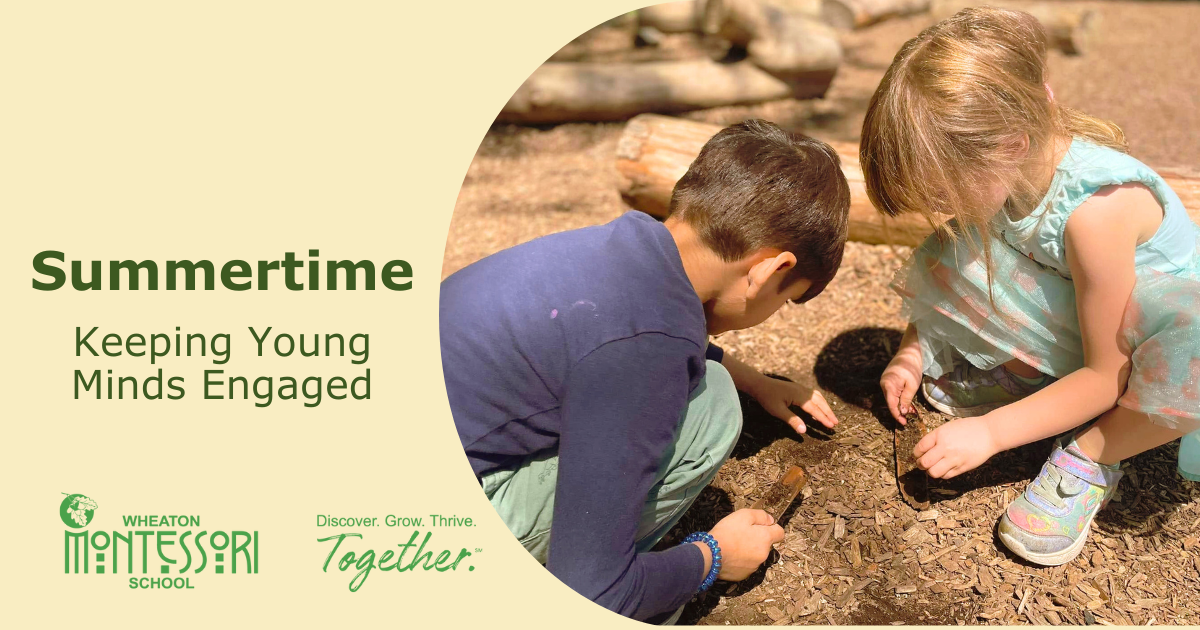
Learning continues all summer. Growing and progressing through milestones is a beautiful, continuous journey, and summer is a special opportunity to discover with longer daylight hours. Wheaton Montessori School’s expert teachers and assistants run summer camps for 10 weeks each summer. They provide suggestions to keep your child engaged and curious about their world during the summer if you are taking some weeks off.
Following the Child to Support Self-Construction
Often, Montessori myths point adults towards following a child means letting them do whatever they want, when they want, or avoiding learning and doing things by choice as well. Instead, authentic Montessori teachers are highly specialized in understanding each child in terms of their developmental characteristics, how each learns best, and sparking interest in every life aspect over time.
If you are taking portions of the summer off and you aren’t sure where to start, look at which milestones they have recently achieved, and which ones are coming next. Are they full of pre-reading skills and ready to explode into fluency? Do they always want to be with their friends? Do they like to move their bodies a lot, or are they more likely to curl up in a quiet corner? Are they more interested in independent or cooperative work/play? Are they focused on precision and order, or do they seem constantly sprawled out over a large area? Pay attention to the types of activities your child gravitates toward naturally.
Much of a child's inclinations relate to their age and developmental stage. Observe in our classrooms, and you’ll notice the variety of choices within the structured communities that support children in their self-construction, the real work of growing.
Making Memories
Whether you’re home all day or working extra hours, there are plenty of ways to make important connections. Children don’t need grand gestures or expensive vacations to look back fondly on their summers. “Special time” is less about what you do and all about joining your children for short periods in their work/play/self-construction.
A few ideas to get you started:
- Plant a garden - even a mini container garden will do - and tend to do it together daily. Notice the changes not only in the plants but in the creatures that begin to interact with them.
- Sing songs together.
- Cook together and involve your child in as many of the steps as is developmentally appropriate. There are endless practical life and math and language skills to be gained in the kitchen.
- Eat outside on the patio or have a picnic
- Invite family or friends to come over
Give plenty of time for play as the child’s work
At Wheaton Montessori School, play occurs all the time, indoors and outside. We spend more time outdoors in the summer, but we go outside all year round. Ideally, play involves time socializing with mixed age groups with as much freedom as each child can handle and just the right amount of supervision for each child to be their best selves. This doesn’t mean that every altercation must be prevented, but that each child has the support, modeling, and guidance necessary to continue to improve in social interactions. For example, as our young students get curious about cooperative play after years of side-by-side play, our highly specialized teachers provide grace and courtesy lessons to reference back to as sharing becomes challenging.
Because children develop, grow, and mature through play, we call every activity at school work. Children’s work (play) develops connections with others, problem-solving skills, motor skills, and essential language skills.
Time Outdoors
This will look different for every family, but everyone benefits from daily time spent in natural spaces.
Swimming - What more can we say about this? Learning to swim keeps kids safe and is an essential life skill. The 8:20 a.m. swim lessons at Northside in Wheaton, IL, are perfectly paired with our 9:00 am summer camp start times. Once they get moving in the water with great instructors, they’ll warm up, and you’ll see the progress that daily attendance offers.
Your Yard - We mentioned gardening above; planting things that need daily care is one way to get outdoors. It can also be nice to encourage unstructured playtime outdoors. You might set up a sprinkler for kids to run through, or take out some bubbles or sports equipment. But you might also just let them figure out what to do on their own.
Bike and Scooter - These skills empower your children and are fun. If you are experiencing challenges getting your child to successfully ride without training wheels, reach out to me, Rebecca, for tips.
Hiking - Looking to revisiting an old hobby or start a new one with your child? Hiking is a great activity with lots of health benefits that can be done pretty much anywhere. Whether you have access to mountains or you take a historic walk through a dense urban center, hiking creates endless learning opportunities as well.
Local Parks- Your child might enjoy playing on a playground, running around in an open field, or maybe climbing a tree or two. Just being in green spaces is highly beneficial for kids physically, mentally, and emotionally. (Plus, all that spent energy might mean a good night’s sleep!)
State and National Parks - Larger parks offer different opportunities. Some may have kiosks that explain the unique features of the park, or even guide visitors toward points of interest. These are the types of places that families can visit again and again, discovering new things each time.
Incorporate Reading
We encourage all families to provide free time for reading in their daily schedules. A quick list of ideas:
- Go to the library once each week
- Read bedtime stories together (even with your teens!)
- Use those hot, quiet, early afternoon hours as a time for everyone to rest with a book
- Let your child see you reading for pleasure
- Listen to audiobooks at home or in the car
- Read a book that was made into a movie - then watch the movie together!
- Don't forget to re-read favorites!
All books are worthy. Don't feel frustrated if your child only reads graphic novels or only wants to re-read the same book!
Chores and Meal Prep
You know how much your child loves the food work at school. Incorporate this at home, too! Tips include- use real tools which are child-sized, allow it to look like they did it, and incorporate clean-up time as part of the activity.
If you find that you are leaning too heavily on screen time, even at educational sites, send us an email at discover@wheatonmontessori.org to see if we have a space for your child to join our summer camps! We keep all of this going year-round.
We invite current primary and elementary families to enroll in a summer camp session, or all four sessions, by sending an email to discover@wheatonmontessori.org. These summer camps continue the lessons and the emotional atmosphere with your teachers, while also incorporating fun, themed activities for each week.
Hopefully, this article has given you a few new ideas to try together this summer. Did we miss anything? Do you have more you would add to the list? Let us know!
We love sharing insights and ideas about supporting children! And often watching your children in our classrooms refreshes your confidence that you are doing enough, you are enough, and your children are loved!
Classroom observations will conclude on May 9. We encourage our primary and elementary families to schedule their observations by then, if you haven’t done so already, by clicking on the links below.
Adolescent Community Classroom Observation
Ms. Searcy’s Upper Elementary Classroom Observation
Mrs. Fortun’s Lower Elementary Classroom Observation
Mrs. Mayhugh’s Lower Elementary Classroom Observation
Mrs. Berdick’s Primary Classroom Observation
Mrs. McClelland's Primary Classroom Observation
Ms. Chiste’s Primary Classroom Observation
Mrs. Rogers’s Primary Classroom Observation
Prospective families with toddlers and children under 4 are encouraged to sign up for a school tour to explore the advantages of our Primary Program, which lays the essential foundation for our Elementary and Adolescent Community Programs*. Prospective families who are enrolled in the 2025-2026 School Year are welcome to sign up for Wheaton Montessori School summer camps.
Open enrollment for summer and fall 2025 will be throughout April and is based on availability for eligible early childhood students. There are limited spots available for new children aged 4 and under for the upcoming summer.
* Individual school tours for kindergarten through 9th grade are not available, and the waitlist remains closed for the 2025-2026 School Year. The only exception is considered for students transferring from AMI-accredited Montessori schools that have maintained continuous attendance.