Our Montessori Bookshelf: Wonders of the Natural World
Rebecca Lingo • June 16, 2025

At Wheaton Montessori School, we recognize the importance of children being immersed in the wonders of the natural world. We want nature to be an integral part of daily life, rich in experiences that awaken curiosity and inspire awe. 


Whether it’s watching ants march across a sidewalk, wondering at the shape of a cloud, or marveling at a tree's branches reaching across the sky, nature has a way of capturing children’s imaginations. Our goal is to help them see the natural world not just as a backdrop for play, but as a living, breathing system of which they are a part.


Children are often drawn to books that reflect the magic they sense outdoors. To support that connection, we’re sharing some of our favorite nature-based book series—beautifully written and illustrated titles that encourage exploration, observation, and a lifelong relationship with the natural world.


“I believe that engaging with books that capture the enchanting essence of the outdoors allows children to experience the narrative dynamically. Immersive reading goes beyond mere words on a page; it transforms into a vibrant journey where students not only read about the world but truly live the stories,” says Ms. Mariam Mohamed, a dedicated Reading Specialist at Wheaton Montessori School. 
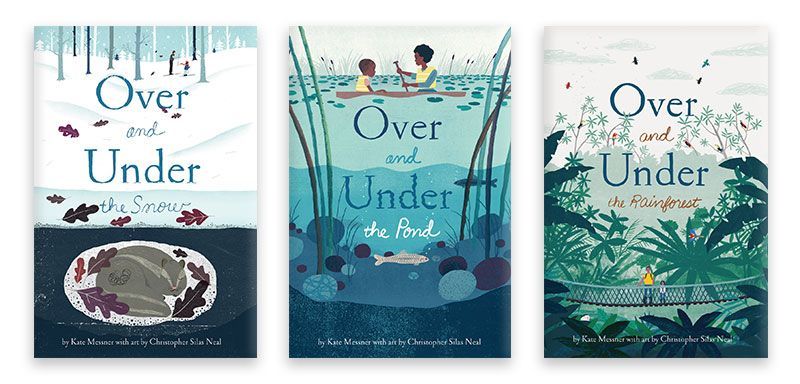

Over & Under Books

By Kate Messner with art by Christopher Silas Neal


These picture books will appeal to the youngest children, while also serving as an invitation for older children to explore. With illustrations that open windows to how we perceive the natural world, the books offer readers a glimpse into what we can discover if we look a little more closely. Whether we lift our gaze or peer deep down into the depths, there are wonders waiting to be revealed. The storyline of each book takes us on a child’s journey, with the security of a loving adult as a companion. 


Messner, a former teacher, also includes descriptions of each animal at the end of the book, as well as additional resources for those who want to learn more about the ecosystem she has highlighted. Depending upon upcoming excursions or current interests, you and your child can explore the following titles:


Up in the Garden and Down in the Dirt

Over and Under the Canyon 

Over and Under the Pond

Over and Under the Rainforest

Over and Under the Snow

Over and Under the Waves

Over and Under the Wetland
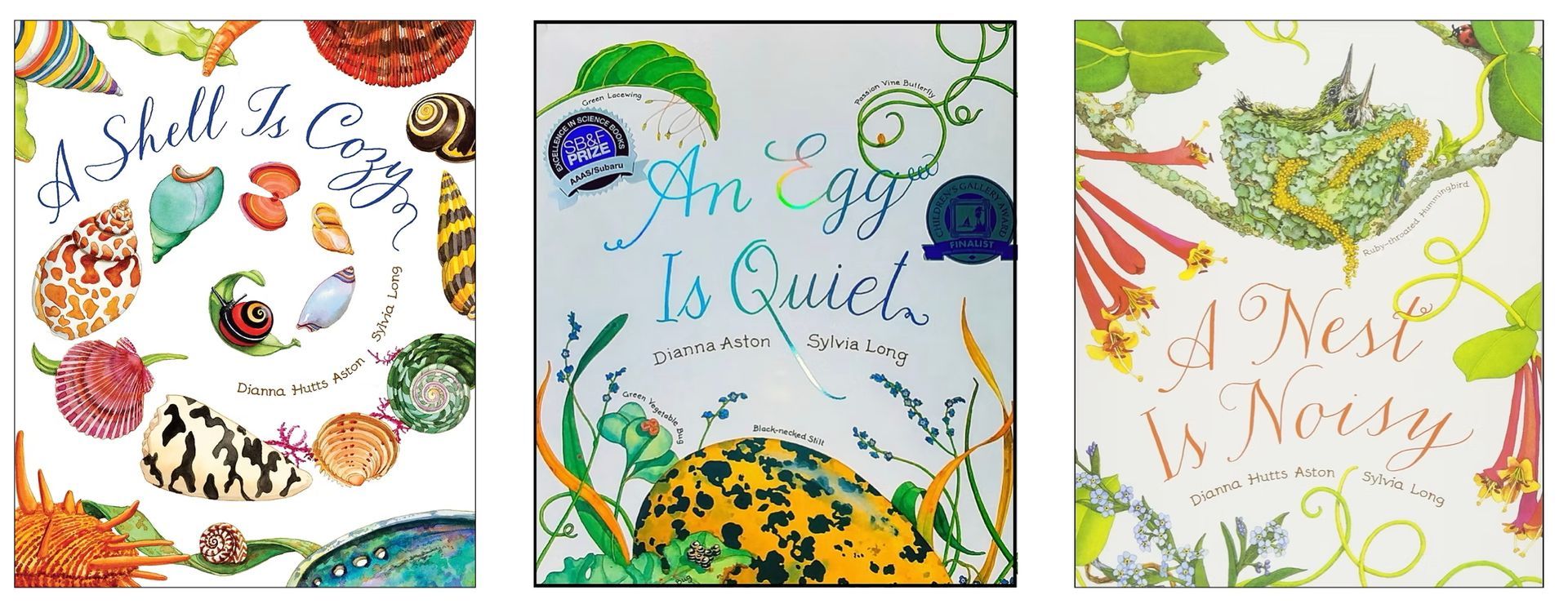

A …. Is …. Series

By Dianna Aston, Illustrated by Sylvia Long


One of the many beautiful features of these picture books is that they can be as simple or as complex as the reader prefers. For our youngest children, it’s easy enough to read the short poetic sentences written in lovely script across the page. For those who want more details, we can delve into fascinating facts and labeled illustrations. The detailed paintings share the splendor of the natural world as well as biological information that captures the imagination. Each of these titles is an invitation to awe:


A Beetle Is Shy 

A Butterfly Is Patient

An Egg Is Quiet

A Nest Is Noisy

A Rock Is Lively

A Seed Is Sleepy

Mary Holland Books


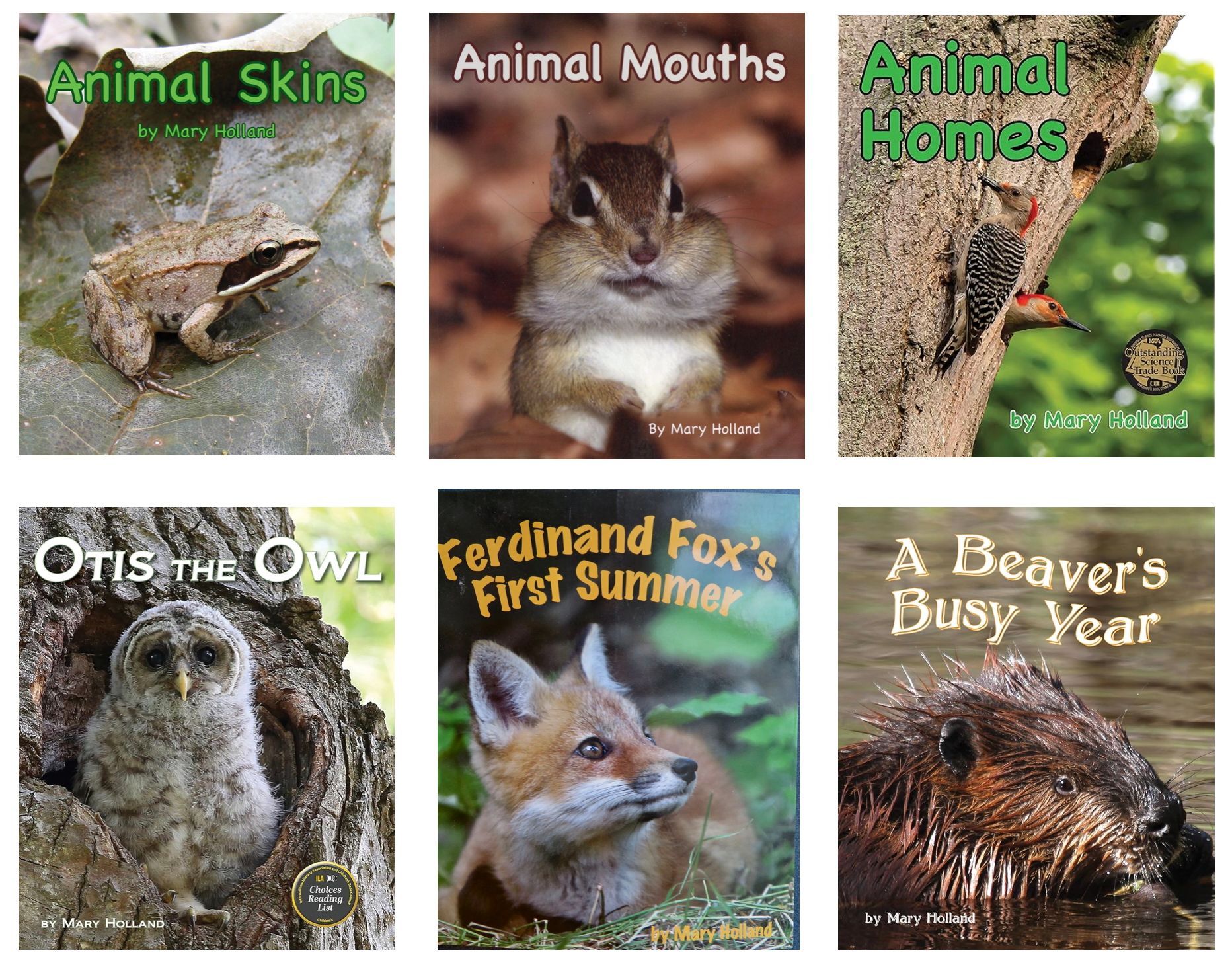
The photographs in Mary Holland’s books bring us close up to the animal world. Crisp and full of detail, each page is immersive, both visually and factually. The books that focus on particular aspects of animals (ears, eyes, legs, etc.) weave together rich information with engaging commentary and questions (“Can you do that?” -or- “Can you find…?”). 


The books that detail a particular animal, such as Ferdinand Fox’s First Summer and Otis the Owl, take us on a seasonal journey through the lens of that animal’s life. Each title also ends with activities, called “For Creative Minds,” for further exploration. Animal lovers will lose themselves in these books!


With over 15 books to choose from, this collection can provide days and weeks of exploration. For those who really fall in love with this series, it’s worth investing in Naturally Curious Day by Day: A Photographic Field Guide and Daily Visit to the Forests, Fields, and Wetlands of Eastern North America, which offers information about the natural world for each day of the year. 


Holland’s picture book titles include:


Animal Ears

Animal Eyes

Animal Homes

Animal Legs

Animal Mouths

Animal Myths

Animal Noses

Animal Skins

Animal Tails

Animal Tracks and Traces

The Beavers' Busy Year 

Ferdinand Fox’s First Summer

Otis the Owl

What’s Inside?

Yodel the Yearling

Rothman’s “Anatomy” Books

Written and Illustrated by Julia Rothman


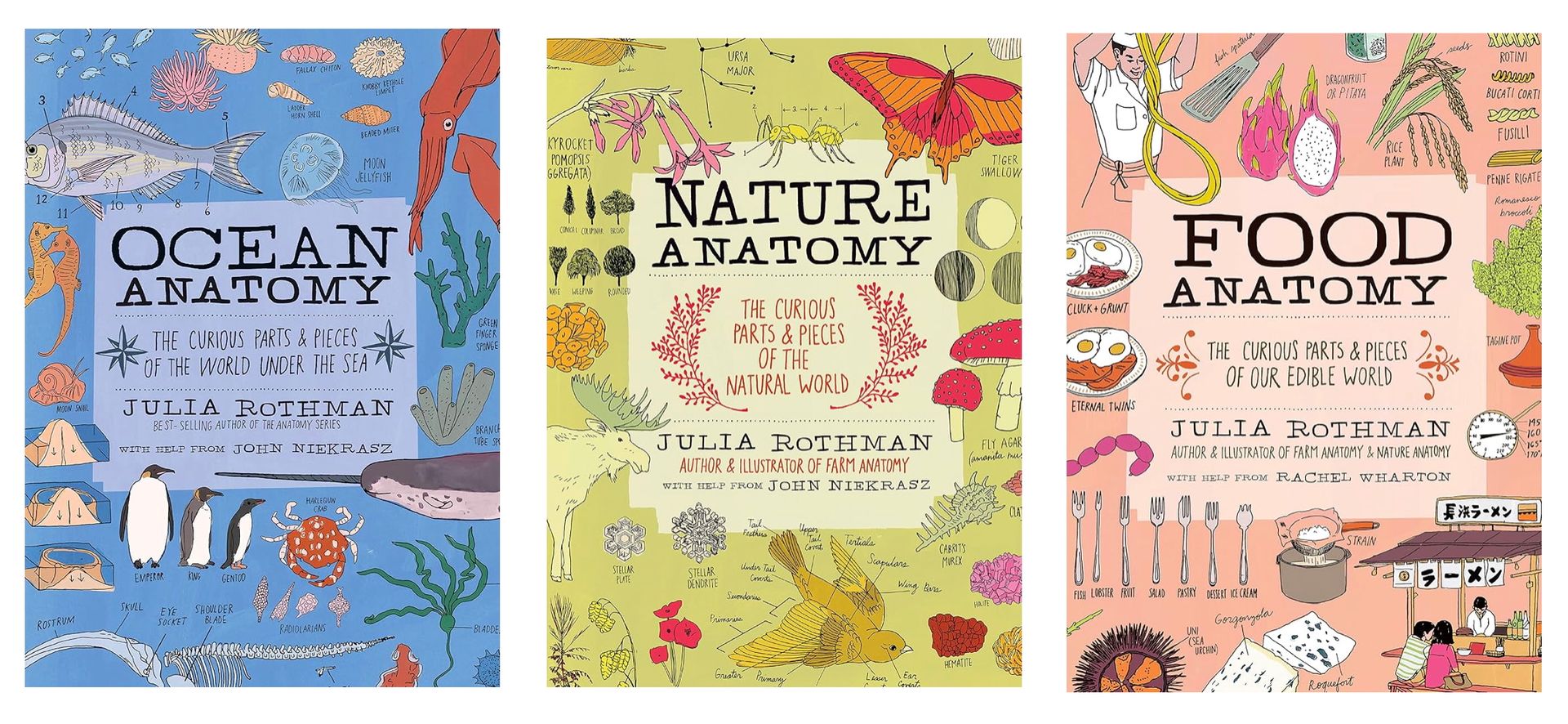
Perhaps more suited for older readers, these books are a treasure trove of information. Easy enough to flip through to discover captivating details, and well worth moving through the thematic chapters, the pages offer sweet illustrations, short descriptions, labeled anatomy, and much more. 


Rothman’s delightful drawings offer just enough detail without being too much, making them accessible yet engaging. If anything, these books are a great introduction to what nature journaling can be! If children are inspired to try their hand at nature journaling, Claire Walker Leslie’s books, especially Keeping a Nature Journal: Deepen Your Connection with the Natural World All Around You, can be another wonderful option to explore with your child!


The five Rothman “Anatomy” books are:


Food Anatomy: The Curious Parts & Pieces of our Edible World

Wildlife Anatomy: The Curious Lives & Features of Wild Animals Around the World

Farm Anatomy: The Curious Parts & Pieces of Country Life

Nature Anatomy: The Curious Parts & Pieces of the Natural World

Ocean Anatomy: The Curious Parts & Pieces of the World Under the Sea


Whether they’re flipping through pages while curled up on the couch or stepping outside to explore with new eyes, these texts and illustrations can help children cultivate a lasting relationship with nature. We hope these books offer a meaningful bridge between your child and the natural world—one that inspires closer observation, deeper questions, and joyful discovery.


At Wheaton Montessori School, we believe that fostering a love for the natural world lays the foundation for stewardship, empathy, and wonder. These books are just a starting point—an invitation to see more, learn more, and care more about the life that surrounds us every day. Please reach out to let us know what you think of these books or to recommend others. Happy reading, and happy exploring! 


Prospective families with toddlers and children under 4 are encouraged to sign up for a school tour the advantages of our Primary Program, which lays the essential foundation for our Elementary and Adolescent Community Programs*. Prospective families who are enrolled in the 2025-2026 School Year are welcome to sign up for Wheaton Montessori School summer camps. 


Preschool enrollment for summer and fall 2025 is ongoing and depends on availability for eligible early childhood students. There are extremely limited spots available for new children aged 4 and under for the upcoming summer and fall of 2025.


 * Individual school tours for kindergarten through 9th grade are not available, and the waitlist remains closed for the 2025-2026 School Year. The only exception is considered for students transferring from AMI-accredited Montessori schools that have maintained continuous attendance.
How Your Young Children Learn and Why It Matters
By Rebecca Lingo February 23, 2026
How Your Young Children Learn and Why It Matters Your young children learn by actively constructing themselves through purposeful work. From birth through age six, learning is not passive or instructional. It is driven from within your child, supported by responsive adults like you and all of my colleagues. This internal passion to learn is also boosted through the campus design and surroundings. Every movement, repetition, and exploration is meaningful work that builds the child’s body, mind, language, and sense of self. How learning happens Active construction through work: Your young children learn by doing. Don’t we all! Movement, using the hands, exploring real materials, and repeating challenging tasks are how the brain develops. This work must be meaningful and appropriately challenging, not busy work. Movement and the hand: Development of walking, balance, and refined hand use is foundational. Your children of all ages need freedom to move and manipulate real objects to fully develop coordination, concentration, and foundational academics like writing and adding. Language through relationship: Language develops through reciprocal human interactions. Rich spoken language, conversation, naming the world, and storytelling are essential. Wheaton Montessori School eliminates screens and background noise to highlight communication. Sensorial exploration of reality: Your children learn the world through their senses. Touching, comparing, carrying, observing, and interacting with real things builds the foundation for imagination, reasoning, and abstract thinking later. Authentic Montessori immerses us in exploration and discovery. Sensitive periods: Your children pass through brief, powerful windows of heightened interest and ability, such as for language, movement, social behavior, etc. Wheaton Montessori School teachers observe and offer the right experience at the right time. Learning happens easily and joyfully and feels like play! Concentration and normalization: When your children are connected to meaningful work that they choose themselves and repeat, they develop deep concentration, self-regulation, delight in effort, and care for others. Why This Is Important Early experiences shape lifelong learning: Early experiences lay the neurological, emotional, and social foundation for everything that follows. Missed opportunities are harder to recover: Skills learned during ideal stages are acquired with ease. When these periods are missed, learning later requires more effort and frustration. My colleagues are passionate about tailoring lessons and their classrooms to match child development (and adolescent development, too!) Strong foundations support later independence: Your children deserve rich early support leading to confident, capable, socially aware, and academically prepared people. Well-supported children become well-adjusted humans: This approach supports not just academic readiness, but the development of secure, courteous, empathetic children who care about their community and the world. In short, your children learn best when they are trusted as active learners, supported by attentive adults, and given real, challenging work at the right time. Investing in this early foundation supports not only your child’s success in school, but their lifelong well-being and ability to thrive.
Be Quiet and Sit Still
By Rebecca Lingo February 16, 2026
At Wheaton Montessori School, your child is guided by highly trained professionals who deeply understand child and adolescent development. Every day, thoughtful structures and intentional practices support students in using their intellect, curiosity, time, and choices successfully, so they can grow into capable, self-directed individuals. Dr. Maria Montessori never equated being “good” with silence or stillness. Our teachers do not equate being well-behaved with being quiet and sitting still. In fact, like Dr. Montessori, we believe that movement, communication, and social interaction are essential to learning. When you observe a classroom at Wheaton Montessori School, you’ll see exactly that: children moving purposefully, talking with peers, collaborating, and responsibly managing their academic work throughout the day. What may look like “freedom” on the surface is actually built upon a strong underlying structure. Students experience a sense of choice, what to work on, where to sit, how long to engage, and who to collaborate with, because the environment has been carefully prepared to support those decisions. The Power of Structure and Grace The foundation of our campus is made up of proactive lessons called Grace and Courtesy . These lessons explicitly teach students how to: Set up and return materials Respect others’ space and work Ask to observe a peer’s work Acknowledge feelings and resolve conflict respectfully These shared lessons give everyone a common language and reference point for living and learning together. Older or more experienced students model appropriate behavior, creating classrooms full of young teachers, not just the adults guiding the environment. Students always have opportunities to challenge themselves or to take a healthy break. They work and play with materials they are developmentally ready to use, ensuring success while still encouraging growth. Not a Free-For-All: A Thoughtfully Designed Community Authentic Montessori environments are often misunderstood as unstructured. In reality, our campus is carefully designed to meet the developmental needs of preschool children through high school freshmen. The structure is natural, respectful, and aligned with who children and adolescents truly are. We know learners may still experience frustration, regret, and disappointment at times. Those moments are part of learning. When a child sits beside a teacher to regroup, it may feel like a “time out” to them, but it is actually a moment of support, reflection, and connection within a safe community. When challenging behaviors arise, our teachers respond with empathy and expertise. They understand that all behavior communicates a need. Rather than relying on rewards or punishments, teachers may guide a child toward a break, offer work that better meets their developmental needs, or help them return to a centered and purposeful state. Growing Self-Discipline From the Inside Out At Wheaton Montessori School, self-discipline and regulation develop through meaningful activity. Expected behavior grows through practice within a warm, structured community. Curiosity sparks interest, interest fuels focus, and focus leads toward mastery. This process contributes to valorization, your child’s growing sense of confidence, capability, and belonging. Children who feel balanced and respected naturally behave with greater care for themselves, others, and their environment. This sums up Dr. Montessori’s limits in three rules: care for yourself, care for others, and care for your surroundings. The true outcome of this work is human development: your child and adolescent’s identity, agency, purpose, and love of learning. When they understand big ideas and see themselves as capable contributors, they grow in ways that last a lifetime.