“Working with elementary students brings some of the most hilarious conversations. Their sense of time is entirely different; what feels ancient to them might be just a few decades to us. When we introduce big concepts in history, children need something tangible to make sense of it. Without that, you might get a sincere question like whether a teacher born in the 1970s was alive when the Titanic sank. True story. These moments remind us how children are learning to find their place. History simply feels far away to them. As we grow older, our relationship with time changes, and it’s easy to forget how complex this concept is for young learners. Giving them tools to visualize and understand time isn’t just helpful—it’s meaningful. I think it's really easy for adults to forget how tricky this concept of time or the passenger time is for young people. Having another tool to describe these big concepts, it is meaningful.”
Emily Searcy, Upper Elementary Teacher at Wheaton Montessori School
Time is one of the most abstract concepts for all young children to understand. Yesterday, tomorrow, next week, last month. These words float through daily conversation long before your child has any concrete sense of what they actually mean. For young children, the passage of time isn't yet something they can feel or visualize. So how do we build an understanding of time?
This is where Montessori timelines come in, and they do far more than most people realize.
Making Time Tangible
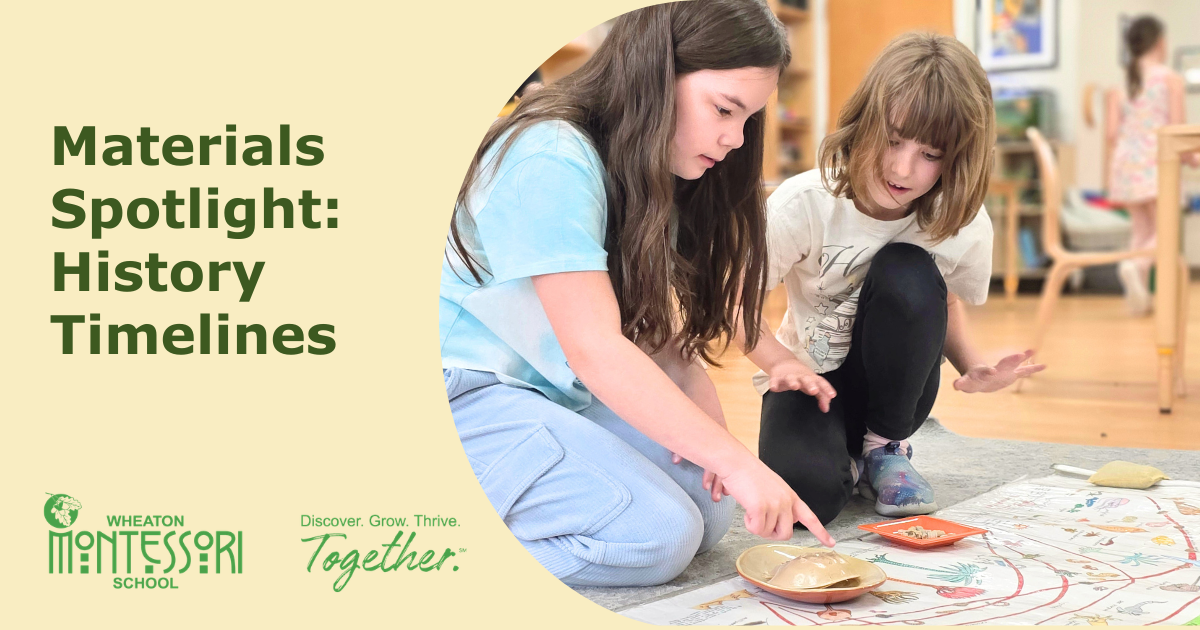
Visit our classrooms and see that our walls are decorated with beautiful artwork and décor- not ABC’s or timelines. Your children actually use the timelines. They handle timelines, construct the pieces, arrange items in sequence, and ultimately connect the vocabulary they've been hearing to something they can see and touch. As your children work with timelines, they begin to understand geologic time and how days accumulate into weeks, weeks into months, and months into years. The concept of time is something your children can manipulate through hands-on materials.
Dr. Maria Montessori was clear about the importance of this. In The Absorbent Mind, she wrote that children at this age are "urged by the laws of their nature to find active experiences in the world about them" and that they take in knowledge through activity involving movement. Engaging timelines are a perfect expression of this principle. Your children construct their understanding of time through activity.
What This Looks Like in Practice
In the first weeks of first grade and repeatedly at different depths, your children will have lessons with timelines to provide overarching stories to introduce:
- story of life on Earth
- history of human civilization
- the development of written language
As preschool and kindergarten students, your child might work with a simple personal timeline to understand their own life in sequence. They might explore timelines for the days of the week, the months of the year, or the stages of a butterfly's life. As elementary students, your children will walk timelines called the black strip, which shows how immense geologic time is.
Emily Searcy explains:
“Imagine your child walking along the Black Strip, physically walking through a representation of Earth’s history. They are feeling the immensity of geologic time long before humans ever appeared. It’s something they can see, touch, and move along.
The same magic happens with the Timeline of Life. As students explore it, they encounter the incredible diversity of life on Earth. They have a chance to see this amazing diversity we have right now and the experiments of life in the past, including, but not limited to, things like dinosaurs and trilobites. Seeing this diversity on a piece of paper is pretty cool.
You can see the outcomes in places like museums, where our visitors are often asked to sequence events or life forms. Our students almost always get it right because they’ve built a deep, visual, and physical sense of history.
And then come the moments of wonder: realizing that the Stegosaurus lived farther in time from the T. rex than the T. rex is from us today.
These timelines give children a powerful, concrete way to grasp vast stretches of time.”
Each experience builds on the last, deepening both historical understanding and your children's capacity for abstract, imaginative thought. The timelines, while an excellent teaching tool, are so much more. It is a way of helping children understand their place in the great sweep of time, and in doing so, they are better able to understand themselves.