So Many Choices for your Child’s Education: Montessori? Waldorf? Play-Based? Don ’t Decide Until You Read This!
It can be a bit overwhelming, right? Adding to this overwhelming input: the number of good-intentioned friends and family that volunteer their recommendations. Everyone has an opinion. Your best friend from college, your grandmother, your neighbor – it seems that everyone has an opinion on the best preschool program for your child. And, once you look online… forget about it! “Experts” from across the world are ready to chime in with a solution for you.
The unfortunate reality is that there are so many options for early childhood education, that many parents avoid the research process and choose a program for the wrong reasons like the distance from home or because the teacher seemed really nice.
Don’t make that mistake. Your child’s first exposure to education will be in the program that you choose now. It’s best to gather some basic information about your options and use it to make the right decision.
Only You Know the Answer
Choosing an early childhood program for your child is a personal decision. No one knows your child as well as you – his strengths, challenges, personality and temperament should all factor into your decision . Despite the best of intentions, the friend who recommended her preschool doesn’t know your child well enough to make the decision for you.
How I Can Help You
In my experience, most parents research three major methods of early childhood education : Montessori, Waldorf and Play-Based. To help in your decision, I wrote a brief synopsis of each method below.
MONTESSORI
Maria Montessori was an Italian physician and scientist who devoted 60 years of her life to studying and observing children.
Montessori education encompasses 3 basic tenants:
- All children develop in their own unique way – not in a strict linear progression.
- Children develop through interaction with their environment.
- Children develop best when they are allowed to pursue their interests.
Dr. Montessori created classrooms that support children’s developmental needs by giving them extraordinarily rich learning environments filled with carefully designed materials to make abstract concepts understandable. She demonstrated respect for each child’s unique developmental timetable, presenting new concepts to a child when he was most interested and capable of learning them. And, within those rich classroom environments, she trained her teachers to serve and follow the child. As a result, children are given the opportunity to choose what they were most interested in learning.
All children from the ages of 0 to 6 years are guided by two powerful intrinsic forces: an absorbent mind and sensitive periods.
- The absorbent mind allows children to simply absorb from their environment effortlessly and easily – much like a sponge absorbs water. What the young child sees and experiences will indelibly be imprinted on his brain. The child does not have to apply himself to learn anything – he simply absorbs impressions and information from the environment.
- Young children are guided by sensitive periods – powerful, time-sensitive phases of profound interest to learn. These windows of opportunity start closing at 4 and by 6 years of age, they are forever gone.
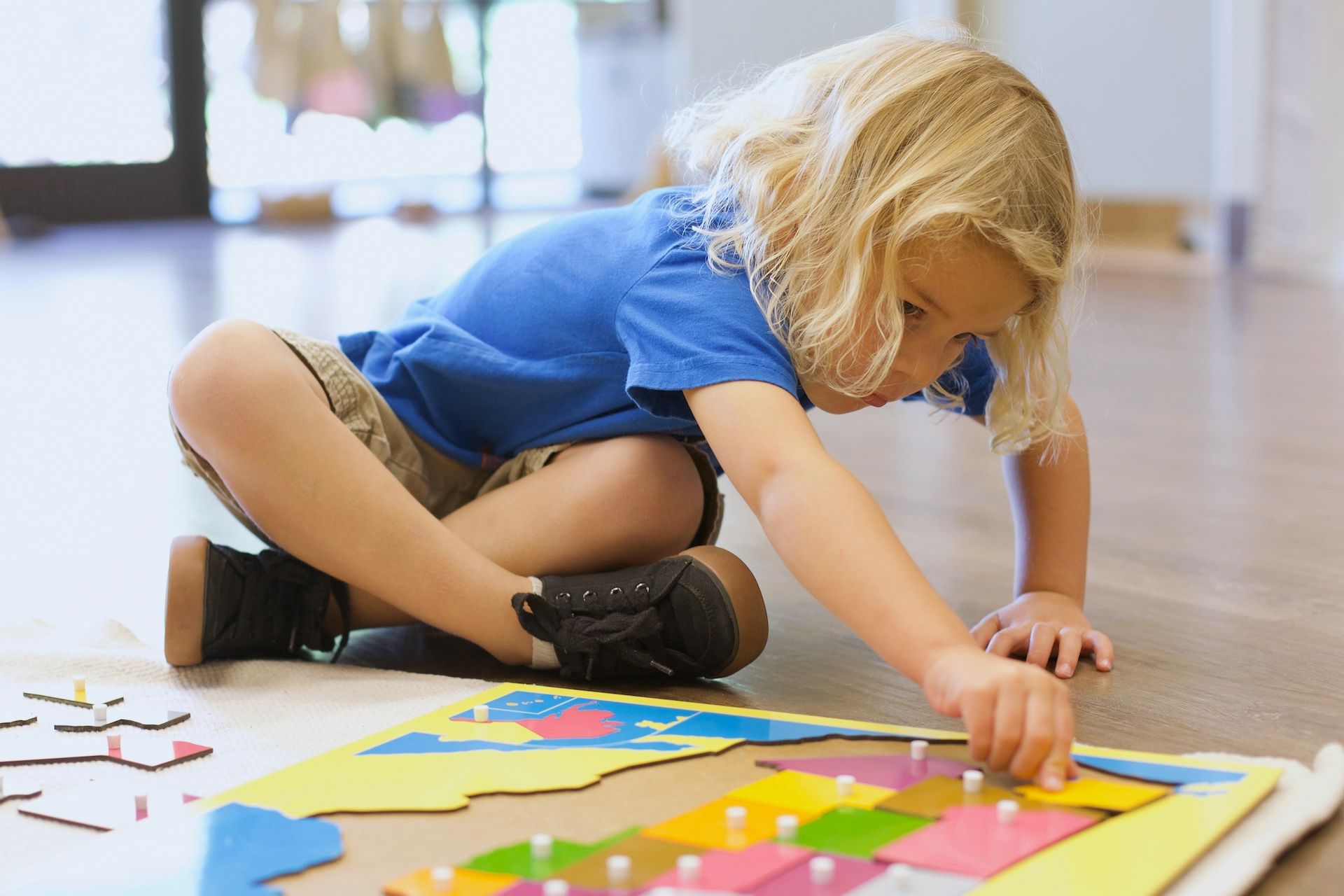
In Montessori schools, work is the child’s play. A century ago, Dr. Montessori discovered that children will almost always abandon pretend toys when they are offered “real things” to do. Instead of pretending to cook, Montessori children cut apples and serve them to their friends, they bake bread from scratch and wash and dry the dirty dishes, and they make flower arrangements from flowers they pick from their garden. They relish doing what they see adults doing in their environment and take pride in being independent.
Children learn at their own pace in a Montessori classroom. The focus is on developing the potential of each individual child. A child moves through the curriculum at her own rate, and she is not taken to the next concept until she has demonstrated that she has a solid understanding of prior concepts.
Teachers in Montessori classrooms serve as guides for the children. They act as the link between the child and the rich learning materials found in these classrooms. Instead of teaching to an entire class or to groups, teachers guide the individual child, observing her carefully to make sure she is ready for the lesson and that it is a match for what she is interested in learning.
Classrooms contain groupings of children across mixed-aged spans. Primary classes house children ages 2.5 through Kindergarten. They are collaborative learning environments with student mentors. Older children serve as role models for the younger children, showing great compassion and kindness toward their younger friends. Their work with the more advanced materials excites and interests the younger ones who want to emulate and be like their older friends. Being the oldest in the class affords the opportunity to develop strong leadership skills. Montessori children stay in the same classrooms for 3 or 4 years, which promotes a close relationship between teacher and child.
Montessori is a holistic approach to educating the child – it is seen as an aid to life. A child’s development of independence is of paramount importance. The more a child can do for himself, the more he will look to the future with the confidence that he is competent and capable.
Character education is also of deep importance in the Montessori philosophy. Children receive many lessons in the social graces that grease human interactions. At Wheaton Montessori School, we call this portion of our curriculum “Grace and Courtesy.” And, in the living laboratory of the classroom, children are supported in developing strong social skills.
WALDORF
Like Montessori, Waldorf cares about and educates “the whole child”. They want every child to reach her individual potential, to be excited about learning and the world around her, to care about and treat her fellow human beings with respect.
Additionally, like Montessori, Waldorf takes a developmental approach to education. Waldorf sees the development of the child divided roughly into three stages (birth to 7, 7 to 14, and 14 to 18). There are characteristics and needs that accompany each stage, and teachers are trained to bring appropriate learning content to each of these stages in order to support and nourish healthy growth.
Waldorf classrooms are beautifully designed. Well-crafted toys made of wood and silk are designed to stimulate fantasy and pretend play.
The Waldorf preschool-kindergarten program places an emphasis on fantasy and imagination as well as storytelling, rhyming and movement games. Their early childhood education programs are experiential (hands-on-involvement) and sensory-based. Practical activities are provided for the children to be able to imitate what they see the adults around them doing, like baking, and gardening. Music, art and story telling are large components of the program.
Abstract learning (using symbols to learn to read, write or calculate mathematically) is discouraged. Waldorf feels that if children are exposed to intellectual learning too early (before 6-7 years of age), it will detract from their optimum physical, social and emotional growth. Therefore, they encourage children in the preschool years to engage in fantasy and pretend play.
Waldorf educators take a particularly hard stand against the use of television and all electronics, because they don’t believe that they support children’s developmental needs. They, instead, want to protect and insulate the young child in that first stage of development by keeping him away from the realities of the world until he is developmentally capable of handling those realities.
Unlike Montessori, Waldorf education is a registered trademark name that allows for complete control over its governance and teacher-training programs. Teachers go through an extensive and thorough training in Waldorf philosophy and practices before they can work with children.
PLAY-BASED PROGRAMS
The theory surrounding play-based programs is that children learn best when they’re having fun, and “fun” is defined as playing. They believe that work-based, rigid approaches to learning actually turn a child off to leaning and that these do not provide children with positive attitudes and skills necessary to succeed as future learners.
Play-based theory uses children’s “play” as the vehicle for developing social skills, imagination, creativity, inner motivation and motor skills. They believe play promotes imagination and creativity and that long un-interrupted periods of play fosters concentration by allowing the child to get deeply involved in an activity. Inner motivation grows when the child has free choice in her play activity; this is seen as the child taking responsibility for her own learning.
The role of the adult in play-based preschool programs is to guide and extend children’s play experiences. They try to figure out what it is the child is learning and then work to support and extend that learning by adding more materials and asking questions or joining in on their play.
There doesn’t seem to be an over-arching theoretical framework to play-based programs in the same way that there are with Waldorf and Montessori. Different theorists add to “the pot” in defining play-based thinking. Some proponents value completely free, unstructured play time while others believe in structured experiences that the adult creates and enrichment opportunities carried out by specialists (yoga, music or Spanish instruction).
The teacher qualifications to work in play-based preschool programs are minimal. In California, for example, four college classes, valued at 3 units each, are the sole requirements to become a lead preschool teacher.
How to Use This Information
Whatever philosophical framework you embrace, remember what matters most is the people who will be with your child. Take your time and go observe in a number of settings so that you begin to get a good feeling of what resonates with you.
You’re invited to come tour our school, classrooms, and campus. Wheaton Montessori School follows the methods of Dr. Maria Montessori and strictly adheres to the guidelines of Association Montessori Internationale. Our Head of School, Rebecca Lingo, and our teachers are happy to answer your questions about the Montessori Method and why they believe it to be the best educational choice for your child.