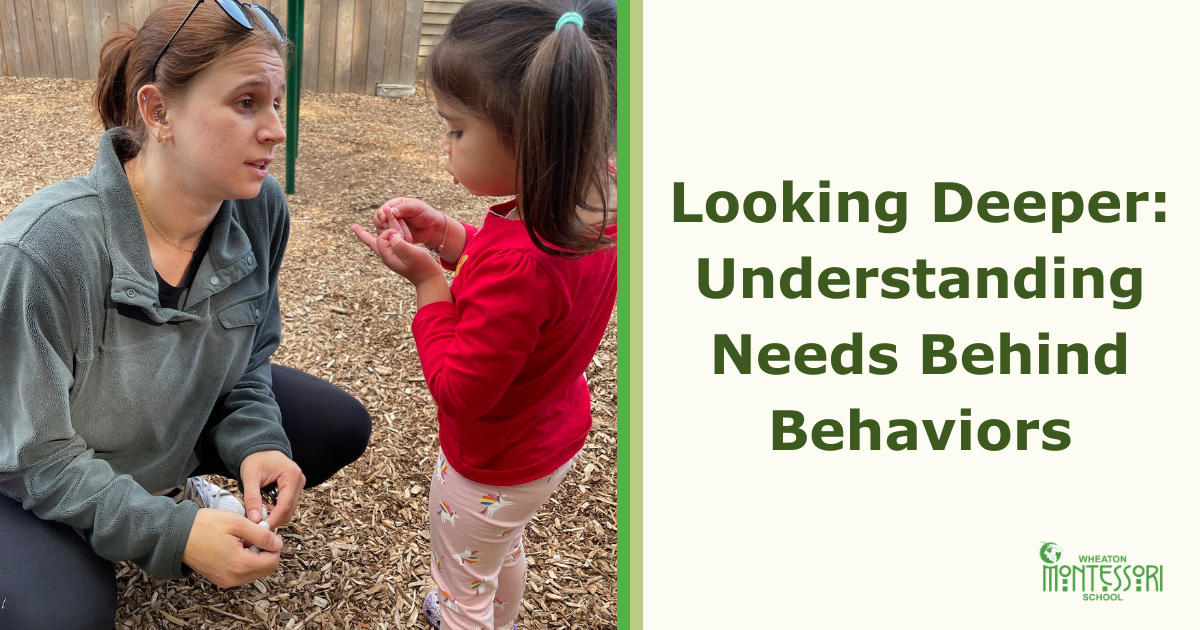
Looking Deeper: Understanding Needs Behind Behaviors
Rebecca Lingo • June 10, 2024

As we transition into the summer months, it’s a good time to take stock of family dynamics. Usually when thinking about how things are going, we focus on children’s behaviors. Yet reflecting upon ourselves and our actions can also be a helpful first step.


First Look at Needs


Psychiatrist Rudolf Dreikurs has explored how human behavior has a purpose. Sometimes we are aware of the purpose and sometimes it is unconscious. Through his work with children, Dreikurs described how to understand behavior by first acknowledging the needs a person is trying to fulfill.


At the most basic level, we all need food, sleep, love, and protection. Certainly, if children (or adults) are starting to act out in some way, the first question to ask is if they are hungry, tired, or not feeling well. Once those basic needs are met, we can consider what else might be at play. 


As humans, our need for belonging, connection, or significance is a strong force. If we don’t feel loved or accepted, we may do something (often unconsciously) to get affection or attention, maybe lash out to get even with whoever doesn't seem to be noticing these needs, or perhaps even retreat into a discouraged mode.


Understand Mistaken Goals


Dreikurs identified how many behaviors stem from four mistaken goals: the desire for attention, the need for power, the hunger for revenge, and the assumption of inadequacy. If our goal is attention, the coded message behind the behavior is "notice me" or "involve me usefully" If we need power, our behavior sends the message that we need meaningful ways to contribute. If we are trying to get revenge, we are communicating that we are hurting or need our feelings validated. When we assume inadequacy by giving up or wanting to be left alone, the message behind the behavior is that we need people to believe in us and show small steps toward success.


Practice Self-Acceptance


Children need the adults in their lives to peer behind their behavior, consider underlying causes, and provide empowering support. As adults, we often need to do this for ourselves first. At the heart of the process is self-acceptance. We need to love ourselves unconditionally and give ourselves the time and space to attend to our unconscious motivations. 


One of the first acts of loving kindness we can do is take care of ourselves, notice our own needs, and patiently honor our efforts. When we are clear about our own needs, we can then be more effective in interpreting our children’s unmet or unspoken needs. 


Examine the Clues


Once we have given ourselves grace, we pause and notice what might be behind our children’s behavior. Look at our emotions when our children act out in some way. The Positive Discipline approach, which is based on Dreikurs’ work, offers a helpful tool called the Mistaken Goal Chart


When our children display some sort of bothersome or upsetting behavior, we can use this chart to hone in on three significant clues that let us know what our children need. 


The first clue is found in recognizing what emotions our children’s behavior brings up for us. Do we feel annoyed and irritated, angry and challenged, hurt and disappointed, or hopeless and inadequate? 


The next clue is how we react to the behavior. Do we coax? Give in? Fight back? Retaliate? Give up? Try to over-help?


The third clue is how our children respond to our reactions. Do they stop temporarily but then resume the behavior? Does the behavior intensify? Is there retaliation? Or just passivity?


Peel Back the Layers


By using the Mistaken Goal Chart, we begin to peel back the layers and start to understand what beliefs may be underlying children’s behaviors. This process helps us look at how we may be contributing to the behavior and what the coded messages mean. Once we understand those pieces, we can shift our responses to empower our children in proactive ways. 


Rather than falling into unconscious patterns, let’s first consider and acknowledge our unspoken needs and proactive ways to take care of ourselves. Then, let’s take the same compassionate approach with our children. We all need to feel a sense of belonging, connection, and significance. Here’s to creating that together this summer!


As always, please also feel free to schedule a visit. We love connecting about all things children and child-rearing! 


If you have not toured yet, schedule soon. Spaces are limited for children who will be between 2.5 and 4 for summer and fall 2024 start dates. Our waitlist is closed for children from Kindergarten through 9th grade. Prospective families can schedule a school tour by clicking on this link


How Geometry Got Its Name
By Rebecca Lingo February 2, 2026
In Wheaton Montessori School classrooms, we like to introduce big ideas with big stories. We offer children a sense of wonder first, sort of like an imaginative doorway, so that when they later study formulas, theorems, and proofs, they already feel connected to the human story behind them. One of these stories is The Story of How Geometry Got Its Name, an introduction to a subject that is far older than the textbooks and protractors we encounter today. In Montessori, Geometry is more than about shapes. It is about human beings solving real problems in the real world. A Problem as Old as Civilization To reintroduce geometry, we time-travel back around 5,000 years to the ancient civilization of Egypt. This was a land shaped by the Nile River, the longest river in the world. Each year, the Nile flooded its banks as snowmelt poured down from the mountains far to the south. The Egyptians depended on this yearly flood as it left behind rich, dark silt that nourished their crops and made life possible in an otherwise harsh desert. But the flood created a challenge, too. It washed away the boundary markers that separated one farmer’s field from another. When the waters receded, no one could quite remember where their land began and ended. Arguments ensued. “This corner is mine!” And the fields needed to be measured and marked again. The First Geometers: The Rope Stretchers To solve this annual problem, the Egyptians relied on a special group of skilled workers called the Harpedonaptai, or Rope Stretchers. These were early land surveyors who used a knotted rope tied at regular intervals and three weights to create a very particular triangle. In our elementary classrooms, we invite a few children to hold a prepared rope at its large knots, forming that same triangle. As they stretch it out and lay it on the ground, many quickly recognize what the Egyptians had unknowingly created: a scalene right-angled triangle. This shape would later become central to the geometry studied by Greek mathematicians. The Harpedonaptai used this simple tool to re-establish field boundaries, set right angles, and make sure the land was measured accurately and fairly. Geometry, in its earliest form, served a deeply practical purpose. From Rope to Pyramid The Harpedonaptai’s expertise was valued far beyond the farmlands. They also helped lay out the foundations of temples, monuments, and even the Great Pyramid of Giza. The base of the Great Pyramid is a perfect square, which is an astonishing feat of measurement and design. The Pharaoh himself oversaw these measurements, but it was the Rope Stretchers who executed them. Their work represents one of humanity’s earliest recorded sciences: the careful measuring of the earth. How Geometry Got Its Name The name geometry reflects this ancient practice. It comes from two Greek words: gê — earth metron — measure Geometry literally means earth measurement. The Egyptians did not use the language of right angles, nor did they classify triangles as we do today. Their work was grounded in practical needs. They needed to solve problems, organize land, and create structures that would endure for thousands of years. Yet their discoveries influenced later thinkers like Pythagoras, who likely traveled to Egypt and learned from their methods. Over time, the simple knotted rope inspired a whole discipline devoted to understanding lines, angles, shapes, and the relationships between them. Why We Tell This Story in Montessori When Montessori children hear this story, something important happens. Geometry becomes more than a set of rules or vocabulary words. It becomes a human endeavor born from curiosity, necessity, and ingenuity. The heart of Montessori education at Wheaton Montessori School is to help children view knowledge not as isolated subjects, but as valuable gifts passed down from earlier generations. When children pick up a ruler, explore angles with a protractor, or classify triangles in the classroom, they are continuing a legacy that began with those early Rope Stretchers, the Harpedonaptai on the banks of the Nile. Through story, students feel connected to the people who shaped our world and to the problems that inspired great ideas. Geometry becomes meaningful, purposeful, and alive, from our preschoolers working with the Geometry Cabinet , to elementary students classifying and measuring angles or using hands-on Pythagorean Theory materials, and all the way through our adolescents. At the adolescent level, geometry moves fully into the real world. Students apply measurement, angles, area, scale, and spatial reasoning through meaningful work across campus, including: Measuring and mapping land for the campus’s Wetland Conservation Area, as well as calculating classroom square footage for recognition and accreditation applications Understanding and applying area, perimeter, scale, and proportion when working with acreage, restoration plans, and campus layouts Designing and situating functional structures such as chicken coops using geometric principles Applying angle classification, measurement, and spatial reasoning through woodworking Using geometry to cut, join, and build accurately, including raised beds, greenhouses, and beehive insulation boxes
Child reaching for an object,
By Rebecca Lingo January 26, 2026
Learn how the Montessori Absorbent Mind empowers young children to effortlessly absorb language, culture, and behavior, and how parents can nurture it.