Creating Family Rituals
Rebecca Lingo • December 27, 2023

During this time of togetherness, we have an opportunity to create family and holiday rituals with our children. In his book, Ritual: How Seemingly Senseless Acts Make Life Worth Living, anthropologist Dimitris Xygalatas explains how rituals provide balm for our anxieties, encourage our connections with each other, and help us find meaning in our lives.


Our children depend upon rituals, too. In fact, rituals provide our family members with an awareness of family identity and positive experiences that help them cope with stress. When we have special memories in our lives, we can draw upon the connective times and rely upon an internal sense of having a web of support rather than feeling alone. 


Rituals also help our children develop a growing sense of themselves as a member of a greater whole which promotes positive developmental outcomes. Plus, traditions are fun!


In this blog, we thought we would share a few ideas of customs and practices. 


Craft (or Re-Craft) Cards Together


Repurposing holiday cards is a fun way to go back through the greetings your family received and extend the spirit of the season. Children can cut out pictures from the cards, or even cut off the half without writing. These pieces can be pasted onto a blank piece of paper or card stock to create a collage or new card. The half-cards can also be used as post-cards with a brief note or thank you jotted on the undecorated site. 


This low-cost activity not only offers children a way to creatively express themselves, but it also can provide practice with several fine motor skills. If your child is not yet writing, they can dictate their message. Children can learn how to make a homemade envelope and even practice writing the mailing and return address. 


If your children are really enjoying this process, they can also send homemade greetings to the nonprofit Cards for Hospitalized Kids for distribution (just be sure to check the site for guidelines, especially regarding glitter!).


Sing Together


Music is a powerful way to cultivate togetherness and belonging. When we sing (and dance!) together we build trust and empathy, while also alleviating stress. The holidays offer so many opportunities for creating music. If you aren’t keen on traditional carols or songs of the season, another fun option is to gather different music-making tools, like different-sized bells or even glasses with different amounts of water in them. Experiment with gently shaking the bells or tapping glasses with a pen or similar item to create a little melody. If everyone likes the tune, play around with adding some words to describe a funny part of the day, tell a story of the holiday, or share about a favorite food! Does your family have a favorite playlist? Now is a great time to create a list of songs to listen to with each other. Ask Kelly and Lauren, our adolescent teachers, about their playlists and about the students’ reactions to singing Over the River and Through the Woods annually!


Cook & Bake Together


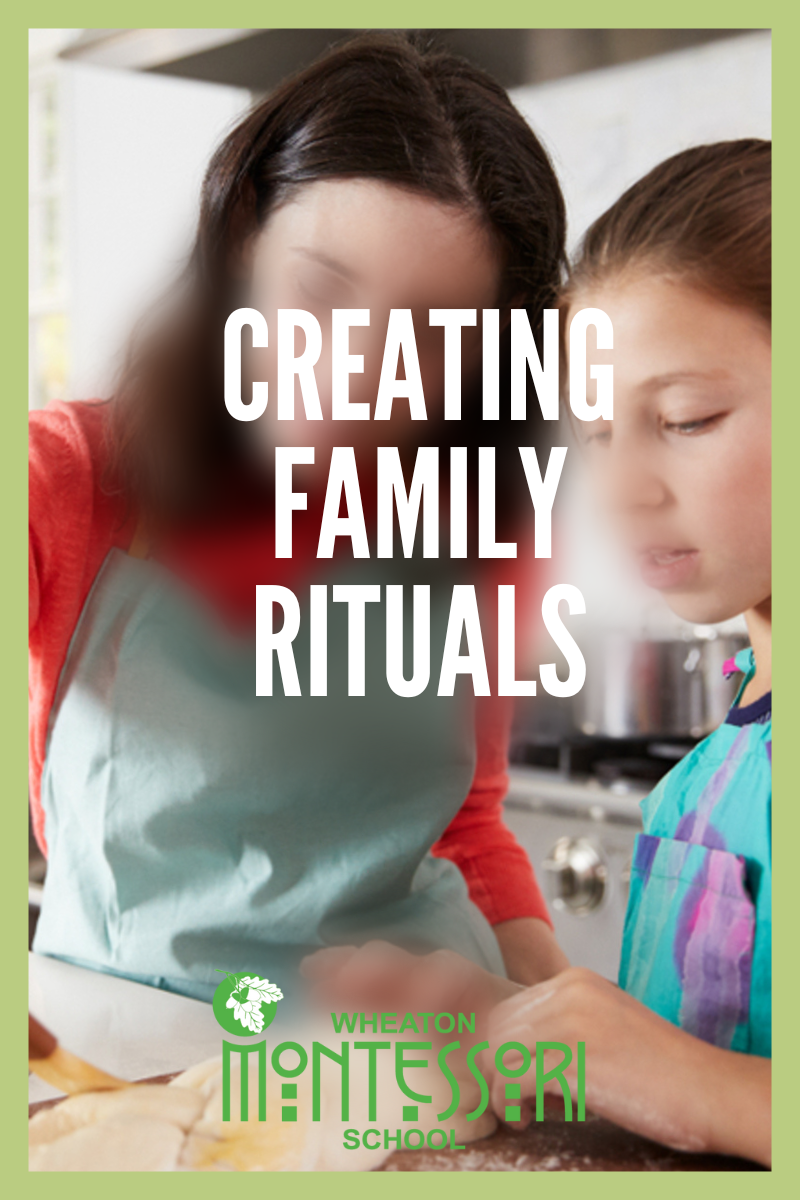
Time in the kitchen is always a wonderful way to create special memories. With extra time during days off, you can revel in the experience of gathering ingredients, measuring, mixing, decorating, and even getting sudsy during the clean-up.


Young children might enjoy dipping pretzels, fruit, or peppermint sticks in melted chocolate and then (before the chocolate hardens) twirling them in sprinkles. Or if you have a favorite cookie recipe for the holidays, your children can help make a batch and then package the cookies with a fancy bow to deliver to neighbors or to those working over holidays (like firefighters, hospital staff, and service industries). 


Listen to or Share Stories Together


Storytelling captures our imaginations and transports us to other times and places. We create special moments when we come together and share stories, memories of past years or stories from our own childhoods. Invite children to share their stories, too! This kind of story time could be an opportunity to read treasured picture books aloud. Even older children will delight in the opportunity to revisit old favorites. 


We can also create a scene like that of the days when families would gather to listen to a radio drama. Make it cozy and special with pillows, soft blankets, and special snacks. Read aloud or listen to an audio story. Every library has free apps for audio books and an audio book section to borrow through. Sites like Story Nory or Light Up Your Brain offer short pieces (roughly 5 to 10 minutes long) if you want to warm up to the story-listening experience! 


Pro-tip: Did you know that children with ADHD tend to love audiobooks? Read https://www.wheatonmontessori.org/listening-is-reading-too for our endorsement of listening to books.


Become a Tourist in Your Town


Tour holiday lights. Have everyone get into pajamas, take a thermos or to-go cups of hot chocolate, and take a neighborhood driving tour with plenty of stops for sipping cocoa. For some added fun, you can rate favorite front-yard displays, create a scavenger hunt, or try to fill out homemade bingo cards. Play holiday music also helps set the mood. Pro-tip: You can do this for Halloween decorations too! St. Charles Park District publishes a map annually.


Rituals are a significant part of our human experience and offer us ways to ground ourselves and form connections. Let’s use these days together to connect with our family and create new memories. Please share your favorite rituals with us in pictures or comments. We love to hear from you!
How Geometry Got Its Name
By Rebecca Lingo February 2, 2026
In Wheaton Montessori School classrooms, we like to introduce big ideas with big stories. We offer children a sense of wonder first, sort of like an imaginative doorway, so that when they later study formulas, theorems, and proofs, they already feel connected to the human story behind them. One of these stories is The Story of How Geometry Got Its Name, an introduction to a subject that is far older than the textbooks and protractors we encounter today. In Montessori, Geometry is more than about shapes. It is about human beings solving real problems in the real world. A Problem as Old as Civilization To reintroduce geometry, we time-travel back around 5,000 years to the ancient civilization of Egypt. This was a land shaped by the Nile River, the longest river in the world. Each year, the Nile flooded its banks as snowmelt poured down from the mountains far to the south. The Egyptians depended on this yearly flood as it left behind rich, dark silt that nourished their crops and made life possible in an otherwise harsh desert. But the flood created a challenge, too. It washed away the boundary markers that separated one farmer’s field from another. When the waters receded, no one could quite remember where their land began and ended. Arguments ensued. “This corner is mine!” And the fields needed to be measured and marked again. The First Geometers: The Rope Stretchers To solve this annual problem, the Egyptians relied on a special group of skilled workers called the Harpedonaptai, or Rope Stretchers. These were early land surveyors who used a knotted rope tied at regular intervals and three weights to create a very particular triangle. In our elementary classrooms, we invite a few children to hold a prepared rope at its large knots, forming that same triangle. As they stretch it out and lay it on the ground, many quickly recognize what the Egyptians had unknowingly created: a scalene right-angled triangle. This shape would later become central to the geometry studied by Greek mathematicians. The Harpedonaptai used this simple tool to re-establish field boundaries, set right angles, and make sure the land was measured accurately and fairly. Geometry, in its earliest form, served a deeply practical purpose. From Rope to Pyramid The Harpedonaptai’s expertise was valued far beyond the farmlands. They also helped lay out the foundations of temples, monuments, and even the Great Pyramid of Giza. The base of the Great Pyramid is a perfect square, which is an astonishing feat of measurement and design. The Pharaoh himself oversaw these measurements, but it was the Rope Stretchers who executed them. Their work represents one of humanity’s earliest recorded sciences: the careful measuring of the earth. How Geometry Got Its Name The name geometry reflects this ancient practice. It comes from two Greek words: gê — earth metron — measure Geometry literally means earth measurement. The Egyptians did not use the language of right angles, nor did they classify triangles as we do today. Their work was grounded in practical needs. They needed to solve problems, organize land, and create structures that would endure for thousands of years. Yet their discoveries influenced later thinkers like Pythagoras, who likely traveled to Egypt and learned from their methods. Over time, the simple knotted rope inspired a whole discipline devoted to understanding lines, angles, shapes, and the relationships between them. Why We Tell This Story in Montessori When Montessori children hear this story, something important happens. Geometry becomes more than a set of rules or vocabulary words. It becomes a human endeavor born from curiosity, necessity, and ingenuity. The heart of Montessori education at Wheaton Montessori School is to help children view knowledge not as isolated subjects, but as valuable gifts passed down from earlier generations. When children pick up a ruler, explore angles with a protractor, or classify triangles in the classroom, they are continuing a legacy that began with those early Rope Stretchers, the Harpedonaptai on the banks of the Nile. Through story, students feel connected to the people who shaped our world and to the problems that inspired great ideas. Geometry becomes meaningful, purposeful, and alive, from our preschoolers working with the Geometry Cabinet , to elementary students classifying and measuring angles or using hands-on Pythagorean Theory materials, and all the way through our adolescents. At the adolescent level, geometry moves fully into the real world. Students apply measurement, angles, area, scale, and spatial reasoning through meaningful work across campus, including: Measuring and mapping land for the campus’s Wetland Conservation Area, as well as calculating classroom square footage for recognition and accreditation applications Understanding and applying area, perimeter, scale, and proportion when working with acreage, restoration plans, and campus layouts Designing and situating functional structures such as chicken coops using geometric principles Applying angle classification, measurement, and spatial reasoning through woodworking Using geometry to cut, join, and build accurately, including raised beds, greenhouses, and beehive insulation boxes
Child reaching for an object,
By Rebecca Lingo January 26, 2026
Learn how the Montessori Absorbent Mind empowers young children to effortlessly absorb language, culture, and behavior, and how parents can nurture it.