Clean Hands: Montessori Explained
Rebecca Lingo • January 13, 2025

Why do Montessori classrooms have a hand washing basin and pitcher when children can just access the sink? Isn’t this an antiquated experience?


To answer these questions, let’s explore why young children are drawn to an elaborate hand-washing process, the benefits of individual lessons breaking down a series of steps, and what children are accomplishing through experiences at Wheaton Montessori School.


Practical life exercises provide the foundation for our early childhood programs. These practical life experiences are foundational and significant for young children’s development. Yet they often don’t receive the appreciation they deserve, especially with the many academic benefits of our amazing academic lessons in logic (sensorial materials), science, math, and language lessons.


To understand the value of practical life activities, we must understand the nature of young children, which Dr. Montessori did over 100 years ago.


Why Practical Life?


The exercises of practical life began to serve a practical need. Dr. Montessori had responsibility for children who were being destructive in a building in the slums of Rome. The proprietors needed to take care of the building, yet the children were unkept and out of control.


As a doctor, Dr. Montessori knew the importance of hygiene in preventing illness. So, one of the first things she did was provide water basins and cakes of soap. Then, Dr. Montessori showed the children how to wash their hands and faces.


What happened was unexpected. Once the children washed their hands and faces, they didn’t stop. They kept washing long after their hands were clean.


Dr. Montessori said the children repeated the activity as if driven by an imperceptible force. Instead of stopping them, like adults are apt to do, Dr. Montessori watched. She wanted to see what would happen. With her curiosity, patience, and powers of scientific observation, Dr. Montessori observed a need that went way beyond washing hands. From these practical beginnings came a very significant discovery for Dr. Montessori.


A Deeper Purpose


Dr. Montessori discovered and articulated the fundamental difference between work as the adult experiences it and work as the child experiences it. While work for the adult brings on fatigue, work for the young child is energizing. This is because children under age six are in a period of self-construction. They are developing their intelligence, memory, language, will, and movement.


Young children are motivated to interact with their environment to develop these essential aspects of themselves. Their goal is self-construction! Adults often don’t recognize this vital urge young children have to work. So typically, adults stop children from doing something because the action seems too tiring, too complicated, or too messy, or because it will be more efficient and faster for adults to do it themselves.


But something deep within is propelling young children to this kind of activity. So, in our scientifically designed classroom communities, we provide activities that will match children’s developmental needs. One of these essential experiences is hand washing.


The Benefits of Hand Washing as an Activity


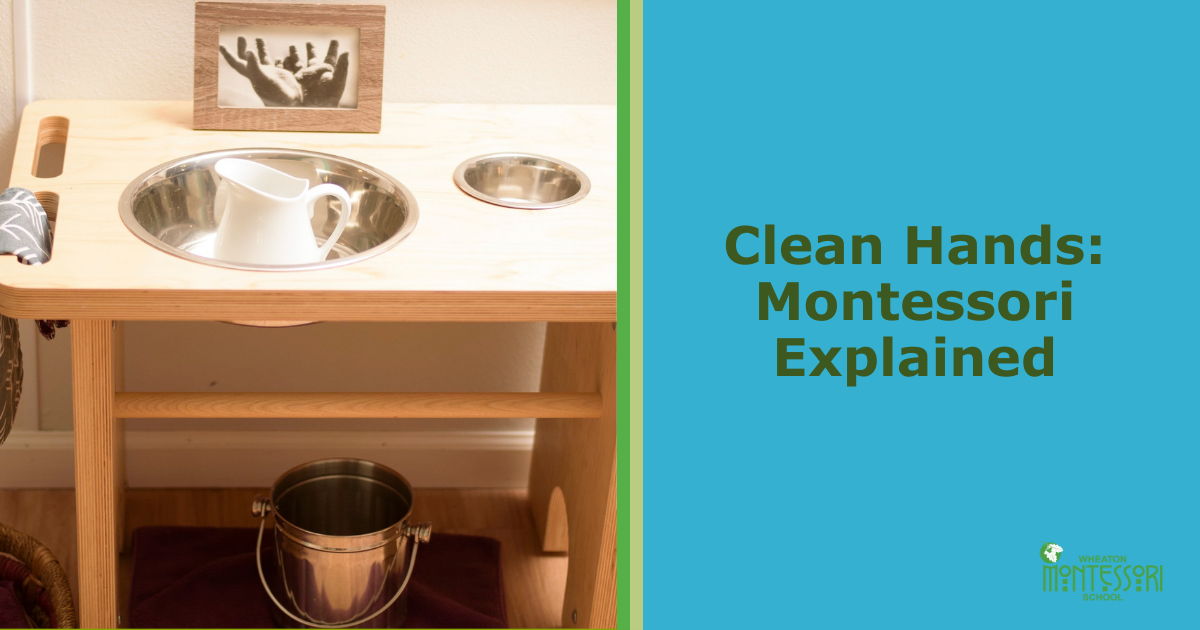
In addition to the typical handwashing at our lowered sinks, our preschool and kindergarten classrooms also include a hand washing table with an apron, a basin and pitcher, soap, hand and drying towels, a bucket, and sometimes even a nail brush or hand lotion when appropriate. 


We break down each step of washing hands: wetting our hands, washing with soap, rinsing, drying our hands, cleaning the wash area, drying the area, and restocking any necessary supplies. 


In the process of filling a pitcher with the appropriate amount of water, pouring the water into a basin, and emptying the basin into a bucket to take back to the sink, children practice crucial gross motor skills. 


As they learn how to get the fronts and back of each hand wet and lather each finger, their palms, the backs of their hands, and their wrists, they refine their visual motor coordination and fine motor skills. 


The hand-washing exercise also helps children develop a sense of order through a logical sequence of activities. Practicing this sequencing lays the foundation for children’s future ability to handle sequences that aren’t as logical, especially as they move into work with mathematical and language materials.


A Love for the Process


Young children love this self-care which involves being able to access and use water in a purposeful way and at their pace. They can often be found repeating the process over and over. Children can also become very focused on the drying process and show remarkable attention to detail as they take care to wipe up any drips or spills. 


As children master these steps, we introduce additional challenges, like using a nailbrush to clean nails or applying lotion when their hands are clean and dry. Children may get their hands wet and soapy, but this is not about getting their hands clean before eating, after using the bathroom, or playing in nature. 


The process is lovely to observe, and we invite you to schedule a preschool tour to see how hand washing helps children with the vital process of self-construction! 


Current families with children of all ages and prospective families with children under 4.5 years of age are invited to attend our Open House on January 16, 2025, at 6:00 p.m. This event will offer comprehensive insights into our school, highlighting the benefits of completing our Primary, Elementary, and Adolescent Community programs, as well as providing a chance to interact with our dedicated teachers.


Current parents are also welcome to schedule a level-up observation to see your next step in our partnership.


In addition, prospective families, with young children can schedule a preschool tour and discover how preschool to 9th grade engage in a lifelong journey of learning and discovery. Our waitlist is closed for students in kindergarten through 9th grade for prospective families unless your child is transferring from an AMI Montessori school with continuous Montessori experience

Materials Spotlight: Sandpaper Letters & Moveable Alphabet
By Rebecca Lingo February 9, 2026
Unlocking Literacy the Montessori Way At Wheaton Montessori School, Montessori literacy materials like Sandpaper Letters and the Moveable Alphabet provide hands-on experiences that connect sounds, symbols, and meaning, building the foundation for confident reading and writing. These materials help children translate the words they hear into the symbols they see, developing strong neural pathways for literacy while fostering independence and a love of language. In this blog, we explore how Sandpaper Letters and the Moveable Alphabet guide children from sound awareness to word building, creating a joyful approach to early literacy. Sandpaper Letters The Sandpaper Letters incorporate decades of insight into how children truly learn to read and write. Sandpaper Letters embody the Science of Reading—connecting sound, symbol, and meaning through hands-on learning and building strong neural pathways for literacy. These timeless Montessori principles continue to align beautifully with what modern science confirms about how your child’s brain learns best. Moveable Alphabet Before handwriting comes word building! The Moveable Alphabet lets your children ‘write’ their thoughts with letters long before they can hold a pencil—bridging the gap between spoken and written language. With literacy materials like the Moveable Alphabet, children communicate their thoughts by building words with cut-out letters—translating the sounds they hear into symbols they can see. This powerful step develops the foundation for reading and writing, helping children understand that words are made of sounds and that sounds can be represented with letters. Because our teachers base every lesson on development, writing comes first—because it’s easier to build words from sounds than to read or decode someone else's written thoughts. Our literacy approach at Wheaton Montessori School is designed to meet each child where they are, providing hands-on experiences that foster confidence, independence, and a lifelong love of reading and writing. From Sandpaper Letters to the Moveable Alphabet, every tool and lesson helps children connect sounds to symbols, build words, and discover the joy of language.
How Geometry Got Its Name
By Rebecca Lingo February 2, 2026
In Wheaton Montessori School classrooms, we like to introduce big ideas with big stories. We offer children a sense of wonder first, sort of like an imaginative doorway, so that when they later study formulas, theorems, and proofs, they already feel connected to the human story behind them. One of these stories is The Story of How Geometry Got Its Name, an introduction to a subject that is far older than the textbooks and protractors we encounter today. In Montessori, Geometry is more than about shapes. It is about human beings solving real problems in the real world. A Problem as Old as Civilization To reintroduce geometry, we time-travel back around 5,000 years to the ancient civilization of Egypt. This was a land shaped by the Nile River, the longest river in the world. Each year, the Nile flooded its banks as snowmelt poured down from the mountains far to the south. The Egyptians depended on this yearly flood as it left behind rich, dark silt that nourished their crops and made life possible in an otherwise harsh desert. But the flood created a challenge, too. It washed away the boundary markers that separated one farmer’s field from another. When the waters receded, no one could quite remember where their land began and ended. Arguments ensued. “This corner is mine!” And the fields needed to be measured and marked again. The First Geometers: The Rope Stretchers To solve this annual problem, the Egyptians relied on a special group of skilled workers called the Harpedonaptai, or Rope Stretchers. These were early land surveyors who used a knotted rope tied at regular intervals and three weights to create a very particular triangle. In our elementary classrooms, we invite a few children to hold a prepared rope at its large knots, forming that same triangle. As they stretch it out and lay it on the ground, many quickly recognize what the Egyptians had unknowingly created: a scalene right-angled triangle. This shape would later become central to the geometry studied by Greek mathematicians. The Harpedonaptai used this simple tool to re-establish field boundaries, set right angles, and make sure the land was measured accurately and fairly. Geometry, in its earliest form, served a deeply practical purpose. From Rope to Pyramid The Harpedonaptai’s expertise was valued far beyond the farmlands. They also helped lay out the foundations of temples, monuments, and even the Great Pyramid of Giza. The base of the Great Pyramid is a perfect square, which is an astonishing feat of measurement and design. The Pharaoh himself oversaw these measurements, but it was the Rope Stretchers who executed them. Their work represents one of humanity’s earliest recorded sciences: the careful measuring of the earth. How Geometry Got Its Name The name geometry reflects this ancient practice. It comes from two Greek words: gê — earth metron — measure Geometry literally means earth measurement. The Egyptians did not use the language of right angles, nor did they classify triangles as we do today. Their work was grounded in practical needs. They needed to solve problems, organize land, and create structures that would endure for thousands of years. Yet their discoveries influenced later thinkers like Pythagoras, who likely traveled to Egypt and learned from their methods. Over time, the simple knotted rope inspired a whole discipline devoted to understanding lines, angles, shapes, and the relationships between them. Why We Tell This Story in Montessori When Montessori children hear this story, something important happens. Geometry becomes more than a set of rules or vocabulary words. It becomes a human endeavor born from curiosity, necessity, and ingenuity. The heart of Montessori education at Wheaton Montessori School is to help children view knowledge not as isolated subjects, but as valuable gifts passed down from earlier generations. When children pick up a ruler, explore angles with a protractor, or classify triangles in the classroom, they are continuing a legacy that began with those early Rope Stretchers, the Harpedonaptai on the banks of the Nile. Through story, students feel connected to the people who shaped our world and to the problems that inspired great ideas. Geometry becomes meaningful, purposeful, and alive, from our preschoolers working with the Geometry Cabinet , to elementary students classifying and measuring angles or using hands-on Pythagorean Theory materials, and all the way through our adolescents. At the adolescent level, geometry moves fully into the real world. Students apply measurement, angles, area, scale, and spatial reasoning through meaningful work across campus, including: Measuring and mapping land for the campus’s Wetland Conservation Area, as well as calculating classroom square footage for recognition and accreditation applications Understanding and applying area, perimeter, scale, and proportion when working with acreage, restoration plans, and campus layouts Designing and situating functional structures such as chicken coops using geometric principles Applying angle classification, measurement, and spatial reasoning through woodworking Using geometry to cut, join, and build accurately, including raised beds, greenhouses, and beehive insulation boxes