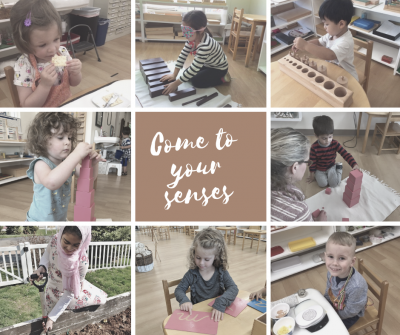
Learning with all our senses involved allows us to have a fuller, richer experience. Montessori classrooms strive to provide multi-layered sensory opportunities for children. The result? Children who have a strong ability to distinguish the variances in the environments around them.
1. Montessori digs deeper than the classic five senses.
Growing up, you undoubtedly learned about sight, hearing, taste, touch, and smell. Of course, these are the five basic senses we tend to think about, but Montessori education has a more extensively defined list all its own:
- Visual – our ability to differentiate objects by form, color, and size
- Tactile – just another name for the sense of touch, or how something feels on our body
- Baric – differentiation based on weight and/or pressure
- Thermic – the ability to sense various temperatures
- Auditory – another name to describe the sense of sound
- Olfactory – our sense of smell
- Gustatory – the sense of taste
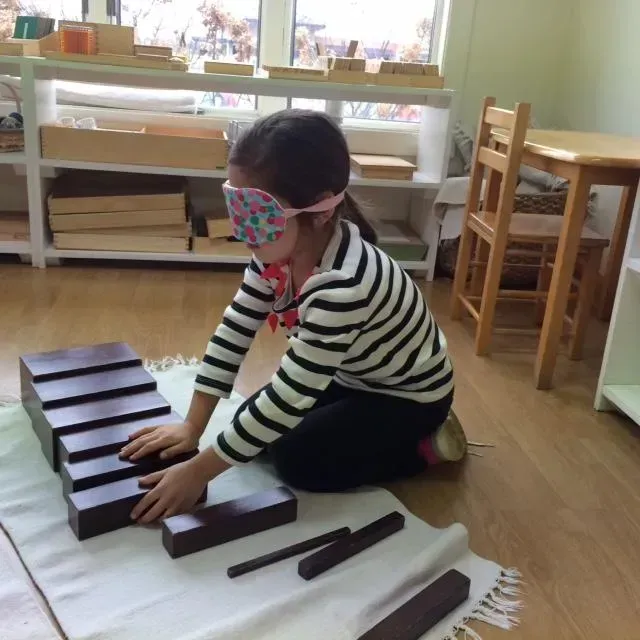
- Stereognostic – a muscular sense, or the ability to distinguish an object without seeing it, hearing it, or smelling it, but relying of touch and muscle memory alone
2. Montessori developed materials to help children refine their senses.
Using what she knew about the above senses, Dr. Montessori developed a series of sensorial materials to be used in the classrooms of young children. These materials were designed to isolate one skill and to be self-correcting. This allows the child to concentrate their efforts and to be independent in their learning. Just a small selection of the more famous sensorial materials include:
- Knobbed Cylinders – small wooden cylinders with knobs that are to be inserted into holes of the corresponding size
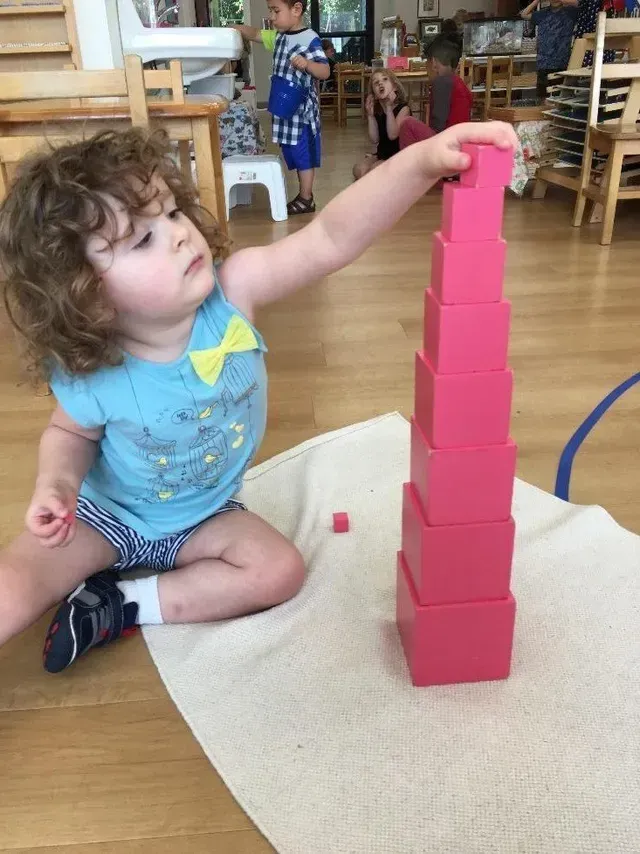
- Pink Tower – a series of pink wooden cubes ranging in size from 10 cm cubed to 1 cm cubed are meant to be stacked in decreasing succession
- Brown Stair – ten brown, wooden rectangular prisms in a range of sizes are meant to be arranged in order
- Color Tablets – a material that allows children to differentiate not just by color, but by shades of colors
- Mystery Bag – children are meant to reach their hand inside the bag without looking to determine the contents
Geometric Solids – a physical representation of an often abstractly-taught concept, these solids allow children to identify their attributes
3. Food is prepared and celebrated regularly in Montessori classrooms.
Beginning when they are just toddlers, Montessori children are directly involved in the preparation and purposeful enjoyment of food. Toddler classrooms have regular tastings, in which they try new and interesting foods. Guides will offer a wide variety of textures, colors, smells, and tastes for the children to explore. These little ones help set the table and learn grace and courtesy through table manners.
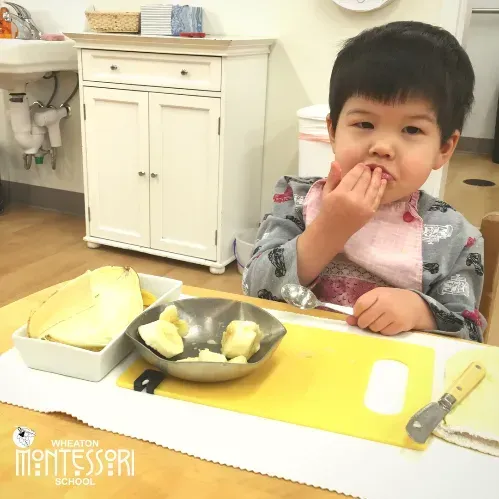
During the primary grades (ages 3-5), children participate in food preparation. They are given lessons and chances to practice slicing, spreading, mixing, blending, and multi-step food preparation. Sometimes they enjoy their work as a snack for themselves; other times they prepare food to serve to others.
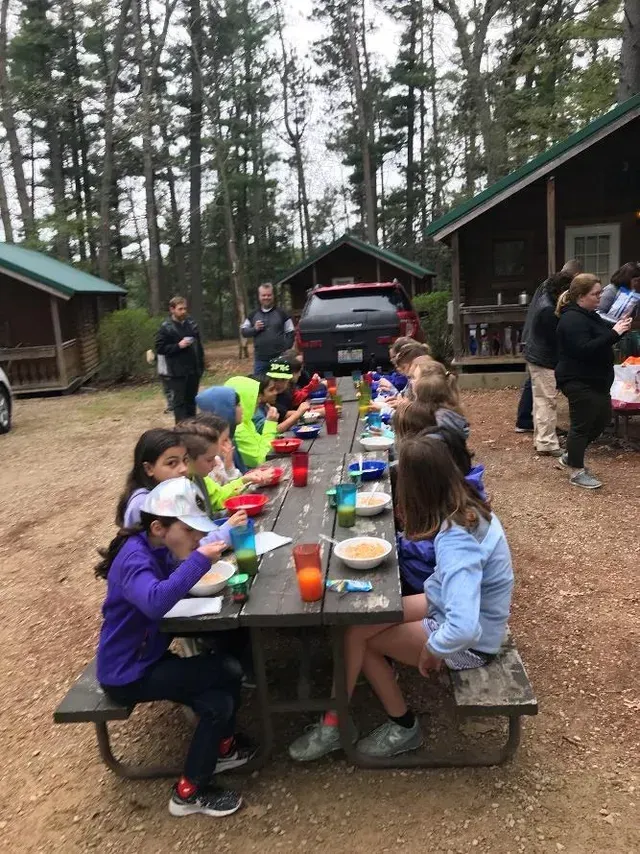
Guides in older levels find ways to continue this important work. Food preparation may be connected to a cultural study, birthday celebration, or school lunch program. In the above picture, our Elementary students enjoy breakfast together on their annual camping trip. Students make shopping lists, purchase groceries, and help with meal times during overnight trips, each classmate working to help the time away go smoothly.
As they get older, children are able to complete more complex and interesting recipes. Below, students in our Elementary classroom prepare meals for “Feed My Starving Children,” combining a community service project and preparing meals for people in need.

4. The classroom environment keeps a focus on the natural world.
Montessori guides are taught to make nature an integral part of the classroom environment, and this often means lots of beautiful indoor plants. Studies have shown that proximity to plants benefits us a variety of ways. They are visually beautiful, but did you know that scientists believe that houseplants can improve our attention? They may also be helpful in reducing sick days and keeping us more productive overall. *See links at the end for more information.
Aside from having live plants in our classrooms, Montessori schools favor natural materials over synthetic. This means that whenever possible, we choose wood, glass, and natural baskets over plastic. We believe that the color and texture of natural materials is more appealing and calming to our senses. While many conventional classrooms favor bright colors, we opt for more muted, natural ones. This allows children to feel calm, safe, and able to focus on their work.
Whenever possible, Montessori schools believe in the importance of taking children into nature on a regular basis. Whether to a local pond, for a walk in the woods, or even a nearby city park, being in green spaces is an important part of learning and growing.
5. Montessori honors children’s developing vestibular and proprioceptive systems.
A couple quick definitions-
The vestibular system is responsible for balance and is closely connected to the inner ear.
The proprioceptive system is important when having awareness of where one’s body parts are in relation to the rest of one’s body and the space/objects around it.
These systems typically develop early in childhood. It’s our job as adults to make sure children have opportunities to refine them. It is especially important that we provide opportunities to children with sensory related disorders.
Although many schools around the country are decreasing or doing away with recess altogether, Montessori schools hold that time in high regard. All the climbing, swinging, spinning, and other types of play are natural ways for children to develop their vestibular and proprioceptive systems.
There are activities built into Montessori classrooms that assist this work as well. Carrying heavier materials, painting, and using playdough are connected to the proprioceptive system. The traditional ‘walking the line’ in Montessori primary classrooms provides excellent vestibular input; children must slowly walk while staying on a taped or painted line. Extensions include walking with a bell in hand and trying not to ring it or balancing something on top of their head.
Interested in seeing the sensory classroom in action? Whether you are a current or prospective parent, we encourage you to give us a call and set up a time to observe.
Sources:
Benefits of Indoor Plants… https://www.sciencedirect.com/science/article/abs/pii/S0272494410001027?via%3Dihub
Psychological Benefits of Indoor Plants…
http://hortsci.ashspublications.org/content/42/3/581.full